




01. Edit your form online
Type text, add images, blackout confidential details, add comments, highlights and more.

Type text, add images, blackout confidential details, add comments, highlights and more.

Draw your signature, type it, upload its image, or use your mobile device as a signature pad.

Send it via email, link, or fax. You can also download it, export it or print it out.
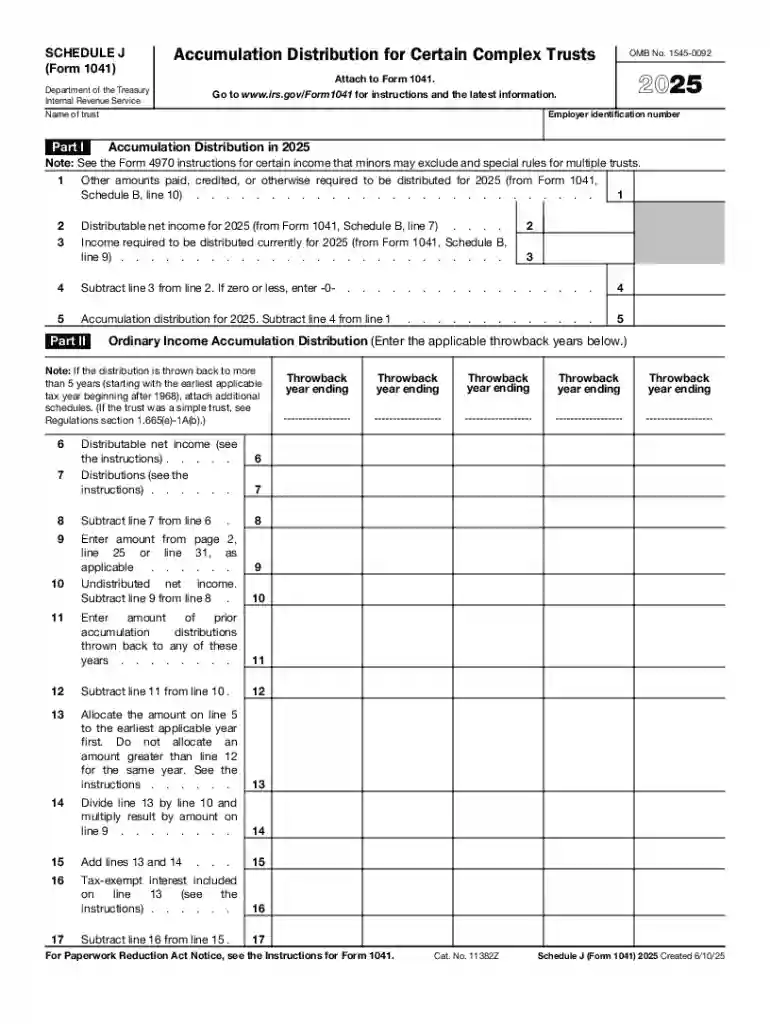
The 2025 Schedule J (Form 1041) serves as an official document for reporting accumulation distributions from certain complex trusts. This form is used to compute tax adjustments related to distributions of previously accumulated income—essential for maintaining compliance with U.S. tax regulations. By completing Schedule J, trustees can accurately reflect how income not previously taxed should be allocated and taxed.
Using Schedule J involves several steps to ensure accurate reporting. First, gather all relevant documentation regarding trust distributions and previous accumulations. Next, complete each section as outlined below, ensuring all calculations reflect accurate taxable amounts.
Completing Schedule J can be intricate due to the calculations involved. Each line must reflect accurate financial information concerning the trust’s distributions.
Trustees managing complex trusts distributing accumulated income notably utilize this form. The aim is to manage tax obligations for beneficiaries effectively.


Understanding terms related to Schedule J is vital for accurate completion and compliance.
The IRS provides comprehensive instructions on completing Schedule J, highlighting specific sections that need careful attention.
Keeping track of filing deadlines ensures that trustees comply with IRS mandates.
Failing to comply with reporting requirements can result in penalties, emphasizing the importance of meticulous completion.
A comprehensive compilation of documents ensures that all necessary information is on hand.
Although not an approval form per se, the submission of Schedule J requires attention to procedural details ensuring IRS recognition.
Real-world scenarios illustrate how Schedule J should be employed in practice.
Different types of business structures might find utility in employing Schedule J for complex trusts.
Key points of interest about the Schedule J provide an at-a-glance reference for users.
We've got more versions of the 2025 Schedule J (Form 1041) Accumulation Distribution for Certain Complex Trusts form. Select the right 2025 Schedule J (Form 1041) Accumulation Distribution for Certain Complex Trusts version from the list and start editing it straight away!
At DocHub, your data security is our priority. We follow HIPAA, SOC2, GDPR, and other standards, so you can work on your documents with confidence.







Oct 16, 2023 TD 9918 provides guidance and allows beneficiaries to deduct excess deductions upon the termination of an estate or trust by providing the following guidance.Read more
Jun 10, 2025 If the trust received an accumulation distribution from another trust, see Regulations section 1.665(d)-1A. If the trust elected the alternativeRead more
Apr 15, 2015 You are filing Schedule D (Form. 1040) and Schedule D, lines 15 and. 16, are both more than zero. Schedule J (Form 1040). If you had incomeRead more


