






Definition and Meaning
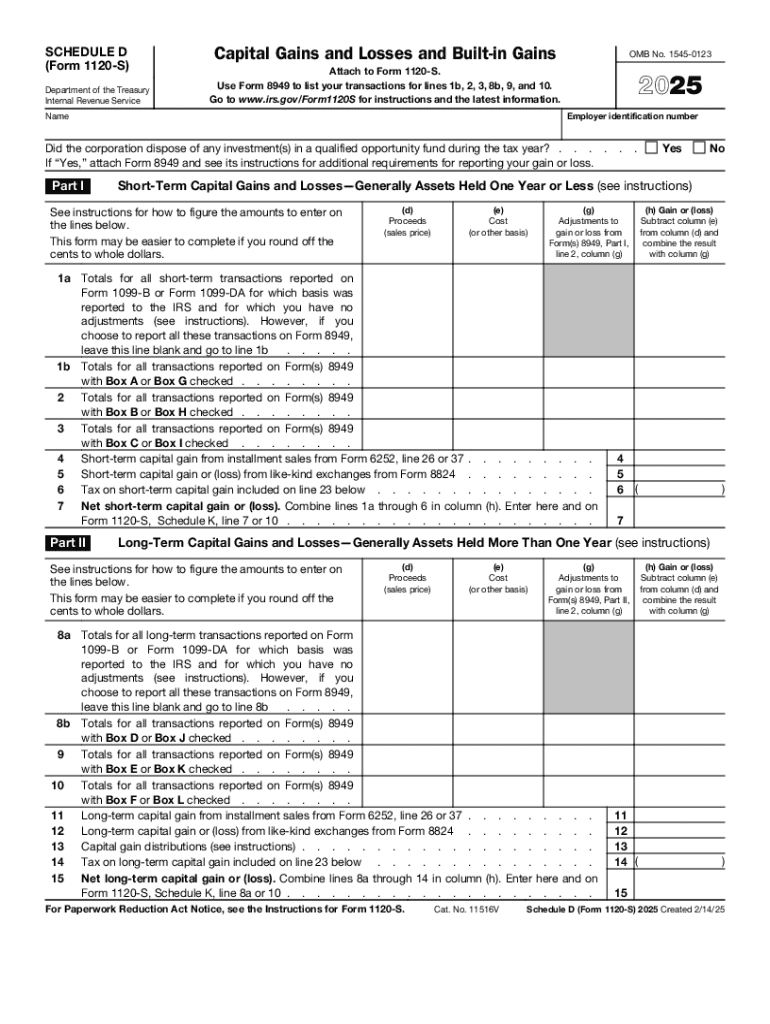
Schedule D (Form 1120-S) Capital Gains and Losses and Built-In Gains is a tax form used by S corporations. It reports the capital gains and losses and calculates built-in gains tax liability. This document is filed alongside Form 1120-S, the main federal tax return for S corporations. This form is essential for tracking and reporting transactions such as the sale of capital assets, which affect the corporation's tax liabilities.
Capital Gains and Losses
- Capital Gains: Profits from the sale of assets or investments, classified as either short-term or long-term.
- Capital Losses: Occur when the proceeds from the sale of an asset are less than the purchase price.
Built-In Gains
- Definition: The increase in value of an asset that has not been sold.
- Tax Implications: Tax may be imposed on these gains if they are realized within a certain period after conversion from a C corporation to an S corporation.
Who Typically Uses the 2025 Schedule D (Form 1120-S)
S corporations and their stakeholders primarily use this form. These entities are distinct from sole proprietorships and partnerships, and their use of Schedule D is due to the tax treatment of their profits and losses. Stakeholders may include:
- Business Owners: Especially those managing investment portfolios.
- Accountants and Tax Professionals: Assisting in compliance and filing requirements.


Business Entity Types
- Corporations: Especially those transitioning from C to S status.
- Limited Liability Companies (LLCs): That elect to be taxed as S corporations.
Common User Scenarios
- Businesses disposing of appreciated real estate or investments.
- Companies converting from C corporations to take advantage of pass-through taxation.
Steps to Complete the 2025 Schedule D (Form 1120-S)
- Gather Required Documents: Collect records of all transactions involving capital assets.
- Fill Personal Information: Include the S corporation's Name, EIN, and tax year.
- List Capital Gains and Losses:
- Use Form 8949 to detail each transaction.
- Transfer aggregated totals to Schedule D.
- Report Carry-over Losses: Include any unused capital losses from prior years.
- Calculate Net Gains or Losses: Sum short and long-term gains and losses.
- Determine Built-In Gains Tax:
- Calculate gains within the prescribed period post-conversion.
- Use IRS guidelines to compute any tax liability.
- Review and Attach: Ensure accuracy and attach to Form 1120-S.
Tips for Accurate Completion
- Double-check transaction dates for correct short or long-term classification.
- Verify all calculations to avoid penalties.
Important Terms Related to Form 1120-S
- Short-term Gains: Gains from assets held for one year or less.
- Long-term Gains: Gains from assets held for more than one year.
- Carry-over: The ability to apply excess losses to future tax years.
Tax Jargon
- EIN (Employer Identification Number): A unique identifier for business entities.
- Pass-through Taxation: Profits and losses passed to shareholders without corporate tax.
IRS Guidelines
The IRS provides specific instructions for completing Schedule D to ensure compliance:
- Use Form 8949: Required for detailing transactions individually.
- Record-Keeping: Maintain detailed records for seven years.
- Error Correction: File amended returns using Form 1120X if errors are found post-filing.
Key Dates
- Filing Deadline: Generally, March 15th for calendar year entities.
- Extension: File Form 7004 for a six-month extension if required.
Filing Deadlines / Important Dates
S corporations must adhere to specific timelines to avoid penalties:
- Regular Filing Deadline: March 15th for a calendar year taxpayer.
- Extended Filing Deadline: September 15th, if an extension is filed.
Late Filing Penalties
- Monetary Penalties: Typically $200 per month, per shareholder.
- Loss of Tax Benefits: Missing the deadline can affect tax status and benefits.
Software Compatibility
Schedule D and related forms can be filed using various tax software platforms:
- TurboTax: Offers step-by-step guidance for S corporations.
- QuickBooks: Provides accounting integration for ease of use.
- DocHub: Facilitates the editing and signing of tax forms digitally.
Benefits of Digital Filing
- Efficiency: Reduces errors with built-in checks.
- Convenience: Facilitates e-filing and direct submissions to the IRS.
Penalties for Non-Compliance
Failure to accurately complete or timely file the Schedule D can result in:
- Financial Penalties: Based on the severity and type of error.
- Increased Scrutiny: Higher audit risks from the IRS.
Avoidance Strategies
- Maintain thorough records and employ tax professionals.
- Utilize tax software for accuracy and compliance checking.