



01. Edit your form online
Type text, add images, blackout confidential details, add comments, highlights and more.

Type text, add images, blackout confidential details, add comments, highlights and more.

Draw your signature, type it, upload its image, or use your mobile device as a signature pad.

Send it via email, link, or fax. You can also download it, export it or print it out.
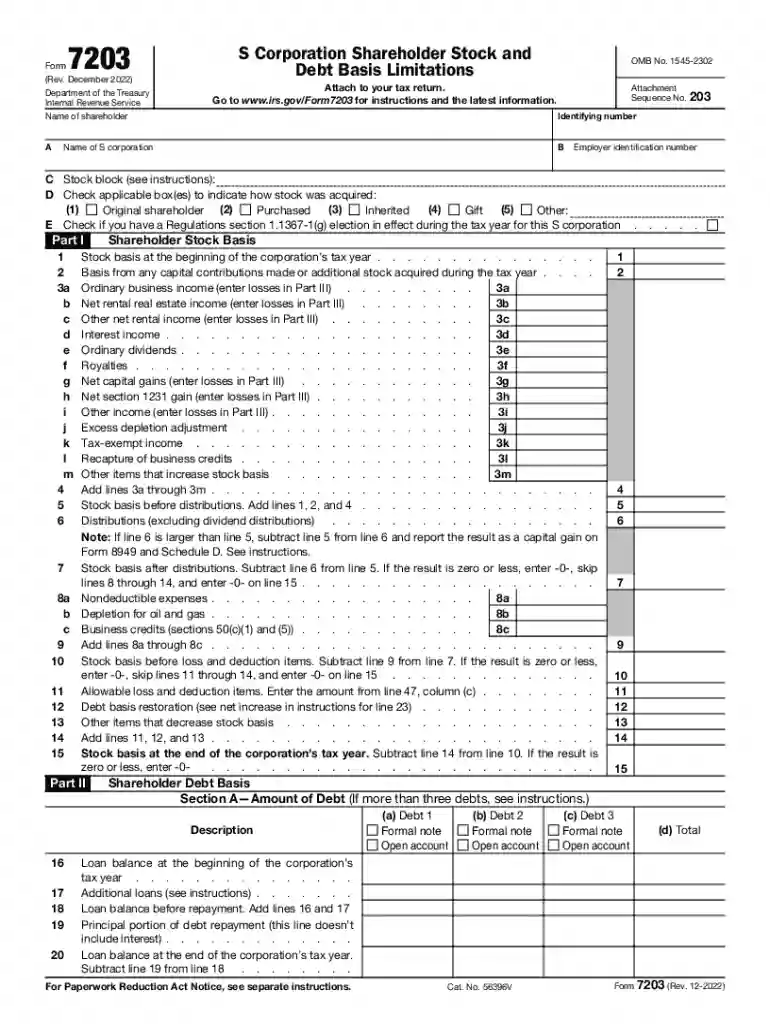
Form 7203 (Rev. December 2022) is a document issued by the Internal Revenue Service (IRS) that helps S corporation shareholders calculate and determine their stock and debt basis limitations. It is vital for reporting the extent to which losses and deductions can be claimed on an individual tax return. This form ensures compliance with the IRS rules and provides a clear view of how much of an S corporation’s losses a shareholder can utilize based on their investment in the company.
Form 7203 is used in conjunction with the shareholder's overall tax return. The purpose is to declare and adjust for any losses that a shareholder might use to offset other types of income. This ensures that shareholders only deduct the eligible amount as specified by their basis limitations. It's necessary to attach this form to your tax return if claiming these deductions.
The primary users are S corporation shareholders, especially those intending to claim deductions based on their stock and debt basis. These shareholders use the form to appropriately report their share of corporate losses, tailored to their stock and debt investments in the corporation. It is particularly relevant for high-net-worth individuals who heavily invest in S corporations.

Submitting Form 7203 is legally required to support claims of loss deductions within an S corporation's annual partnership tax return. The IRS requires accurate reporting to ensure compliance with federal tax codes. The document essentially corroborates any claimed financial losses against the afforded legal basis without which deductions can be disallowed leading to penalties or additional tax burdens.
The IRS stipulates strict guidelines for the correct calculation of stock and debt basis to prevent errors in the deductions claimed on tax returns. IRS publications provide specific instructions aligning with form usage to ensure full compliance. It's important to consult these guidelines to avoid misstatements and potential audits.
The Form 7203 is due with the annual tax return filing, typically April 15 for individuals. Extensions to October 15 are possible, aligning with the individual's return extension. It's crucial to keep track of these dates to ensure timely submission and avoid penalties.
Failing to file Form 7203 or misrepresenting the basis can result in substantial penalties. Shareholders may face fines for inaccuracies or failure to substantiate claims. Additionally, the IRS may audit past tax returns, which can lead to larger penalties if consistent discrepancies are found.
Form 7203 has significant utility for taxpayers in various scenarios:
Form 7203 is an essential tool in ensuring proper tax reporting and optimization of tax liabilities. It guides shareholders in maintaining compliance with the IRS and leveraging their investments for permissible tax advantages.

At DocHub, your data security is our priority. We follow HIPAA, SOC2, GDPR, and other standards, so you can work on your documents with confidence.


Use Form 7203 to figure potential limitations of your share of the S corporations deductions, credits, and other items that can be deducted on your return. WhoRead more
Apr 18, 2023 Form 7203 (12-2022). BIDEN JR., JOSEPH R .. Page 15. Form 7203 (Rev. 12-2022). Part II Shareholder Debt Basis. Description. 21 Debt basis atRead more
Jun 26, 2014 Form 20-F. REGISTRATION STATEMENT PURSUANT TO SECTION 12(b) OR 12(g) OF THE SECURITIES EXCHANGE ACT OF 1934.Read more


