Definition & Meaning
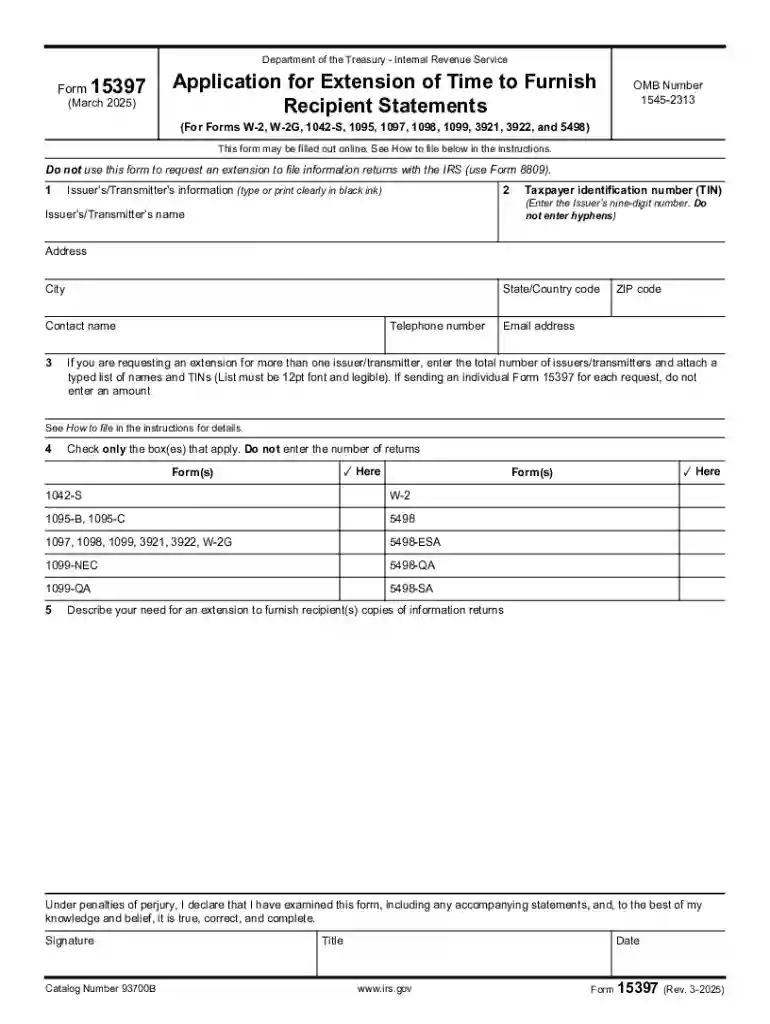
Form 15397 (Rev 3-2025), officially titled as the "Application for Extension of Time to Furnish Recipient Statements," is a document issued by the Department of the Treasury's Internal Revenue Service (IRS). It is primarily utilized to request additional time to provide recipients with necessary tax-related statements, such as Forms W-2, W-2G, 1042-S, and 1095. This form plays a crucial role in supporting businesses and individuals who need a temporary reprieve from strict filing deadlines, ensuring compliance while maintaining accurate and timely communication with recipients.
How to Use the Form 15397 (Rev 3-2025)
Using Form 15397 effectively involves several steps to ensure the request for an extension is completed accurately and submitted within the IRS guidelines. Individuals or entities seeking an extension should:
- Determine Eligibility: Verify that the circumstances justify an extension request, such as unforeseen delays or complex data compilation processes.
- Complete Required Information: Accurately provide all necessary details, including the applicant's name, taxpayer identification number, and the specific forms for which the extension is sought.
- Specify the Duration: Clearly indicate the period of extension being requested.
- Detail the Reason: Offer a concise explanation for the extension request, emphasizing the need and justification for additional time.
Steps to Complete the Form 15397 (Rev 3-2025)
Completing Form 15397 requires precision and attention to detail. Follow these steps for successful form completion:
-
Header Information
- Enter the applicant's name and taxpayer identification number accurately.
- Specify the type of entity or individual requesting the extension.
-
Form Identification
- Indicate the specific forms (e.g., W-2, W-2G) for which the extension is needed.
-
Extension Request
- Specify the duration of the requested extension.
- Provide a detailed explanation for why the extension is necessary.
-
Sign and Date
- Ensure the form is signed and dated by an authorized individual to legitimize the request.
Important Terms Related to Form 15397 (Rev 3-2025)
Understanding key terminology associated with Form 15397 is essential to ensure compliance and accurate completion:
- Recipient Statements: These are tax documents, such as Forms W-2 or 1095, that are provided to individuals or entities to report income and other relevant tax information.
- Extension of Time: A temporary allowance for additional time beyond the original deadline to fulfill an obligation.
- Furnish: The process of delivering or providing necessary tax statements to recipients.
Legal Use of the Form 15397 (Rev 3-2025)
The legal purpose of Form 15397 is to facilitate compliance with IRS requirements by providing an official mechanism to request a time extension. Proper use involves:
- Adhering to IRS guidelines and deadlines for submission.
- Providing truthful and lawful reasons for requesting an extension.
- Understanding that misuse or inaccurate information may lead to penalties or nullification of the extension request.
Key Elements of the Form 15397 (Rev 3-2025)
Form 15397 is comprised of crucial components that must be accurately completed:
- Applicant Information: Includes name, taxpayer identification, and address.
- Specific Forms Identified: Details the forms, such as W-2 or 1042-S, that require an extension.
- Justification: Explains the necessity for additional time, which must be reasonable and well-documented.
- Signature and Date: Confirms the authenticity of the extension request.
Filing Deadlines / Important Dates
Filing deadlines for Form 15397 are critical to ensuring that an extension is considered valid and processed in time:
- Submit Form 15397 as soon as the need for an extension becomes apparent, ideally before the original filing deadline of the form in question.
- Recognize that the IRS may have different cutoff dates for various recipient statements, necessitating early and proactive submission of extension requests.
Penalties for Non-Compliance
Failure to comply with the filing requirements of Form 15397 can lead to significant consequences:
- Late Filing Penalties: If an extension request is not approved or submitted late, fines may be assessed for each delayed form.
- Inaccurate Reporting: Erroneous or incomplete forms may result in denial of extensions and potential legal repercussions.
- Loss of Good Standing: Loss of trust and credibility with the IRS, impacting future dealings and compliance efforts.
Who Typically Uses the Form 15397 (Rev 3-2025)
Form 15397 is predominantly used by:
- Businesses: Companies that require more time to compile comprehensive employee tax statements.
- Tax Professionals: Accountants or tax preparers handling multiple client forms who need additional time for careful data verification.
- Non-Profit Organizations: Entities that face resource limitations necessitating extra time for statement preparation.