






Definition and Meaning
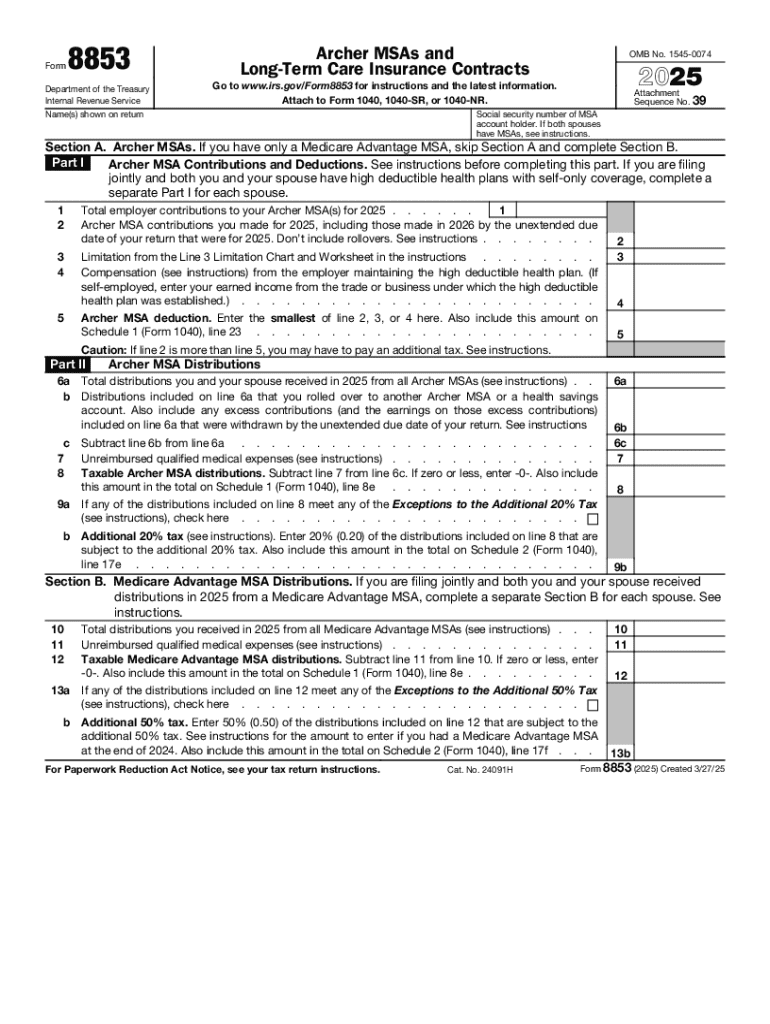
Form 8853 is utilized by individuals in the United States to report contributions to Archer Medical Savings Accounts (MSAs) and to determine any tax implications associated with long-term care insurance contracts. This IRS form allows taxpayers to document the amounts contributed to these accounts and any distributions received during the tax year, ensuring compliance with federal tax regulations and facilitating accurate tax reporting.
Archer MSAs
- Archer MSAs are tax-advantaged savings accounts designed to help individuals save for medical expenses. They are typically paired with high-deductible health plans (HDHPs) and are available to self-employed individuals and employees of small businesses.
Long-term Care Insurance
- This form also covers premiums paid on qualified long-term care insurance contracts. Such contracts are designed to cover services that assist with daily living activities, often required as a person ages or when they are disabled.
How to Use the 2025 Form 8853
Using Form 8853 involves a series of steps to ensure accurate reporting of contributions and distributions related to Archer MSAs and long-term care insurance. Below are the primary steps one would follow:
-
Gather Necessary Information
- Collect relevant financial documents, including evidence of contributions to Archer MSAs and any distributions received in 2025.
- Obtain records of long-term care insurance premiums paid during the tax year.
-
Complete Part I: Archer MSA Contributions and Distributions
- Report the specific amounts contributed to the Archer MSA.
- Calculate taxable and non-taxable distributions, considering any qualified medical expenses paid with MSA funds.
-
Complete Part II: Long-term Care Insurance Contracts
- Enter the premiums paid for qualifying long-term care insurance contracts.
- Determine if any portion is deductible based on IRS guidelines for medical expense deductions.
Calculating Taxable Amounts
- Taxable distributions from MSAs occur if funds are used for non-qualified expenses, necessitating precise record-keeping and adherence to IRS rules.
How to Obtain the 2025 Form 8853
Form 8853 can be obtained through various methods to facilitate ease of access for taxpayers:
-
Online Access
- Download the latest version of Form 8853 from the official IRS website. Updated annually, this version reflects any changes in tax law or reporting requirements.
-
Physical Copies
- Request a paper form via mail from the IRS or visit a local IRS office to obtain a physical copy, which may be beneficial for those preferring or requiring printed forms.
Digital Formats
- The form can typically be filled out digitally using PDF editing software or printed for manual completion.
Steps to Complete the 2025 Form 8853
Completion of Form 8853 requires careful attention to detail to ensure accurate reporting and compliance:
-
Review IRS Instructions
- Before completing the form, review the IRS instructions to understand eligibility criteria, limits, and specific reporting requirements.
-
Enter Personal Information
- Fill in personal information, including name, Social Security Number, and any other identifying details as required.
-
Report Contributions and Distributions
- Accurately enter all contributions to and distributions from Archer MSAs. Ensure calculations align with records collected.
-
Review and File
- After completing the form, review all entries for accuracy before attaching it to your Form 1040.
- File the completed form by the tax filing deadline to avoid penalties.
Key Elements of the 2025 Form 8853
Several key elements should be noted to avoid common errors:
-
Contributions Limits
- Ensure contributions to Archer MSAs align with annual limits set by the IRS, which can vary based on individual circumstances.
-
Record-Keeping
- Maintain detailed records of all medical expenditures, particularly when using MSA funds, to substantiate non-taxable distributions.
Avoiding Penalties
- Accurate reporting is essential to avoid penalties for misreporting contributions or distributions, including potential excise taxes on excess contributions.
IRS Guidelines
The IRS provides specific guidelines for completing Form 8853, ensuring taxpayers meet their reporting obligations:
-
Eligibility and Qualifications
- Guidelines outline who qualifies for Archer MSAs, including high-deductible health plan participants.
-
Tax Implications
- Offer detailed explanations of the tax implications associated with MSA distributions used for non-medical purposes.
Filing Deadlines and Important Dates
Adhering to deadlines is critical when filing Form 8853 to ensure compliance:
-
Regular Filing Deadline
- Typically due by April 15th in conjunction with the taxpayer's annual tax return unless an extension is granted.
-
Extensions
- Extensions allow additional time to file, but form requirements and deadlines persist within the extended timeline.
Timely Submission
- Submit the form before the deadline to avoid late filing penalties and ensure accurate processing by the IRS.
Penalties for Non-Compliance
Failure to correctly complete and file Form 8853 or meet reporting requirements can result in penalties:
-
Accuracy-Related Penalties
- Misreporting amounts could result in accuracy-related penalties, including additional taxes on unreported amounts.
-
Excise Taxes
- Excess contributions that exceed annual limits may incur excise taxes, further emphasizing the need for accurate reporting.
Avoidance Strategies
- Implement diligent record-keeping and meticulous form completion to prevent such penalties and ensure full compliance.