






Definition & Purpose of Form 8815
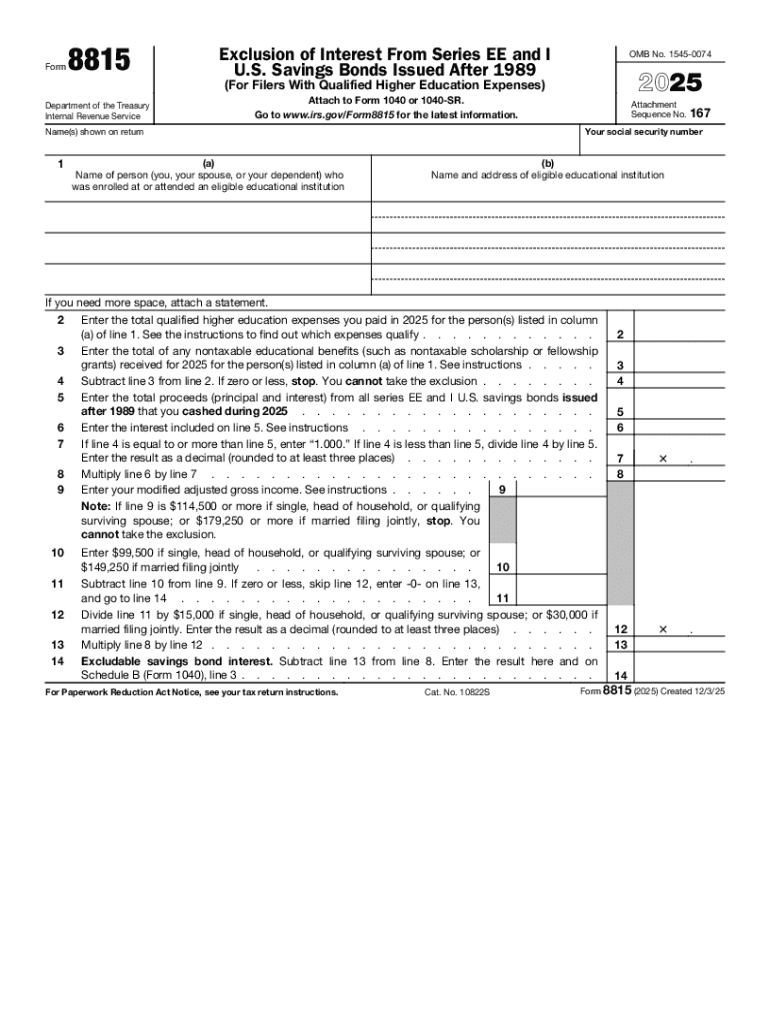
Form 8815, known as the Exclusion of Interest from Series EE, is a tax form issued by the Internal Revenue Service (IRS). This form is specifically designed to allow taxpayers to exclude interest from Series EE and I U.S. Savings Bonds issued after 1989. The primary purpose is to provide tax benefits for interest earned on these bonds when used for qualifying educational expenses under specified terms. Understanding the criteria and requirements for tax-free interest can help taxpayers maximize their financial planning for education.
Eligible Savings Bonds
- Series EE Bonds: Must be issued after 1989.
- Series I Bonds: Also eligible under similar conditions.
- The interest exclusion applies when bonds are used to finance qualified educational expenses for the taxpayer, their spouse, or dependents.
How to Use Form 8815 for Exclusion
Utilizing Form 8815 requires precise documentation of bond purchases and the calculation of eligible interest exclusions. The form acts as a worksheet for determining the amount of interest one can potentially exclude. Here’s a simplified process:
- Gather all relevant bond information: Have ready the issue dates, serial numbers, and total interest earned.
- Calculate eligible expenses: Ensure expenses align with IRS guidelines for education-related costs.
- Complete the form using the IRS instructions: Enter data accurately to avoid discrepancies.
Accumulate Necessary Details
- Interest income: Record the exact amount earned.
- Educational expenses: Include tuition and fees; room and board may not qualify.
- Verification: Ensure educational institutions are eligible.
Steps to Complete Form 8815
Accurately completing Form 8815 is crucial for the correct exclusion of interest. Follow these steps for thorough completion:
- Download the Form: Access it on the IRS website.
- Fill in Personal Information: Name, Social Security Number, etc.
- Calculate Interest Income: Sum the interest from eligible Series EE and I Bonds.
- Input Qualified Educational Expenses: Collect and enter amounts directly related to the exclusion.
- Final Calculations: Use the worksheet portion within Form 8815 to conclude your exclusions.
Documentation Required
- Bond statements: Proof of interest earned.
- Receipts for educational expenses: Adequate evidence ties expenses to qualified institutions.
IRS Guidelines & Eligibility Criteria
The IRS outlines specific restrictions on who and what qualifies for the interest exclusion. Familiarize yourself with these guidelines to ensure eligibility:
- Bonds must be in the taxpayer’s name, or co-owned with a spouse.
- Age limitations: Must be at least 24 years old before the bond’s issue date.
- Employment beyond present requirements is allowed but not mandated.
Common Eligibility Missteps
- Exclusions for businesses: Typically, interest used purely for professional or business education does not qualify.
- Unauthorized expenses: Expenses need to connect directly with educational advancement in a recognized degree or certification.
Important Terms Related to Form 8815
Understanding terms associated with Form 8815 aids in precise completion:
- Qualified Expenses: As previously mentioned, must align with IRS directives for the exclusion to apply.
- Maximum Adjusted Gross Income (AGI): Limits are imposed which phase out benefit for higher incomes.
- Exclusion Limit: There may be caps on the amount of interest excluded based on educational expenses or modified AGI.
Associated Definitions
- Bond maturity: Refers to the time when a bond’s principal amount is due.
- Educational institution: Must be accredited to qualify as an eligible establishment.
Form Submission Methods
Submitting Form 8815 correctly ensures a smooth filing process. Taxpayers have several options:
- Online Submission: Include with electronically filed taxes using compatible software like TurboTax or QuickBooks.
- Mail-in Option: Attach the form to a physical tax return.
- In-Person: Less common but possible through IRS Taxpayer Assistance Center appointments.
Digital vs. Paper Submission
- E-Filing: Faster, with immediate IRS confirmation.
- Manual Filing: More time-consuming, with ongoing mailing and processing debates.
Filing Deadlines & Important Dates
The timing for submitting Form 8815 coincides with traditional tax deadlines:
- Annual Deadline: Typically April 15, aligning with federal tax submission dates.
- Extensions: Permissible under the same rules as other tax forms, providing extra months for filing without penalty.
- Postmark Relevance: Physical forms rely on postal date for deadline confirmation.
Considerations for Extensions
- Automatic extensions: File Form 4868 to secure additional time.
- Impact on refunds: Delays might affect prompt refund processing if filing is late without requisite extensions.