




01. Edit your form online
Type text, add images, blackout confidential details, add comments, highlights and more.

Type text, add images, blackout confidential details, add comments, highlights and more.

Draw your signature, type it, upload its image, or use your mobile device as a signature pad.

Send it via email, link, or fax. You can also download it, export it or print it out.
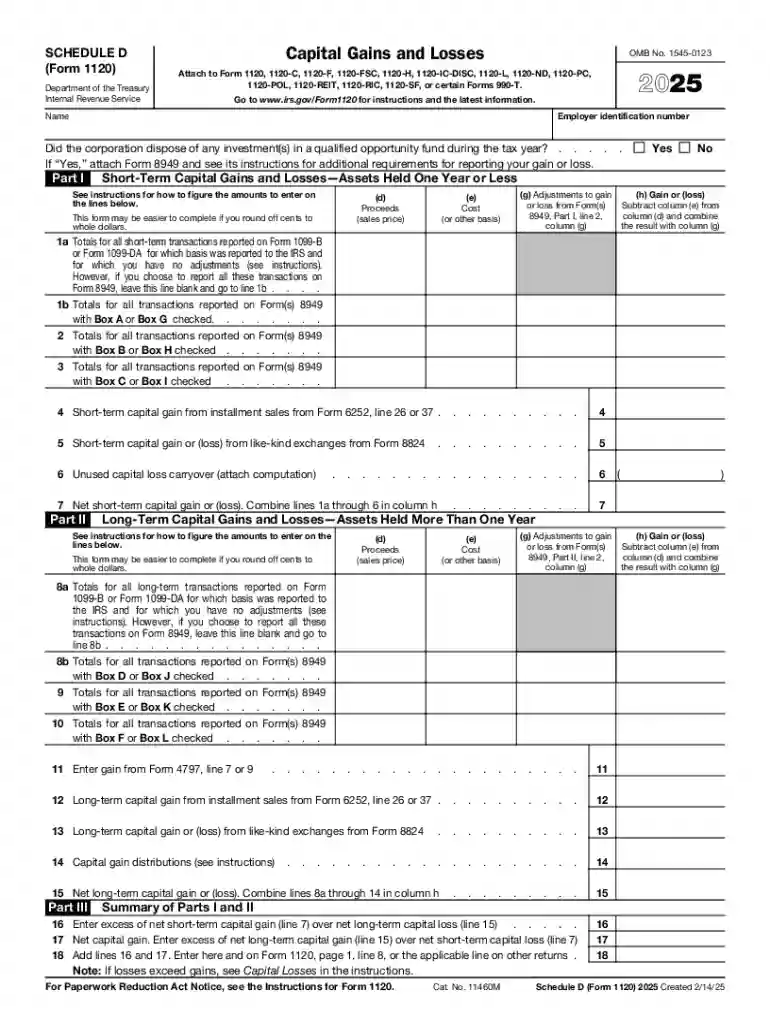
The 2025 Schedule D (Form 1120) relates to the reporting of capital gains and losses for corporations as part of their tax filings with the IRS. This document is crucial for accurately capturing and reporting capital transactions that a corporation undertakes during the tax year. Understanding the form's purpose and structure ensures compliance with tax regulations and informs strategic financial planning.
Gather Required Information:
Calculate Gain or Loss:
Summarize Total Gains and Losses:
Review and Sign Form:
Part I and II – Short-Term and Long-Term Transactions:
Section 1231 Gains and Losses:
Capital Loss Carryovers:
Accurately completing Schedule D is vital for mitigating tax liability and ensuring compliance with IRS mandates. Capital gains can sometimes result in significant tax obligations, and leveraging losses effectively can reduce tax burden. This document is an integral part of corporate tax strategy and planning.
Corporations of various types, including C corporations, S corporations, and foreign corporations conducting business in the United States, typically need to file Form 1120 along with Schedule D if they have reportable capital gain or loss activities during the tax year.
Filing the 2025 Schedule D is a legal obligation for corporations engaging in capital asset transactions. Ensuring its proper completion is crucial to avoid penalties and maintain a corporation’s good standing with tax authorities. Accurate filing ensures that companies maximize benefits from capital loss offsets allowed under tax law.
The IRS provides detailed instructions on completing Schedule D, highlighting nuances such as:
Corporations are required to file Form 1120, including Schedule D, by the 15th day of the fourth month following the end of their fiscal year. For most corporations, operating on a calendar year basis, this translates to April 15.
Failure to properly complete and file Schedule D alongside Form 1120 can lead to:
The 2025 Schedule D is a critical component of corporate tax compliance, ensuring accurate reporting and taxation of capital transactions. By following IRS guidelines and utilizing available resources, corporations can fulfill their obligations while leveraging strategic tax planning opportunities.
We've got more versions of the 2025 Schedule D (Form 1120) form. Select the right 2025 Schedule D (Form 1120) version from the list and start editing it straight away!
| Versions | Form popularity | Fillable & printable |
|---|---|---|
| 2025 | 4.6 Satisfied (46 Votes) | |
| 2024 | 4.4 Satisfied (56 Votes) | |
| 2023 | 4.7 Satisfied (48 Votes) | |
| 2022 | 4.2 Satisfied (24 Votes) | |
| 2021 | 4.8 Satisfied (151 Votes) | |
| 2020 | 4.4 Satisfied (230 Votes) | |
| 2019 | 4.2 Satisfied (143 Votes) | |
| 2018 | 4.3 Satisfied (108 Votes) | |
| 2017 | 4.4 Satisfied (145 Votes) | |
| 2016 | 4.3 Satisfied (99 Votes) | |
| 2015 | 4.4 Satisfied (33 Votes) | |
| 2014 | 4.1 Satisfied (60 Votes) | |
| 2013 | 4.2 Satisfied (67 Votes) | |
| 2012 | 4 Satisfied (40 Votes) | |
| 2011 | 4 Satisfied (60 Votes) |
At DocHub, your data security is our priority. We follow HIPAA, SOC2, GDPR, and other standards, so you can work on your documents with confidence.


Purpose of This Package. Use Form 1040-ES to figure and pay your estimated tax for 2025. Estimated tax is the method used to pay tax on income.Read more
by D SCHEDULE Cited by 1 For Paperwork Reduction Act Notice, see the Instructions for Form 1120. Cat. No. 11460M. Schedule D (Form 1120) 2025 Created 2/14/25.Read more
▷ Attach to your tax return. ▷ Go to for instructions and the latest information. OMB No. 1545-2025.Read more


