




01. Edit your form online
Type text, add images, blackout confidential details, add comments, highlights and more.

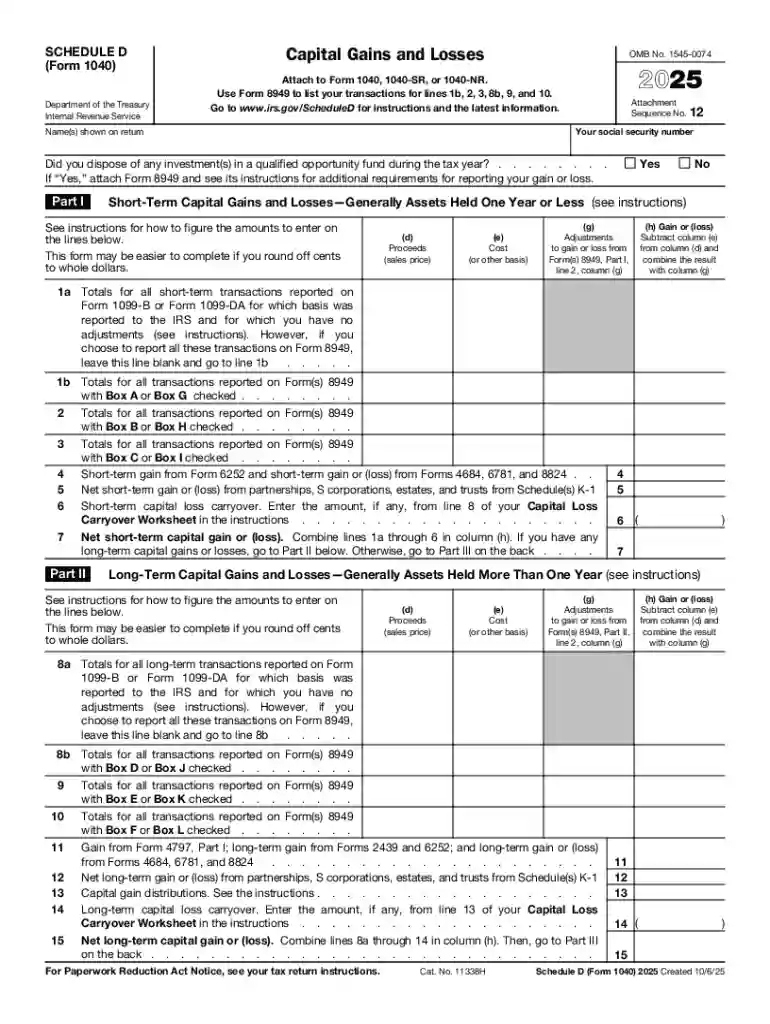
Type text, add images, blackout confidential details, add comments, highlights and more.

Draw your signature, type it, upload its image, or use your mobile device as a signature pad.

Send it via email, link, or fax. You can also download it, export it or print it out.
Schedule D is an integral component of the Form 1040 and focuses on reporting capital gains and losses. It is used by U.S. taxpayers to detail the total capital gains and losses realized from the sale or exchange of capital assets. By using Schedule D, individuals can demonstrate investment and asset disposition results while potentially minimizing tax liability through loss deductions.
Capital assets include stocks, bonds, and real estate, excluding a taxpayer's principal residence. Proper understanding and completion of Schedule D are crucial because capital gains can impact overall tax obligations. The form aids in calculating the net capital gain or loss, which subsequently affects the tax on other forms of income and assists in optimizing overall taxation strategy.
Gather Necessary Documents: Start by collecting all relevant documents, such as Form 1099-B, which provides details of transactions made over the year.
Fill Out Form 8949: Individual transactions should first be listed on Form 8949, detailing information such as description, date acquired, date sold, and resulting gain or loss for each asset.
Summarize Short-Term Transactions: Enter total short-term gains or losses from Form 8949 onto Part I of Schedule D. Remember, short-term gains are from assets held for less than one year.
Summarize Long-Term Transactions: Similarly, apply for long-term capital gains or losses from assets held for over a year onto Part II of Schedule D.
Calculate Net Gain or Loss: Deduct total losses from total gains, including both short-term and long-term, to compute the net capital gain or loss.
Special Considerations: Note any special situations such as gains from collectibles, which might be subject to different tax rates.
Transfer Totals to Form 1040: Finally, move the net gain or loss to line 15 of Form 1040, where it influences your total tax computation.
Primarily, individuals in the U.S. who have experienced capital gains or losses throughout the tax year utilize Schedule D. This form is essential for those involved in investments, including stocks, bonds, and real estate (other than primary residences). Taxpayers who partake in activities such as selling valuable artworks, collectibles, or other tangible assets should be familiar with completing this form.
Additionally, small business owners and self-employed individuals who derive income through selling shares or other capital assets significantly benefit from Schedule D. Recognizing who uses this form aids in understanding its relevance across various tax-paying scenarios, from the regular investor to business entities managing diverse asset portfolios.


Understanding these segments is imperative for comprehensive reporting, as inaccuracies in any section can result in financial penalties or incorrect tax obligations.
The IRS offers detailed instructions and guidelines for correctly preparing and understanding Schedule D. Compliance with these directions ensures accuracy in reporting capital transactions, ultimately influencing tax liability.
Adhering to IRS regulations, American taxpayers will decrease the risk of audits or fines due to misreporting.
The standard deadline for filing Form 1040, including Schedule D, coincides with America's Tax Day, generally around April 15th each year. Taxpayers should ensure timely submission to evade penalties and interest charges attributed to late filings. If an extension is necessary, the extended deadline usually falls around October 15th, offering more time for detailed reviews and updates on submitted information.
Awareness and adherence to these deadlines are indispensable, as missing them can lead to financial fines and a stressful tax management experience.
By leveraging practicality in examples, Schedule D's utility across variances is clear, noting its critical role in financial management for asset buyers and sellers.
Keeping organized records aids in providing accurate, reliable information for each capital transaction inquirers submit to the IRS. With these documents, taxpayers can ensure compliance, reduce discrepancies, and foster accurate financial documentation.
We've got more versions of the Schedule D Form 1040: How to Report Capital Gains and form. Select the right Schedule D Form 1040: How to Report Capital Gains and version from the list and start editing it straight away!
| Versions | Form popularity | Fillable & printable |
|---|---|---|
| 2025 | 4.1 Satisfied (26 Votes) | |
| 2024 | 4.2 Satisfied (58 Votes) | |
| 2023 | 4.1 Satisfied (28 Votes) | |
| 2022 | 4.5 Satisfied (56 Votes) | |
| 2021 | 4.9 Satisfied (24 Votes) | |
| 2020 | 4.4 Satisfied (80 Votes) | |
| 2019 | 4.3 Satisfied (168 Votes) | |
| 2018 | 3.9 Satisfied (48 Votes) | |
| 2017 | 4.2 Satisfied (53 Votes) | |
| 2016 | 4.2 Satisfied (39 Votes) | |
| 2015 | 4 Satisfied (22 Votes) | |
| 2014 | 4 Satisfied (59 Votes) | |
| 2013 | 4.3 Satisfied (33 Votes) | |
| 2012 | 4 Satisfied (29 Votes) | |
| 2011 | 4 Satisfied (20 Votes) |
At DocHub, your data security is our priority. We follow HIPAA, SOC2, GDPR, and other standards, so you can work on your documents with confidence.
Enter Form 8814 and this amount on the dotted line next to line 13 of Schedule D or in the space to the left of line 13 of Form 1040 or line 14 of Form.Read more
Mar 25, 2025 Use Schedule D (Form 1040) to report the following: The sale or exchange of a capital asset not reported on another form or schedule. GainsRead more
If the taxpayer receives a Form. 1099-S, it is a good idea to report the transaction on Schedule D (Form 1040), even though there is no taxable gain, so thatRead more


