01. Edit your form online
Type text, add images, blackout confidential details, add comments, highlights and more.

Type text, add images, blackout confidential details, add comments, highlights and more.

Draw your signature, type it, upload its image, or use your mobile device as a signature pad.

Send it via email, link, or fax. You can also download it, export it or print it out.
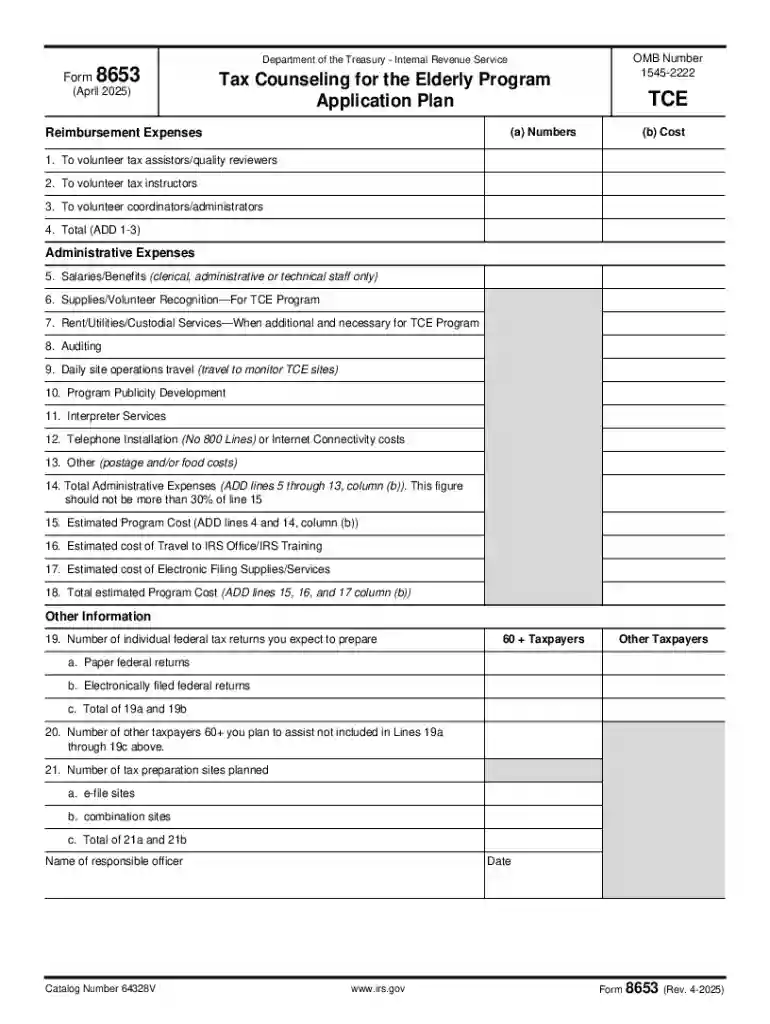
Form 8653 (Rev 4-2025), officially known as the Tax Counseling for the Elderly (TCE) Program Application Plan, is a form used to apply for funding and outline reimbursement expenses under the TCE program. The form is overseen by the Internal Revenue Service (IRS) and is designed to support organizations that provide free tax help to individuals aged 60 and older. This initiative aims to ensure that the elderly receive the necessary tax assistance, particularly focusing on tax issues relevant to their life circumstances, such as retirement benefits and pensions.
Organizations intending to participate in the TCE program must complete and submit Form 8653. It serves as an application to receive grant funding to support elderly-focused tax counseling sessions. The form allows applicants to detail their service plan, budget projections, and expected outcomes, ensuring that the IRS can assess the suitability and viability of each applicant's program. Filling out the form accurately and providing comprehensive information is crucial for obtaining approval and funding.
Form 8653 can be obtained directly from the IRS website, where it is available for download in PDF format. For individuals without internet access, the form can also be requested by contacting the IRS via phone to have a physical copy mailed. Organizations involved in community outreach, such as libraries or senior centers, may also have copies available for public distribution.
Ensuring accuracy and thoroughness in each section increases the likelihood of approval.
Each section is crucial for IRS assessment, ensuring that the organization aligns with TCE program objectives.
The form must be used for its intended purpose, which is to apply for participation in the TCE program, and should not be repurposed or reused for other grant applications. Complying with legal guidelines is paramount since misuse can lead to severe penalties or disqualification from the program. The information provided must be truthful and accurate, as any fraudulent claims can result in legal action.
The IRS provides explicit guidelines governing the application and approval process of Form 8653. These guidelines include eligibility criteria, submission procedures, and compliance expectations. Familiarity with these rules is essential for organizations to ensure their applications are fully compliant and stand a better chance of acceptance.
Organizations need to adhere to strict deadlines set by the IRS for the submission of Form 8653. The specific dates vary annually, but timely submission is critical to enable adequate processing time and timely allocation of funds. Applicants should monitor IRS announcements or consult the IRS website for up-to-date deadline information to ensure they do not miss crucial dates.
Including all required documents with your submission ensures a complete and robust application, facilitating smoother review by IRS personnel.
Failure to comply with the guidelines associated with Form 8653 or any misuse of funds can lead to severe penalties. Organizations may face revocation of funding, disqualification from future grant opportunities, legal action, and financial restitution obligations. It is therefore critical to maintain transparency and adhere strictly to the terms set forth by the IRS.
The form is available in both digital and paper formats, offering flexibility in submission methods. The digital version can be filled out online and submitted electronically, helping speed up the review process. Conversely, paper submissions may require additional handling and processing time, thereby potentially delaying approval. Organizations are encouraged to consider the benefits of each option and choose based on their infrastructure capabilities.
These examples illustrate the form's utility in facilitating tax assistance that caters specifically to the elderly community’s unique challenges.
At DocHub, your data security is our priority. We follow HIPAA, SOC2, GDPR, and other standards, so you can work on your documents with confidence.