






Definition & Meaning
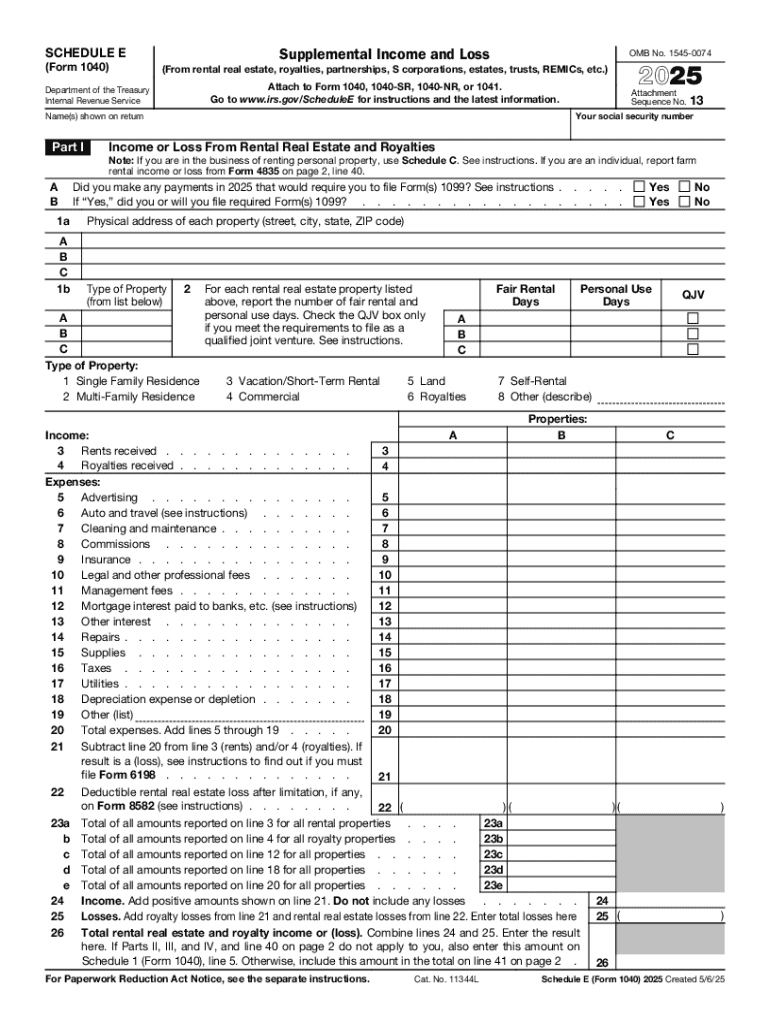
The 2025 Schedule E (Form 1040) is a supplemental form used by taxpayers in the United States to report income or loss from rental real estate, royalties, partnerships, S corporations, estates, trusts, and residual interests in real estate mortgage investment conduits. This form is essential for those who have passive income-generating activities and need to disclose additional income streams to the Internal Revenue Service (IRS). By completing this form, taxpayers can ensure all their income is properly accounted for during tax filing.
Key Elements of the Form
- Rental Income and Expenses: Include gross rental income, expenses like mortgage interest, repairs, insurance, and net income or loss.
- Partnership and S Corporation Income: Report share of income, deductions, and credits from partnerships and S corporations.
- Royalty Income and Expenses: Detail any payments for intellectual property use, mineral rights, or similar sources.
- Trust and Estate Income: Document distributions received from estates or trusts.
- RIMICs: Account for residual interests in real estate mortgage investment conduits.
Steps to Complete the 2025 Schedule E (Form 1040)
- Gather Necessary Documents: Collect 1099 forms, K-1 forms from partnerships and corporations, and documentation for income and expenses for rental properties.
- Fill Out Part I for Rental Real Estate and Royalties:
- Enter income and deductions.
- Calculate total rental income or loss.
- Complete Part II for Partnership and S Corporations:
- Report pass-through income and deductions.
- Include information from Schedule K-1.
- Enter Data in Part III for Estates and Trusts:
- Document income received from these entities.
- Include additional deductions or credits applicable.
- Review Part IV for Real Estate Mortgage Investment Conduits:
- Account for residual interest income.
- Validate Comprehensive Records: Ensure all reported data matches source documents to avoid discrepancies.
- Submit with Form 1040: Attach Schedule E when filing the full Form 1040 tax return.
Important Considerations
- Verification: Double-check all entries for accuracy.
- Efficiency: Utilize tax software compatible with Schedule E for easier preparation.
Who Typically Uses the 2025 Schedule E (Form 1040)
Individuals with diverse income sources beyond traditional employment often leverage Schedule E. These include landlords, property owners with royalty agreements, partners in businesses, or beneficiaries of trusts and estates. It is also used by passive investors in real estate ventures or those with financial interests in real estate mortgage investment conduits.


Variations in Taxpayer Scenarios
- Property Owners: Must include rental income and related expenses.
- Business Shareholders: Reported earnings from pass-through entities.
- Royalty Recipients: Include income from intellectual property.
- Estate Beneficiaries: Capture distributions received from estates or trusts.

IRS Guidelines
The IRS provides specific instructions and guidelines for completing Schedule E accurately as part of the broader Form 1040 filing process. The goal of these guidelines is to ensure proper reporting of both income and associated expenses to calculate net income correctly. Essential IRS instructions can be accessed directly from their website or through authorized tax preparation software that often integrates these details for the filer's ease.
Key Points Emphasized by the IRS
- Accuracy: Correct reporting of all income types listed.
- Documentation: Importance of retaining supporting documents for at least three years.
- Deductions: Allowable deductions aligned with IRS rules.
Filing Deadlines / Important Dates
For the year 2025, the deadline for completing and submitting Schedule E along with Form 1040 is typically April 15. However, this is subject to changes based on federal holidays and weekends, potentially resulting in an extension to the next business day. For those filing for an extension, the extended deadline generally falls on October 15.
- Key Dates:
- April 15: Regular filing deadline.
- October 15: Extended deadline upon filing Form 4868 for extension.
Penalties for Non-Compliance
Missing the filing deadline can result in penalties and interest on unpaid taxes. Additionally, inaccuracies or omissions on Schedule E might lead to further scrutiny, audits, or penalties from the IRS.
State-Specific Rules for the 2025 Schedule E (Form 1040)
While Schedule E is a federal form, there may be nuances at the state level depending on where the taxpayer resides. Some states conform to federal tax laws, while others require separate state-specific forms or schedules. It's crucial for taxpayers to check their state’s tax regulations to ensure compliance.
Variations in State Regulations
- Conformity: Majority of states align with the IRS definition of income and deductions.
- Differences: Some states may have unique reports or adjustments for income recognition.
Software Compatibility
Many taxpayers use tax preparation software that is compatible with Schedule E and can streamline the filing process. Popular software like TurboTax, QuickBooks, and others are equipped to handle the complexities of Schedule E, ensuring accuracy and adherence to IRS guidelines.
- Benefits of Using Software:
- Simplifies data entry with automatic form population.
- Ensures calculation accuracy and consistency with the latest tax laws.
Recommended Software
- TurboTax: Offers user-friendly navigation and comprehensive guidance.
- QuickBooks: Useful for business owners for synchronized financial recording.
Examples of Using the 2025 Schedule E (Form 1040)
Consider a real estate investor who owns several rental properties and has additional income from a mineral rights lease. This individual will use Schedule E to report income from each rental property separately, deducting expenses such as repairs, property tax, and mortgage interest. Additionally, the royalty payments from the lease must be included, with allowable deductions for any related fees or expenses, ensuring all sources of secondary income are properly accounted for and taxed appropriately.
Practical Scenarios
- Multi-Property Owners: Benefit from organized reporting for each unit to maximize deductions.
- Shareholders in Small Businesses: Use to report income from S corporations or partnerships.
Understanding these sections and adhering to outlined procedures helps in accurately completing the 2025 Schedule E (Form 1040), ensuring compliant and efficient tax reporting.