




01. Edit your form online
Type text, add images, blackout confidential details, add comments, highlights and more.

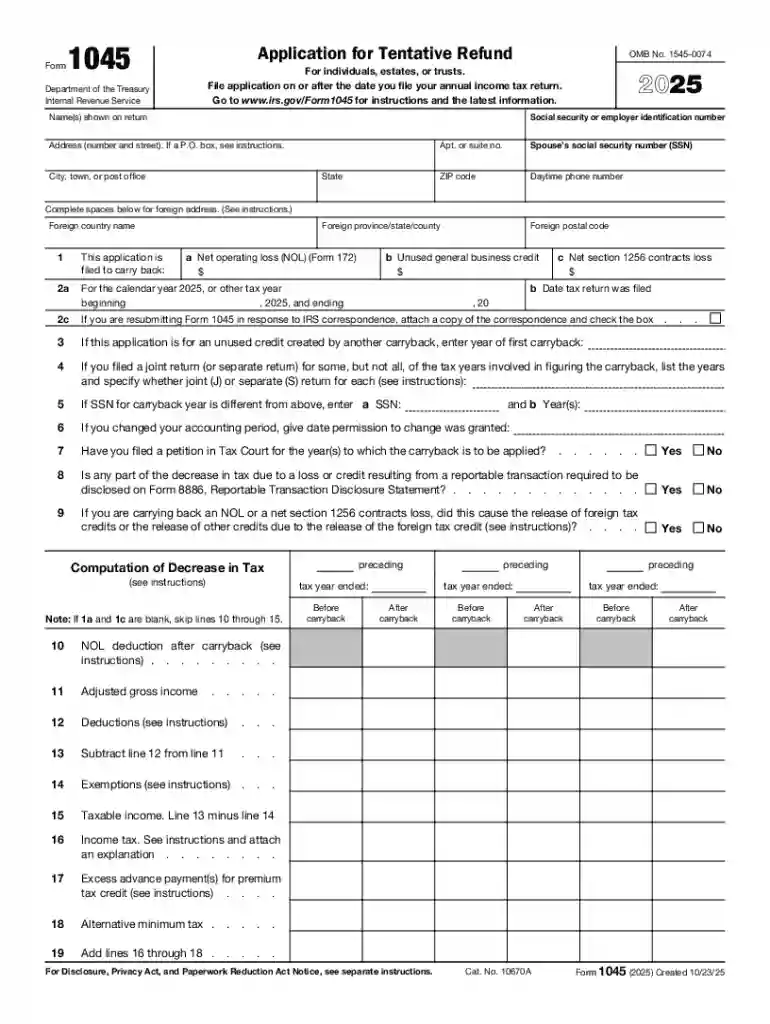
Type text, add images, blackout confidential details, add comments, highlights and more.

Draw your signature, type it, upload its image, or use your mobile device as a signature pad.

Send it via email, link, or fax. You can also download it, export it or print it out.
The Form 1045 Application for Tentative Refund is a document used by taxpayers to apply for a quick refund of taxes due to the carryback of net operating losses (NOL), unused general business credits, or for recovering overpayment attributable to a claim of right adjustment. It is primarily utilized by individual taxpayers, estates, or trusts who have realized a tax situation change after filing their returns. The form plays an essential role in facilitating the recovery of funds owed by the IRS, thereby offering relief from past tax liabilities and improving cash flow.
Using Form 1045 involves applying for refunds based on tax adjustments efficiently. It typically requires calculation of the carryback period benefits, reiterating how tax liabilities have shifted, and preparing documentation that substantiates the claim. Key steps include:
Filing Form 1045 involves several precise actions:
Form 1045 is beneficial for taxpayers aiming to promptly amend their tax liabilities, particularly following a significant financial shift that affects past tax responsibilities. This form delivers a faster method of tax fund recovery compared to standard amended returns, as the IRS typically processes these applications much quicker, thus alleviating financial stress and stabilizing cash flow.
Form 1045 is mainly utilized by individuals, estates, and trusts that experience changes in financial standing due to events such as natural disasters, business failures, or significant tax credit introductions. It's also ideal for those reporting net operating losses or adjusting tax credits, further assisting businesses adjusting post-tax year assessments.


Form 1045 seeks legal compliance by adhering to U.S. tax regulations concerning NOL and credit adjustments. Accurate submission, with full transparency and necessary documentation, ensures lawful claims and alignment with IRS statutes. Under ESIGN, digitally signed submissions maintain their legality, further enhancing accessibility.
Understanding specific terminology within Form 1045 is vital for accurate completion:
IRS guidelines emphasize complete and accurate filling of Form 1045 accompanied by appropriate documentation. The IRS advises meticulous record maintenance and verification of all calculations indicative of carrybacks or credit applications. Guidelines clarify application submission within a year of the end of the year in which the NOL or credit arose, ensuring compliance with tax statutes.
This structured content comprehensively addresses Form 1045, blending detailed explanations and practical instructions to serve as a valuable resource for those seeking to align financial obligations with IRS provisions.
We've got more versions of the Form 1045 Application for Tentative Refund - Valur Library form. Select the right Form 1045 Application for Tentative Refund - Valur Library version from the list and start editing it straight away!
| Versions | Form popularity | Fillable & printable |
|---|---|---|
| 2025 | 4.1 Satisfied (55 Votes) | |
| 2024 | 4.1 Satisfied (55 Votes) | |
| 2023 | 4.6 Satisfied (37 Votes) | |
| 2022 | 4.5 Satisfied (25 Votes) | |
| 2021 | 4.8 Satisfied (62 Votes) | |
| 2020 | 4.4 Satisfied (134 Votes) | |
| 2019 | 4.1 Satisfied (74 Votes) | |
| 2018 | 4.3 Satisfied (164 Votes) | |
| 2017 | 4.3 Satisfied (145 Votes) | |
| 2016 | 4.4 Satisfied (684 Votes) | |
| 2015 | 4.4 Satisfied (1090 Votes) | |
| 2014 | 4 Satisfied (60 Votes) | |
| 2013 | 4 Satisfied (20 Votes) | |
| 2012 | 4 Satisfied (58 Votes) | |
| 2011 | 4 Satisfied (58 Votes) |
At DocHub, your data security is our priority. We follow HIPAA, SOC2, GDPR, and other standards, so you can work on your documents with confidence.



The StarCore linker is a part of StarCore development tools and generates an executable file for the StarCore family of digital signal processors.Read more
IRS Form 1045, Application for Tentative Refund, is used for calculating the NOL and reporting the adjustments. The 4- and 5-year farm NOL carrybacks mayRead more
Overview: This IRM provides procedural and processing instructions to the Accounting Operations to approve, schedule, and DocHub refunds.Read more


