




01. Edit your form online
Type text, add images, blackout confidential details, add comments, highlights and more.

Type text, add images, blackout confidential details, add comments, highlights and more.

Draw your signature, type it, upload its image, or use your mobile device as a signature pad.

Send it via email, link, or fax. You can also download it, export it or print it out.
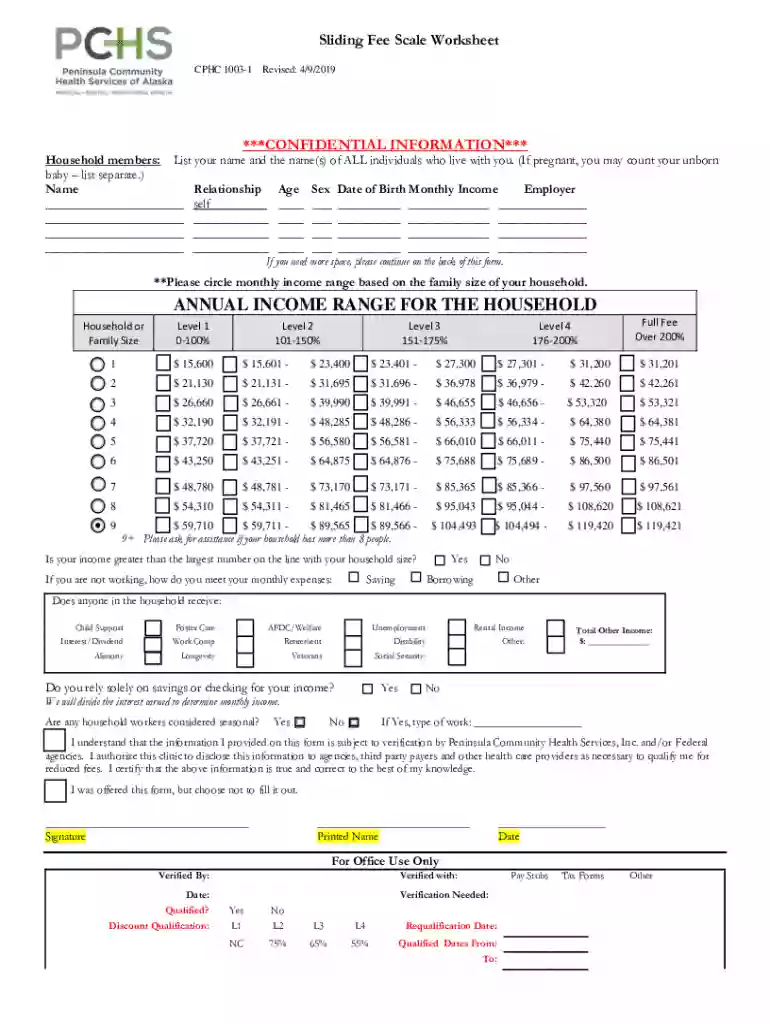
Understanding the Sliding Fee Scale Worksheet is essential for organizations and individuals aiming to determine payment plans based on income levels. This tool is primarily used by health services and non-profit organizations to calculate service fees relative to an individual's ability to pay. By considering household size and income, the worksheet ensures equitable access to services, offering discounted rates to low-income individuals who qualify. This form aligns payment responsibilities with financial capacities, promoting inclusivity in access to essential services.
Organizations such as community health centers use this worksheet to ensure patients are not denied services due to financial constraints. For example, a family of four with an income of $30,000 might receive a 50% discount on medical services based on their position within the scale.
To effectively use the Sliding Fee Scale Worksheet, follow these steps:
Consider a single individual with an annual income of $20,000. By consulting the worksheet:
Organizations typically distribute this tool in a manner that is accessible to their clientele. Here's how you can obtain this essential worksheet:
Ensure the version acquired is updated according to the current fiscal year, as financial guidelines and poverty levels may change, affecting eligibility criteria.
When filling out the Sliding Fee Scale Worksheet, accuracy is crucial to ensure proper fee adjustments:
Utilizing the worksheet serves various important purposes:
By implementing the worksheet, service providers can sustain operations while ensuring no individual's financial constraints preclude access to necessary support.
Understanding the critical components of this worksheet enhances its effective use:
Understanding how each factor directly influences the resulting fee calculations ensures balanced and equitable application of discounts.
State laws and regulations can influence how sliding fee scales are implemented, as each may have unique guidelines:
In California, higher living costs may influence the income brackets for discounts compared to a state with a lower cost of living. Understanding and accounting for these differences is essential for implementation.
This worksheet must be employed in compliance with federal and state legal requirements:
Improper use of the worksheet, such as unauthorized data sharing or discrimination, could result in legal consequences for organizations. Understanding and adhering to these regulations helps maintain trust and legal compliance.
At DocHub, your data security is our priority. We follow HIPAA, SOC2, GDPR, and other standards, so you can work on your documents with confidence.




The Federal Poverty Guidelines are used in creating and annually updating the sliding fee schedule to determine eligibility. PROCEDURE: The following guidelinesRead more
**Imaging services eligible for the sliding fee schedule include: plain medical films, basic gynecological ultrasounds, basic obstetrical ultrasounds, andRead more
We can offer this treatment to you at a sliding scale at our clinic. (cost) I will be your therapist. Im a third year resident in psychiatry that meansRead more


