Definition and Purpose of Form 8990
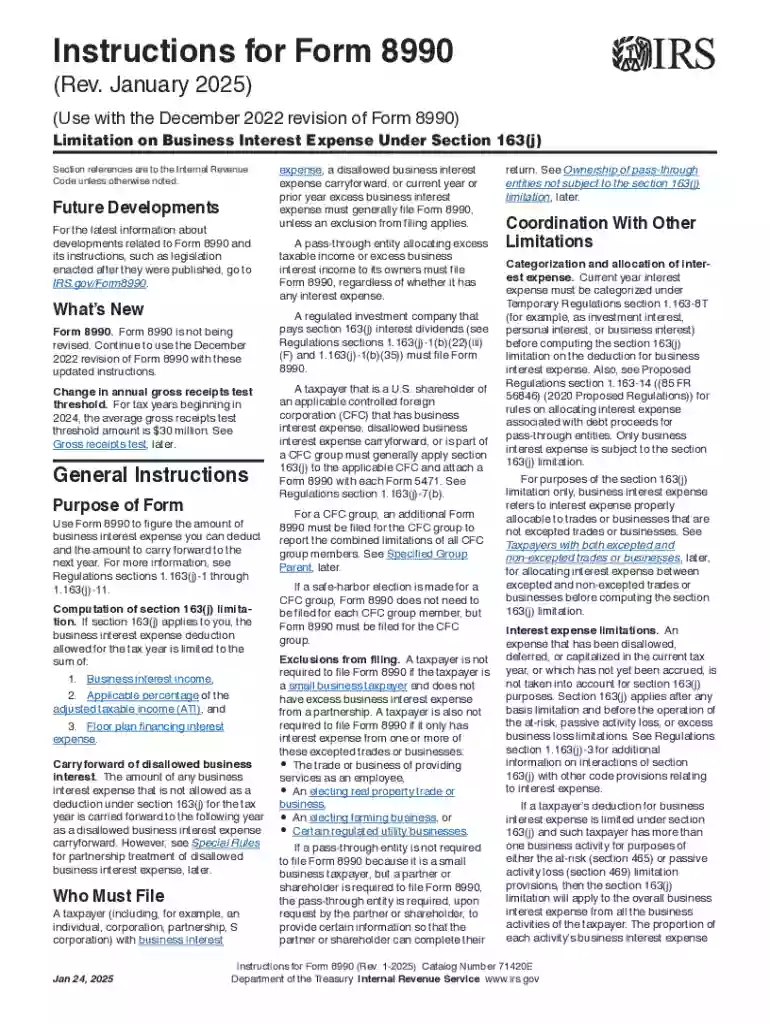
Form 8990 is used by taxpayers to determine the limitation on business interest expenses under Section 163(j) of the Internal Revenue Code. The primary purpose is to prevent excessive interest deductions that may erode taxable income. This form is crucial for businesses aiming to comply with IRS regulations on interest deductibility limitations.
Key Concepts
- Foundation of the Limitation: Section 163(j) generally limits the deduction of business interest expenses to the sum of business interest income, 30% of adjusted taxable income, and floor plan financing interest.
- Affected Entities: C corporations, partnerships, and some individuals and estates that have significant business interest expense may need to complete this form.
Steps to Complete Form 8990
- Gather Necessary Information: Start by collecting all relevant financial records, including income statements and balance sheets, to ascertain business interest income and expenses.
- Determine Adjusted Taxable Income: Calculate or retrieve your adjusted taxable income, which plays a critical role in determining the limitation amount.
- Complete Part I: Enter business interest income and expenses. Understand which amounts can be deducted immediately and which need to be carried over.
- Fill in Part II: Focus on applicability and exceptions. Identify if your business qualifies for any exceptions, such as small business exemptions.
- Verify Calculations and Compliance: Review all figures carefully to ensure compliance with IRS requirements, and verify that calculations align with the adjusted taxable income limitations.
IRS Guidelines and Requirements
The IRS provides comprehensive guidelines for filing Form 8990 effectively.
Detailed Directives
- Documentation: Maintain thorough documentation supporting all figures to ensure accuracy and readiness in case of an IRS audit.
- Computational Details: Follow IRS guidelines for specific computations, especially concerning the carryover of disallowed interest expenses.
- Amendments and Corrections: Understand the procedure for making amendments if errors are found after submission.
Filing Deadlines and Important Dates
Filing deadlines for Form 8990 align with regular tax return deadlines unless an extension is granted.
- Annual Filing Deadline: Typically April 15 for individuals, though business entities may have different schedules based on their tax year.
- Extension Provisions: Extensions must be filed in accordance with general IRS guidelines for tax returns, and they automatically apply to the Form 8990 submission.
Important Terms Related to Form 8990
Understanding key terms is vital for accurate completion.
Notable Terminology
- Interest Expense: Costs incurred from borrowing funds to finance business operations.
- Floor Plan Financing: A specific type of borrowing for purchasing high-cost inventory items.
- Interest Income: Any income received from lending activities or invested capital.
Business Entity Types and Form 8990
Different business entities must evaluate their unique circumstances to determine how Form 8990 applies to them.
Evaluation by Entity Type
- Corporations: Often required to fill out this form due to their exposure to significant interest expenses.
- Partnerships: Need specific attention to Part II, as pass-through dedications can affect individual partners differently.
- LLCs: Requirements depend on tax treatment (e.g., sole proprietorship versus partnership).
Penalties for Non-Compliance
Failure to properly file Form 8990 can lead to significant penalties and interest charges.
Understanding Risks
- Missed Deduction Benefits: Inaccurate filings may lead to reduced deductions and higher than necessary tax liabilities.
- IRS Audits: Incorrect or late submissions increase the likelihood of an IRS audit, which can result in further financial scrutiny and penalties.
Examples of Using Form 8990
Real-world scenarios help illustrate the practical application.
Illustrative Scenarios
- Small Manufacturing Business: This business might analyze its loans for equipment purchases under Floor Plan Financing to accurately determine applicable interest deductions.
- Tech Startup: A rapidly growing startup will calculate its adjusted taxable income precisely to understand how venture capital-derived interest affects its tax obligations.
These detailed sections of the "Instructions for Fill Out Form 8990" not only guide users through the completion of the form but also provide practical context for understanding its impact on business finances.