




01. Edit your form online
Type text, add images, blackout confidential details, add comments, highlights and more.

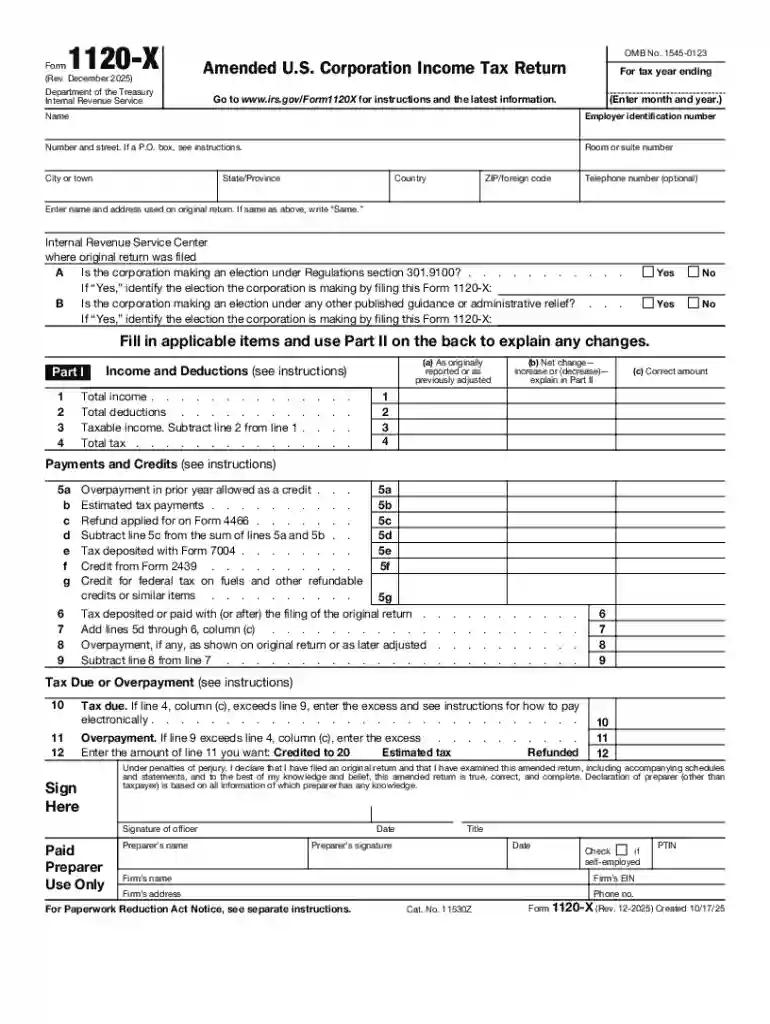
Type text, add images, blackout confidential details, add comments, highlights and more.

Draw your signature, type it, upload its image, or use your mobile device as a signature pad.

Send it via email, link, or fax. You can also download it, export it or print it out.
Form 1120X, known officially as the Amended U.S. Corporation Income Tax Return, is utilized by corporations in the United States to make any corrections to previously filed Form 1120. This form allows for adjustments in taxable income, credits, and tax figures after an original return submission. The purpose of Form 1120X is to provide a structured method for corporations to amend their tax records to reflect accurate financial positions and compliance with federal tax regulations.
Accurate filing ensures compliance and helps corporations avoid additional penalties and interest due to underreported taxes.
To obtain Form 1120X, corporations can visit the Internal Revenue Service (IRS) website, where the form is available for download in PDF format. Alternatively, corporations may retrieve the form through tax preparation software platforms like TurboTax or QuickBooks, where they have integrated access to IRS forms.
By using credible sources, corporations ensure they are working with the most recent revision of the form, minimizing the risk of misinformation.
Ensuring precision at this stage aids in a clear and valid amendment of records with the IRS.
The IRS provides comprehensive guidelines for Form 1120X to assist corporations in completing amendments accurately. Key areas include instructions for determining changes in income, providing detailed explanations, and understanding correction impact on tax liability. Corporations are advised to adhere closely to these guidelines to avoid misinterpretations that might lead to audit triggers or penalties.
Following IRS protocols not only helps in seamless corrections but also facilitates smoother processing and acceptance of the amendments.
Corporations must be mindful of specific deadlines associated with filing Form 1120X to ensure their amendment is timely and valid. Generally, the form should be submitted within the aforementioned time constraints of three years post-filing of the original return or two years post-tax payment.
Timely filing ensures corporations remain compliant and avoid unnecessary penalties associated with late amendments.
Failing to properly file Form 1120X or submit it within the specified time limits can result in penalties or additional tax delays. The IRS may impose penalties and interest charges on corporations that neglect to amend evident errors, leading to understated taxes.
Corporations must diligently follow the amendment process to avoid monetary penalties and ensure accurate financial reporting.
Form 1120X is compatible with several tax preparation and accounting software solutions. Tools like TurboTax and QuickBooks enable corporations to import data directly from their financial records, making the process more streamlined and less prone to manual entry errors.
Utilizing compatible software supports efficiency in filing amendments and maintaining accurate tax records over time.
At DocHub, your data security is our priority. We follow HIPAA, SOC2, GDPR, and other standards, so you can work on your documents with confidence.



Aug 27, 2025 Information about Form 1120-X, Amended U.S. Corporation Income Tax Return, including recent updates, related forms, and instructions on how
Use Form 1120X to correct Form 1120, U.S. Corporation. Income Tax Return, or Form 1120-A, U.S. Corporation. Short-Form Income Tax Return, as you originallyRead more
Jan 19, 2017 U.S. Return of Partnership Income. Amended Return or Administrative. Adjustment Request (AAR). U.S. Income Tax Return for an S. Corporation.Read more


