






Definition and Meaning
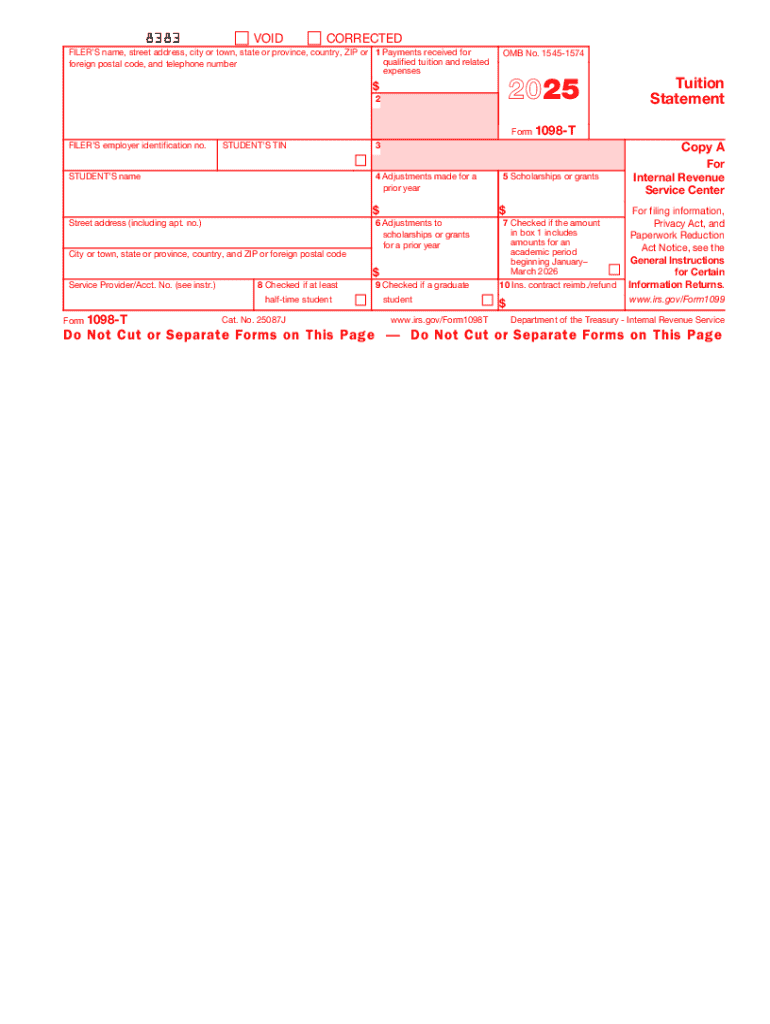
The 1098-T form, known as the Tuition Statement, is used to report payments received for qualified tuition and related educational expenses. Institutions that are eligible to participate in a student aid program administered by the Department of Education must issue this form to students. The form provides important information regarding education-related tax credits that taxpayers can claim, such as the American Opportunity Credit and the Lifetime Learning Credit.
Educational institutions issue the form not only to inform students or their guardians of the amount paid toward tuition but also to aid in calculating the educational benefits they might claim on their tax returns. Understanding the 1098-T form is crucial as it outlines expenses that could considerably lessen taxable income through relevant credits.
How to Use the Form 1098-T
Students or taxpayers should utilize the 1098-T form when filing their tax returns to claim education credits like the American Opportunity Credit or Lifetime Learning Credit. The American Opportunity Credit is accessible during the first four years of post-secondary education, offering a maximum of $2,500 per eligible student. On the other hand, the Lifetime Learning Credit is not limited to undergraduate expenses and can be applicable for post-graduate and professional degree courses, offering up to $2,000 annually per tax return, regardless of the number of students.
Both credits require the form to substantiate claims. Therefore, attaching a copy of the 1098-T when submitting tax returns can expedite the filing process. It is essential to accurately assess which credit to claim based on the form information and eligibility.
How to Obtain the Form 1098-T
Students typically receive the 1098-T form from their educational institution at the start of each year. It can be delivered either by mail or electronically, depending on the institution's policy. If a student does not receive it by late January, they should contact their school’s finance or bursar’s office. Students should ensure their mailing address and email are up-to-date with their educational institution to prevent any delays in receiving the form.
Many institutions also provide an option to download the form from their student account portal. In such cases, students must log in to their school’s online system to access and print the form, so exploring these options can be beneficial in obtaining the form on time.
Steps to Complete the Form 1098-T
Verify Information
- Check Personal Information: Ensure that the student’s name, SSN, and address are correct. Any errors should be reported to the institution to re-issue a corrected form.
- Review Amounts: Analyze Box 1, which outlines qualified tuition and fees paid, and Box 5, detailing scholarships or grants provided, to ensure accuracy.
Understanding Boxes
- Box 1: Reflects payments received for qualified tuition and related expenses.
- Box 5: Shows scholarships and grants, affecting the amount eligible for tax credits.
Subsections
- Box 2 and Box 7: While rarely used now, Box 2 previously reported amounts billed for qualified expenses. Box 7 indicates if amounts reported include expenses for academic periods starting in Jan-March of the subsequent year.
Include in Tax Return
Integrate data from these boxes into the corresponding sections when claiming education credits on your tax return. Accurate reporting using this information will assist in determining eligible credits.
Eligibility Criteria
To benefit from the 1098-T form, students must have made payments toward eligible educational institutions in the U.S., covering tuition and related expenses. Students who enrolled in courses for academic credit and are completing requirements necessary to earn a post-secondary degree are eligible.
To claim these tax credits, the taxpayer must:
- File a tax return.
- Be enrolled in an educational institution eligible to participate in a program administered by the U.S. Department of Education.
- Ensure that their Modified Adjusted Gross Income is within the credit limits.


IRS Guidelines
Specific IRS guidelines dictate how the 1098-T form should be used and reported. Taxpayers should refer to IRS Publication 970, which covers Tax Benefits for Education, for detailed legal requirements and conditions applicable to claiming these education credits.
Educational institutions must send 1098-Ts by January 31 of each year, and students are encouraged to contact the IRS through their help centers or online resources if they need further assistance with tax credits or interpreting the form.
Filing Deadlines and Important Dates
Key Dates
- January 31: Deadline for schools to provide the 1098-T to students.
- April 15: Usual tax filing deadline, which is the final date to claim the education credits for the previous tax year.
To avoid penalties or missed opportunities for credits, ensure the form is obtained and used effectively by these dates.
Who Issues the Form
Colleges, universities, and other eligible educational institutions issue the 1098-T form. Any institution that applies for, administers, or participates in the student aid programs through the Department of Education is responsible for disseminating the form to students who paid qualified expenses during the tax year.
Penalties for Non-Compliance
Failure by educational institutions to furnish accurate 1098-T forms to students can result in penalties from the IRS. Similarly, taxpayers who fail to accurately report the information on their tax returns risk facing audits or the denial of education credits. Taxpayers should ensure all information from the form is promptly and accurately integrated into their tax filings to avoid such concerns.