






Definition & Meaning
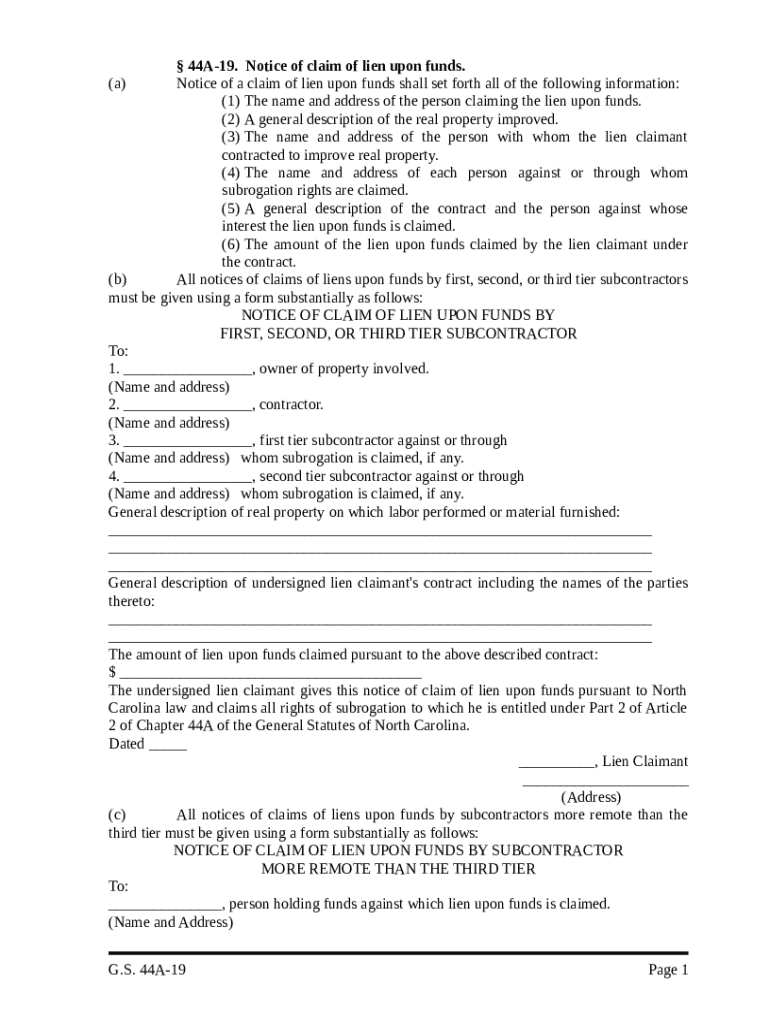
A 44A-19 Notice of Claim of Lien Upon Funds is a legal document used primarily in construction law. It is a formal notification by a claimant that asserts a right to receive payment from funds due to another party, usually a contractor, who has not paid for services or materials. This notice serves as a claim against funds owed to the contractor, effectively stopping the payment to that party until the lien is resolved. The intent is to ensure that subcontractors, suppliers, or parties further down the chain of a construction project receive due payment for their contributions.
By establishing this claim, the notice acts as a protective measure for contractors to avoid scenarios where they complete work yet face non-payment. It is crucial in maintaining fair financial transactions within construction projects, compelling main contractors or project owners to withhold the funds until the claim is satisfied.
How to Use the 44A-19 Notice of Claim of Lien Upon Funds
To effectively use the 44A-19 Notice of Claim of Lien Upon Funds, individuals must acquire detailed knowledge about their local laws regarding liens. Generally, this involves drafting the notice with the correct information and submitting it to the appropriate parties.
- Preparation: Gather necessary documentation, including contracts, invoices, and communications that support your claim for payment.
- Create the Notice: Accurately fill out the 44A-19 form, ensuring all details are clear and truthful.
- Submission: Deliver the notice to the project owner and any other relevant parties along the payment chain. This may require both physical delivery and a confirmation of receipt.
Mistakes in the submission or preparation of this notice can invalidate the claim, so attention to detail and compliance with regulations are critical throughout the process.
Steps to Complete the 44A-19 Notice of Claim of Lien Upon Funds
Completing the 44A-19 Notice of Claim of Lien Upon Funds involves a series of steps that ensure accuracy and legality:
- Information Verification: Double-check all involved parties' names, addresses, and legal entities.
- Detail of Work/Services Rendered: Clearly specify the work or materials provided, including dates and specific contributions.
- Amount Claimed: Clearly state the amount owed, supported by past invoices and payment agreements.
- Declaration: Include a statement affirming the accuracy and truthfulness of the claim to avoid legal repercussions.
- Date and Signature: Affix the current date and, if applicable, a notarized signature to validate the form.
Ensuring these steps are followed with precision is vital to uphold the validity of the lien notice.
Key Elements of the 44A-19 Notice of Claim of Lien Upon Funds
The 44A-19 form comprises several crucial elements:
- Claimant's Information: Full legal name and address of the claimant.
- Debtor's Information: Name and address of the party responsible for payment.
- Owner's Information: Information for the property or project owner, if different from the debtor.
- Details of Obligations: Comprehensive description of the services or products provided.
- Legal Basis for the Claim: Reference to any underlying agreements or laws that justify the lien.
- Proclaimed Amount: Exact sum being claimed, backed by proper documentation.
Each element must be clearly outlined to facilitate a straightforward validation process by legal parties.
Who Typically Uses the 44A-19 Notice of Claim of Lien Upon Funds
Typically, subcontractors, suppliers, and laborers in the construction industry utilize the 44A-19 Notice of Claim of Lien Upon Funds. This group often provides services or materials under contracts where direct payment from the property owner is managed by intermediaries like general contractors. By filing this notice, they safeguard against the risk of non-payment due to the principal contractor's financial difficulties or unwillingness to release funds.
In addition to these parties, any entity involved in the chain of service provision within a construction project may find it necessary to employ this form to protect their financial interests.


Legal Use of the 44A-19 Notice of Claim of Lien Upon Funds
The legal utilization of the 44A-19 Notice lies within construction law, acting as a tool to enforce payment security. Claimants use this avenue to apply pressure on the owing party and bring outstanding payment issues to immediate attention.
- Filing the Lien: This is done as per state-specific regulations, often requiring timely submission within strict legal deadlines.
- Effectiveness: The lien remains effective usually until the debtor pays the owed amounts or until the lien expires or is otherwise removed legally.
This notice is highly effective in scenarios where verbal or formal demands for payment have been consistently ignored.
State-Specific Rules for the 44A-19 Notice of Claim of Lien Upon Funds
State-specific rules dictate the exact usage and requirements for filing a 44A-19 Notice. This can affect:
- Filing Duration: Strict timelines detailing when a lien claim can be filed post-service or delivery.
- Additional Documentation: Some states may require supporting documents, such as contracts or receipts, to accompany the claim.
- Submission Process: States may have specific protocols for how and where these forms need to be filed.
Understanding and adhering to these region-specific laws are essential, as non-compliance could lead to rejection or invalidation of the lien.
Penalties for Non-Compliance
Failure to properly file a 44A-19 Notice can lead to serious consequences:
- Invalid Claims: Missing deadlines or incomplete submissions often result in an invalid claim, forfeiting payment rights.
- Legal Repercussions: In some jurisdictions, improper filing might lead to legal disputes or counterclaims.
- Financial Loss: Non-compliance means loss of leverage for payment, potentially leading to financial detriment for that business or individual.
To avoid these penalties, claimants should familiarize themselves thoroughly with the procedural legalities and use precise documentation throughout the process.