




01. Edit your form online
Type text, add images, blackout confidential details, add comments, highlights and more.

Type text, add images, blackout confidential details, add comments, highlights and more.

Draw your signature, type it, upload its image, or use your mobile device as a signature pad.

Send it via email, link, or fax. You can also download it, export it or print it out.
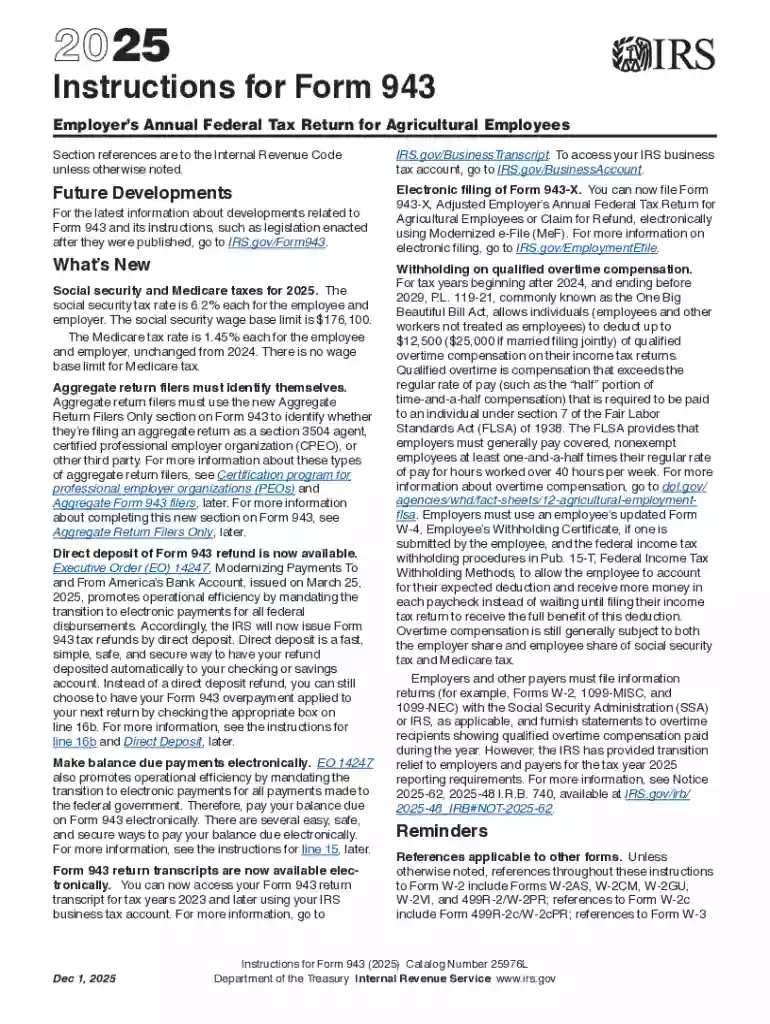
The Form 943, also known as the "Employer's Annual Federal Tax Return for Agricultural Employees," is a crucial document used by agricultural employers in the United States to report income tax withheld and Social Security and Medicare taxes. Its primary intent is to ensure compliance with the Internal Revenue Code by mandating employers to declare these taxes annually, thus streamlining tax obligations specific to the agricultural sector. This form is an essential component for managing taxation within this industry, providing clarity and orderliness in tax reporting.
The 2025 Instructions for Form 943 facilitate the correct completion and filing of the form by elucidating each section comprehensively. These instructions serve as a guide to accurately determine the taxes you must report and remit. Follow these steps to ensure accuracy:
Completing Form 943 requires precision and careful documentation. The following steps streamline the process:
Understanding submission timelines is pivotal for compliance. Form 943 is due by January 31 following the close of the tax year. If earlier deposits cover the full tax liability, you may qualify for a filing extension until February 10. Monitoring IRS updates and reminders is essential for meeting these deadlines without penalty.
These instructions are predominantly utilized by employers in the agricultural industry. This includes businesses that pay wages to farmworkers and are required to report on income tax withholding, as well as Social Security and Medicare taxes for their employees. The instructions are crafted to guide users who might range from small family-owned farms to large agribusiness corporations.


The instructions encompass several critical components designed to bolster compliance:
Failure to file Form 943 in a timely or accurate manner can result in penalties, including fines and interest on unpaid taxes. Specifically, errors or omissions in reporting can lead to financial repercussions from the IRS. It is critical to maintain thorough and precise records as a safeguard against any potential penalties.
Form 943 offers flexibility in submission through both digital and paper methods:
Understanding both methods allows employers to choose the most convenient option based on resources and preferences.
We've got more versions of the 2025 Instructions for Form 943 form. Select the right 2025 Instructions for Form 943 version from the list and start editing it straight away!
| Versions | Form popularity | Fillable & printable |
|---|---|---|
| 2025 | 4.8 Satisfied (54 Votes) | |
| 2024 | 4.7 Satisfied (57 Votes) | |
| 2023 | 4.3 Satisfied (51 Votes) | |
| 2022 | 4.2 Satisfied (35 Votes) | |
| 2021 | 4.8 Satisfied (85 Votes) | |
| 2020 | 4.4 Satisfied (294 Votes) | |
| 2019 | 4.3 Satisfied (107 Votes) | |
| 2018 | 4.4 Satisfied (248 Votes) | |
| 2017 | 4.4 Satisfied (318 Votes) | |
| 2016 | 4.3 Satisfied (159 Votes) | |
| 2015 | 4 Satisfied (41 Votes) | |
| 2014 | 4.1 Satisfied (56 Votes) | |
| 2013 | 4.4 Satisfied (64 Votes) | |
| 2012 | 4.1 Satisfied (57 Votes) | |
| 2011 | 4.4 Satisfied (38 Votes) |
At DocHub, your data security is our priority. We follow HIPAA, SOC2, GDPR, and other standards, so you can work on your documents with confidence.






Apr 15, 2015 Whats New. Premium tax credit. You may be eligible to claim the premium tax credit if you, your spouse, or a dependent.Read more
You can now file Form. 943-X, Adjusted Employers Annual Federal Tax Return for. Agricultural Employees or Claim for Refund, electronically using Modernized e-Read more


