




01. Edit your form online
Type text, add images, blackout confidential details, add comments, highlights and more.

Type text, add images, blackout confidential details, add comments, highlights and more.

Draw your signature, type it, upload its image, or use your mobile device as a signature pad.

Send it via email, link, or fax. You can also download it, export it or print it out.
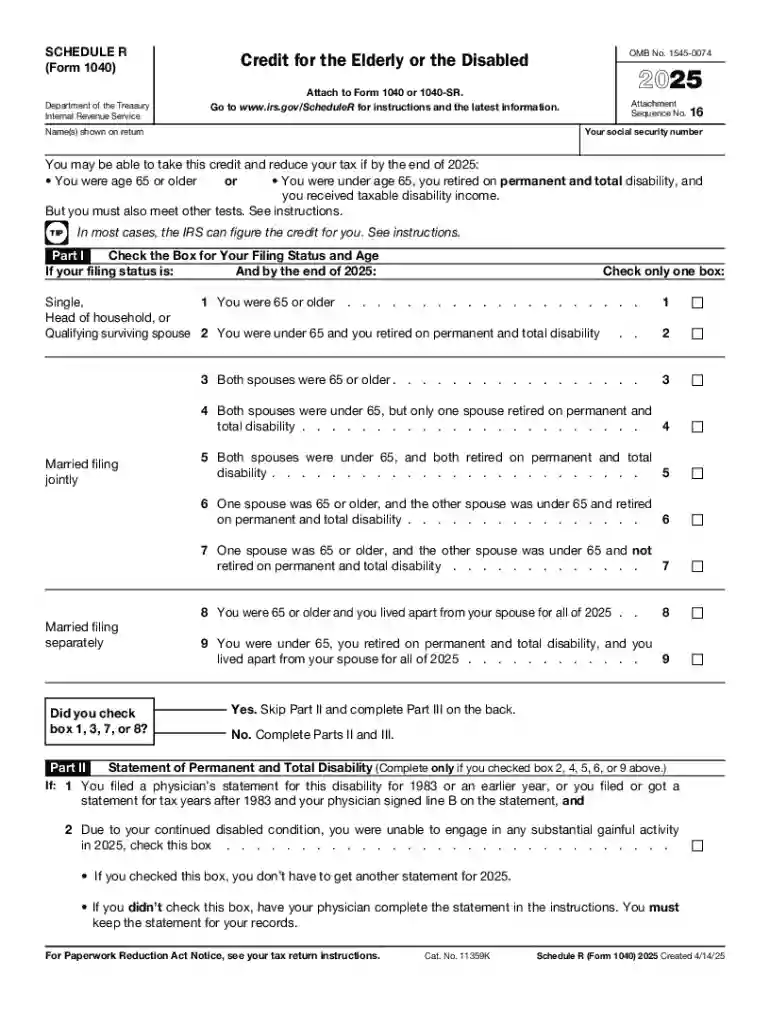
Schedule R, attached to Form 1040 or 1040-SR, allows eligible taxpayers to claim the Credit for the Elderly or the Disabled. This credit is designed to provide financial relief to those who are retired or disabled and meet certain income and age or disability criteria. By utilizing this form, eligible individuals can reduce their tax liability, thereby receiving additional support.
Using Schedule R involves calculating the credit by completing the worksheet associated with the form. This worksheet helps to determine eligibility and the exact credit amount by using details from the taxpayer’s income sources.
Understanding specific terminology associated with Schedule R is crucial for accurate completion.
Timing is critical for tax filings, and Schedule R is no exception. Attaching Schedule R to Form 1040 or 1040-SR must occur by the tax filing deadline, typically April 15, unless extensions apply.
Accurate preparation and completion of Schedule R require attention to detail and an understanding of the process.
Eligibility for the credit involves several factors, including age, disability status, and income levels. Generally, individuals must be 65 or older at the end of the tax year or meet the IRS criteria for disability.


The IRS provides comprehensive instructions for completing Schedule R. This includes eligibility criteria, step-by-step calculation methods, and examples to illustrate specific scenarios.
Several scenarios illustrate the practical application of Schedule R, demonstrating how individuals in different circumstances can avail themselves of the credit.
By addressing these sections comprehensively, the content provides a detailed and structured guide on how to navigate Schedule R, ensuring eligible taxpayers can effectively claim the Credit for the Elderly or the Disabled.
We've got more versions of the Guide to Schedule R: Tax Credit for Elderly or Disabled form. Select the right Guide to Schedule R: Tax Credit for Elderly or Disabled version from the list and start editing it straight away!
| Versions | Form popularity | Fillable & printable |
|---|---|---|
| 2025 | 4.8 Satisfied (45 Votes) | |
| 2024 | 4.7 Satisfied (21 Votes) | |
| 2023 | 4.8 Satisfied (57 Votes) | |
| 2022 | 4.3 Satisfied (40 Votes) | |
| 2021 | 4.8 Satisfied (87 Votes) | |
| 2020 | 4 Satisfied (46 Votes) | |
| 2019 | 4.1 Satisfied (36 Votes) | |
| 2018 | 4.4 Satisfied (182 Votes) | |
| 2017 | 4.3 Satisfied (71 Votes) | |
| 2016 | 4.4 Satisfied (398 Votes) | |
| 1995 | 4.7 Satisfied (43 Votes) |
At DocHub, your data security is our priority. We follow HIPAA, SOC2, GDPR, and other standards, so you can work on your documents with confidence.





Jan 23, 2018 See chapter 5 for discussions on the credit for the elderly or the disabled, the child and dependent care credit, and the earned income credit.Read more
Earned Income Credit. Schedule R Calculated the Credit for the Elderly or the Disabled, reported on line 54 of Form 1040. Schedule. 8812. Form used to calculateRead more
Jun 24, 2025 Information about Schedule R (Form 1040), Credit for the Elderly or the Disabled, including recent updates, related forms, and instructions


