




01. Edit your form online
Type text, add images, blackout confidential details, add comments, highlights and more.

Type text, add images, blackout confidential details, add comments, highlights and more.

Draw your signature, type it, upload its image, or use your mobile device as a signature pad.

Send it via email, link, or fax. You can also download it, export it or print it out.
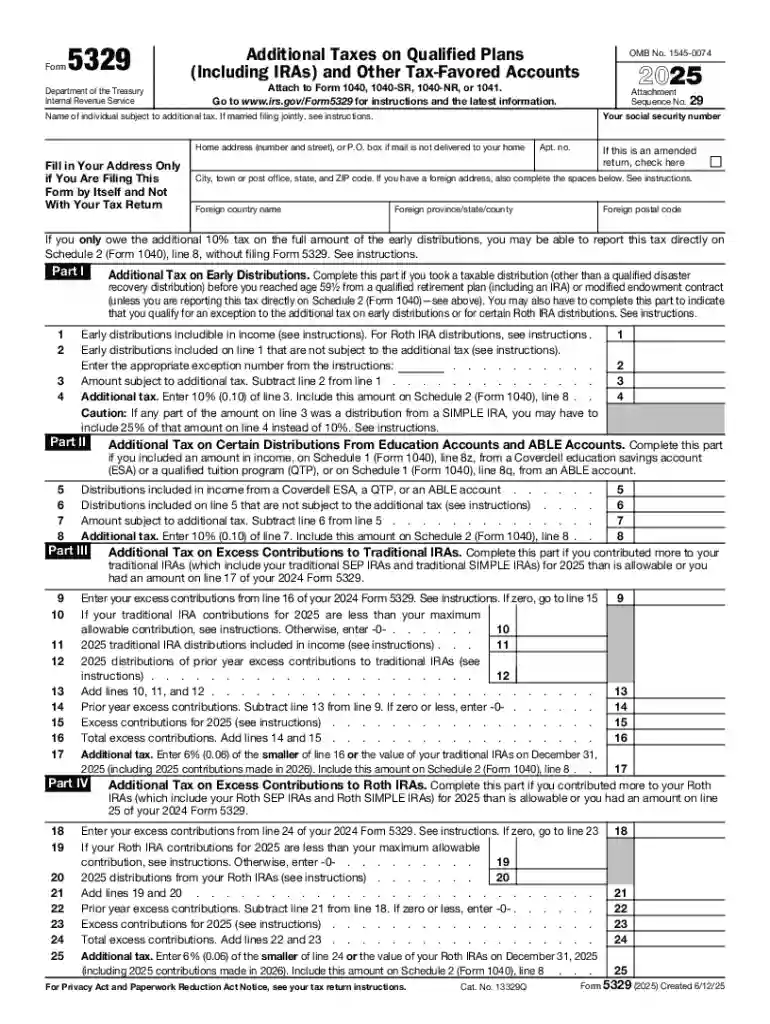
Form 5329, officially titled "Additional Taxes on Qualified Plans (Including IRAs) and Other Tax-Favored Accounts," is a tax document used by individuals who need to report additional taxes related to early distributions, late distributions, or excess contributions to qualified retirement plans and IRAs. It helps taxpayers calculate and declare penalty taxes associated with non-compliance with specific IRS retirement account rules.
If an individual takes an early distribution from their IRA without qualifying for an exception, they must use this form to report the 10% additional tax.
To acquire Form 5329, you can visit the official IRS website where it is available for download as a PDF. It can also be sourced from accounting software platforms like TurboTax or QuickBooks if you are using these for filing your taxes.
Ensure you are using the most current form version to avoid filing errors.
Completing Form 5329 requires attention to detail to ensure accurate reporting of additional taxes owed. Here's a breakdown of how to fill out this form:
Double-check calculations and exceptions to ensure compliance and avoid penalties.
Form 5329 is primarily used by individuals who have taken distributions from their retirement accounts that may incur additional taxes. This includes retirees, self-employed individuals with personal IRAs, and taxpayers who have made excess contributions to their retirement plans.
A 62-year-old retiree forgot to take their required distribution from a traditional IRA and uses Form 5329 to report the 50% penalty tax.
The form consists of multiple parts addressing various types of penalties:
Accurate entries in these sections are crucial for minimizing IRS penalties.
The IRS provides comprehensive instructions for Form 5329 to ensure taxpayers apply the correct tax rates, recognized exceptions, and codes for special conditions. Following these guidelines helps avoid inaccurate reporting.
If claiming an exception for certain medical expenses, ensure you are using the correct IRS code.
Form 5329 should be filed concurrently with your annual tax return, typically due by April 15th of the following year. Timely filing is critical to avoid additional penalties and interest charges.
Consult a tax advisor if you are unsure about deadlines or require an extension.
Failing to file Form 5329 when necessary can result in significant financial penalties. The form helps calculate taxes such as a 10% penalty for early withdrawals and can prevent the accumulation of additional fines and interest.
Regularly review your retirement account activities to ensure compliance with IRS regulations.
We've got more versions of the Form 5329 Additional Taxes on Qualified Plans (Including form. Select the right Form 5329 Additional Taxes on Qualified Plans (Including version from the list and start editing it straight away!
| Versions | Form popularity | Fillable & printable |
|---|---|---|
| 2025 | 4.1 Satisfied (50 Votes) | |
| 2024 | 4.3 Satisfied (24 Votes) | |
| 2023 | 4.6 Satisfied (52 Votes) | |
| 2022 | 4.3 Satisfied (54 Votes) | |
| 2021 | 4.9 Satisfied (41 Votes) | |
| 2020 | 4.3 Satisfied (76 Votes) | |
| 2019 | 4.4 Satisfied (768 Votes) | |
| 2018 | 4.1 Satisfied (62 Votes) | |
| 2017 | 4.4 Satisfied (180 Votes) | |
| 2016 | 4.4 Satisfied (1170 Votes) | |
| 2015 | 4 Satisfied (52 Votes) | |
| 2014 | 4 Satisfied (57 Votes) | |
| 2013 | 4.4 Satisfied (59 Votes) | |
| 2010 | 4 Satisfied (20 Votes) | |
| 2008 | 4.2 Satisfied (52 Votes) |
At DocHub, your data security is our priority. We follow HIPAA, SOC2, GDPR, and other standards, so you can work on your documents with confidence.

Aug 2, 2025 Use Form 5329 to report additional taxes on IRAs, other qualified retirement plans, modified endowment contracts, Coverdell ESAs, QTPs, Archer MSAs, or HSAs.Read more
Jan 26, 2017 5329. Additional Taxes on Qualified Plans (Including IRAs) and. Sch. E. Supplemental Income and Loss. Other Tax-Favored Accounts. Sch. F. ProfitRead more
Complete this part if a taxable distribution was made from your qualified retirement plan (including an IRA other than an education IRA), annuity contract, orRead more


