






Definition and Meaning
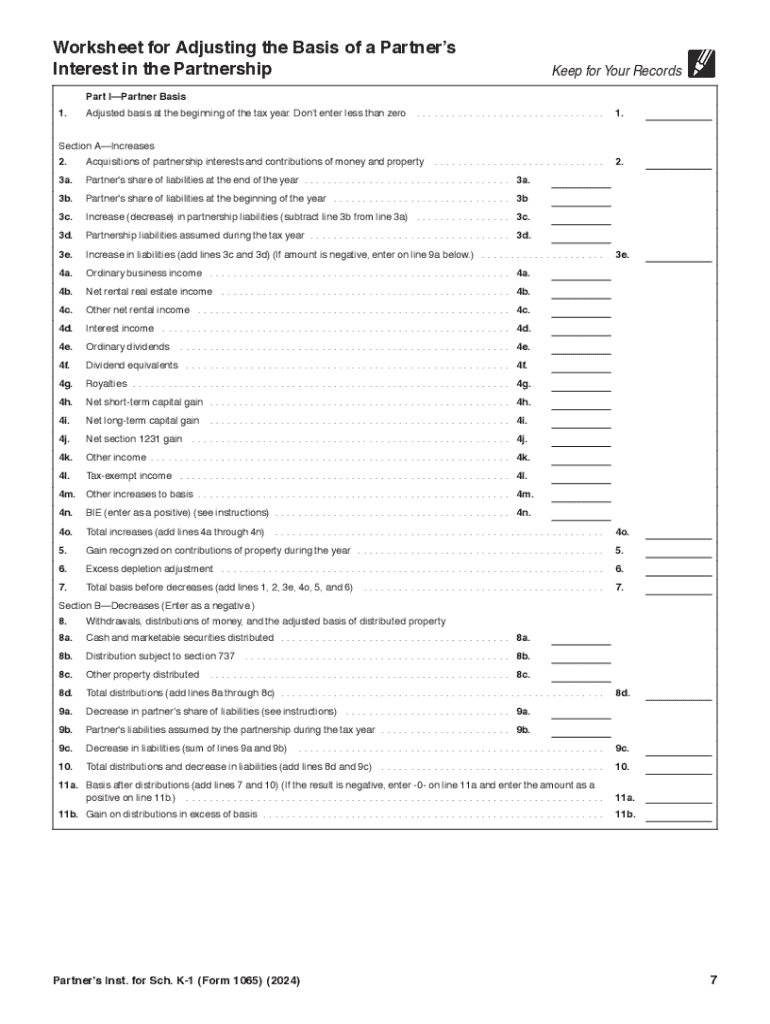
Schedule K-1 (Form 1065) is a crucial tax document used by partnerships to report each partner's share of income, deductions, credits, and other tax-related items. This form aids in transferring the financial activities and obligations from the partnership entity to the individual partners, as partnerships themselves do not directly pay taxes. Instead, partners are taxed on their share of the income, making this form a vital component for accurate individual tax filings.
Importance in Tax Reporting
- Pass-through Taxation: Since partnerships are not taxed as separate entities, the Schedule K-1 distributes earnings among partners for taxation on their personal returns.
- Annual Requirement: This form must be completed annually, providing a consistent method for handling partnership earnings and losses.
- Transparency and Accountability: Partners gain a clear view of their individual tax responsibilities within the partnership context.
How to Obtain Schedule K-1 (Form 1065)
To procure a Schedule K-1, partners typically receive this document from the partnership's managing members or accountants after tax calculations are finalized. It's important for partners to obtain their Schedule K-1 before the partnership's tax filing deadline to ensure timely personal tax filing.
Methods for Obtaining the Form
- Direct Distribution: Usually, managing partners distribute the completed forms to each partner.
- Professional Services: Many partnerships employ accountants or tax professionals who handle the preparation and distribution of Schedule K-1s.
- Online Access: Partnerships using tax software platforms often provide electronic access to these forms, simplifying retrieval for partners.
Steps to Complete the Schedule K-1 (Form 1065)
Completing the Schedule K-1 involves several detailed steps, generally performed by the partnership's accounting team or a hired professional. Accuracy is essential to ensure that each partner's tax obligations are correctly calculated and reported.
Detailed Steps
- Collect Financial Information: Gather all necessary financial details related to the partnership's operations during the tax year.
- Calculate Shares: Determine each partner's share of income, deductions, and credits based on their ownership percentage or specific agreement terms.
- Complete Form Sections: Fill in each section of the Schedule K-1, detailing the partner's share of distributions and tax items.
- Review and Distribute: Review the completed form for accuracy, then distribute copies to partners and submit to the IRS.
Who Typically Uses Schedule K-1 (Form 1065)
Schedule K-1 is most commonly used by individuals involved in partnerships, ranging from small business owners to larger partnership arrangements. Understanding who uses this form helps in planning tax strategies and ensuring compliance with reporting requirements.
Types of Users
- Partners in LLCs and LLPs: Members of limited liability companies or partnerships use K-1s for personal tax filings.
- Investors in Partnerships: Individuals actively investing in partnership arrangements, such as real estate or business capital ventures.
- Limited Partners: Those with a more passive role in partnerships, relying primarily on K-1s for accurate income reporting on personal taxes.
Key Elements of Schedule K-1 (Form 1065)
Understanding the major components of Schedule K-1 helps partners know what tax data they can expect and need to report on their personal returns.
Major Components
- Income: Reflects different types of income such as ordinary business income or rental income.
- Deductions: Includes deductible expenses allocated among partners.
- Credits: Any tax credits applicable to the partnership are detailed here.
- Additional Schedules: May include information on foreign transactions, self-employment earnings, or alternative minimum tax items.
IRS Guidelines for Schedule K-1 (Form 1065)
Adhering to IRS guidelines is critical to prevent inaccuracies and avoid penalties. Keeping up to date with IRS rules ensures compliance and smooth processing of tax returns.
Key Guidelines
- Timely Submission: K-1 forms must be ready by the partnership's filing deadline, often aligning with March 15 for calendar-year entities.
- Accuracy and Updates: Any changes to partner allocations or partnership agreements must be promptly reflected.
- Filing with Returns: Partners need to attach copies of the Schedule K-1 to their personal tax returns.
Filing Deadlines and Important Dates
Timely filing is essential to avoid penalties. Understanding key dates for Schedule K-1 ensures partners can prepare accordingly and meet all necessary deadlines.
Important Deadlines
- Partnership Filing Deadline: Generally due on March 15, or the 15th day of the third month following the end of the partnership’s fiscal year.
- Partner Filing Deadline: Personal tax returns, including the Schedule K-1, are due by April 15.
Required Documents for Schedule K-1 (Form 1065)
Accurate completion of Schedule K-1 necessitates the collection and organization of certain documents, ensuring a seamless tax reporting process.
Necessary Documents
- Partnership Agreement: Used to verify the allocation of income, deductions, and credits.
- Financial Statements: Includes year-end balance sheets and income statements for precise reporting.
- Previous Tax Returns: Necessary for referencing prior allocations and identifying any carryover items.
Each of these aspects ensures that partners are adequately prepared for tax season, have comprehensive knowledge of their finances, and can appropriately utilize the Schedule K-1 for individual tax purposes.