




01. Edit your form online
Type text, add images, blackout confidential details, add comments, highlights and more.

Type text, add images, blackout confidential details, add comments, highlights and more.

Draw your signature, type it, upload its image, or use your mobile device as a signature pad.

Send it via email, link, or fax. You can also download it, export it or print it out.
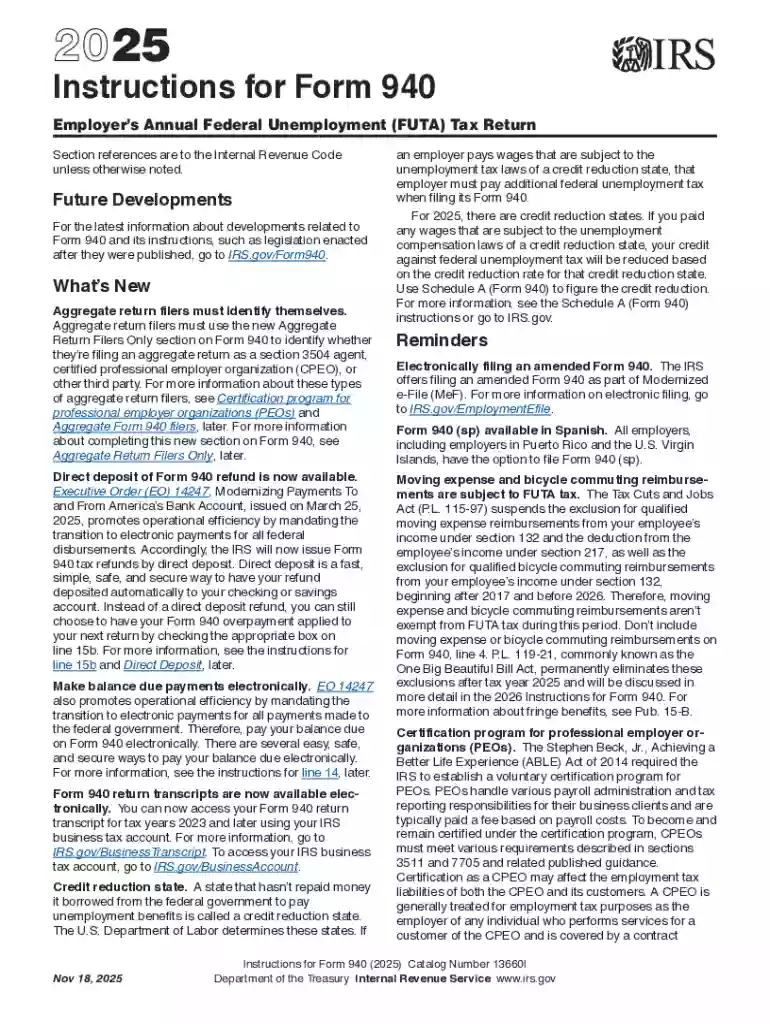
Understanding the 2025 Instructions for Form 940, Employers Annual Federal Unemployment (FUTA) Tax Return, is vital for employers managing unemployment tax responsibilities in the U.S. The Federal Unemployment Tax Act (FUTA) requires employers to pay unemployment taxes on wages paid to employees, which supports the federal unemployment trust fund.
Form 940 is used to report annual Federal Unemployment Tax Act (FUTA) tax. Employers need to understand various components:
Employers should follow these precise steps to ensure accurate filing:
Employers can file the 2025 Form 940 via:
Employers generally required to file Form 940 are those that:


To complete Form 940, employers must have:
The due date for Form 940 is January 31st each year. If employers have deposited all FUTA taxes when due, they have until February 10th to file.
Complying with IRS Form 940 guidelines requires:
Form 940 serves as an essential legal document for:
Understanding potential variations and updates for 2025 is critical:
Each state may have unique unemployment tax rules affecting:
While virtually all businesses handling payroll must comply with FUTA regulations, these entities benefit significantly from understanding Form 940:
By delving into these aspects, employers can confidently manage their unemployment tax responsibilities, ensuring compliance and avoiding penalties.
We've got more versions of the 2025 Instructions for Form 940 Instructions for Form 940, Employers Annual Federal Unemployment (FUT form. Select the right 2025 Instructions for Form 940 Instructions for Form 940, Employers Annual Federal Unemployment (FUT version from the list and start editing it straight away!
| Versions | Form popularity | Fillable & printable |
|---|---|---|
| 2025 | 4.7 Satisfied (38 Votes) | |
| 2024 | 4.6 Satisfied (24 Votes) | |
| 2023 | 4.2 Satisfied (33 Votes) | |
| 2022 | 4.1 Satisfied (34 Votes) | |
| 2021 | 4.9 Satisfied (26 Votes) | |
| 2020 | 4.4 Satisfied (156 Votes) | |
| 2019 | 4.3 Satisfied (257 Votes) | |
| 2018 | 4.2 Satisfied (89 Votes) | |
| 2017 | 4.4 Satisfied (197 Votes) | |
| 2016 | 4.4 Satisfied (416 Votes) | |
| 2015 | 4.2 Satisfied (84 Votes) | |
| 2011 | 4.4 Satisfied (261 Votes) | |
| 1997 | 4 Satisfied (24 Votes) |
At DocHub, your data security is our priority. We follow HIPAA, SOC2, GDPR, and other standards, so you can work on your documents with confidence.



In accordance with OCGA 36-81-6 and the duties and responsibilities of the County Manager, I am pleased to present to you the proposed budget for LowndesRead more
Nov 14, 2019 This Annual Report on Form 10-K contains forward-looking statements within the meaning of the U.S. Private Securities Litigation Reform Act ofRead more
Use Form 940 to report your annual Federal Unemployment Tax Act (FUTA) tax. Together with state unemployment tax systems, the FUTA tax provides funds for payingRead more


