






Definition and Meaning
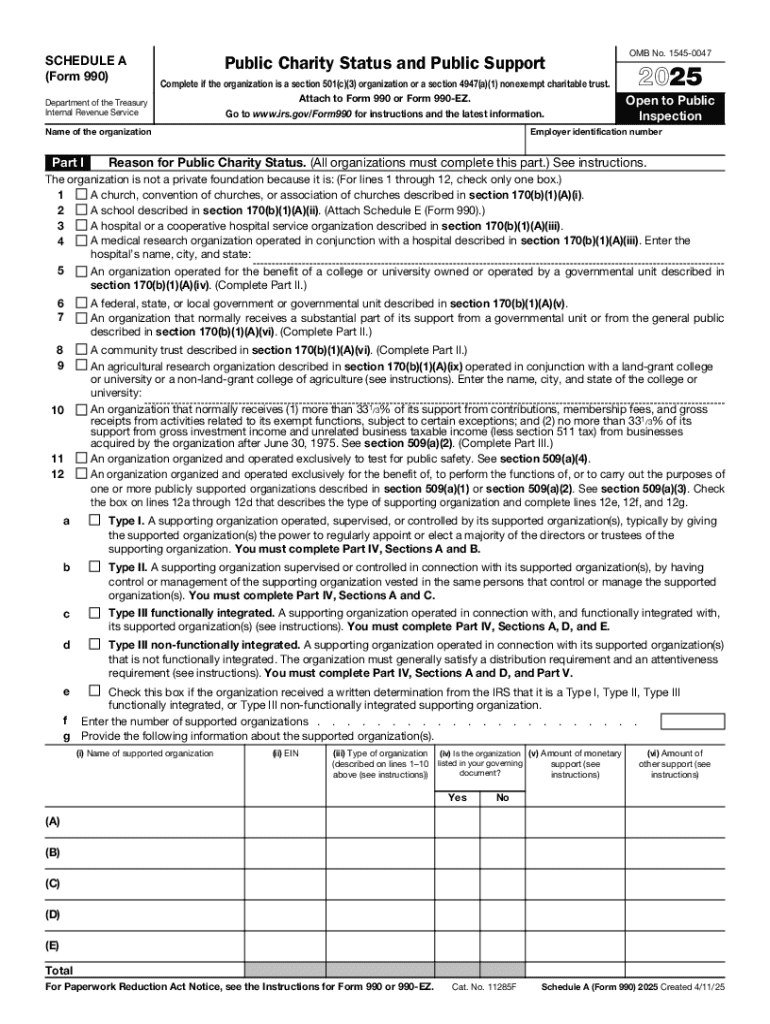
The Tax Brief: Form 990, Schedule A: Public Charity Status is a supplementary document required by some nonprofit organizations in the United States. It provides detailed information about the organization's status as a public charity, including its financial backing, mission, and adherence to specific IRS codes. This schedule is used to determine whether an organization is compliant with the regulations governing public charities as defined under section 501(c)(3) and section 4947(a)(1) of the Internal Revenue Code.
Important Terminology
- Public Charity: A nonprofit that receives broad support from the public, government, or another charity.
- Section 501(c)(3): Specifies the tax-exempt status of charities, religious, educational, and other organizations.
- Section 4947(a)(1): Relates to nonexempt charitable trusts treated as private foundations for tax purposes.
Key Elements of the Tax Brief: Form 990, Schedule A
Schedule A is divided into several parts, each focusing on different aspects of the public charity status:
- Part I: Requires organizations to state their current public charity classification.
- Part II: Collects information for organizations described in sections 170(b)(1)(A)(iv) and 170(b)(1)(A)(vi).
- Part III: Inquires about organizations supported by a governmental unit.
- Part IV: Involves undistributed income and certain private foundation rules.
- Part V: Pertains to organizations receiving a substantial portion of support from a governmental unit or the general public.
Steps to Complete the Tax Brief: Form 990, Schedule A
- Gather Required Information: Ensure you have the organizational documents, financial records, and prior tax filings.
- Review Guidance: Refer to the IRS instructions for Schedule A to understand the specific requirements.
- Complete Each Section: Fill out each part as applicable to your organization.
- Note: Parts I through XI may not apply to all organizations. Only complete relevant sections.
- Verify Financial Information: Double-check the financial data reported, as inaccuracies can lead to compliance issues.
- Consult a Tax Professional: Consider seeking advice from a CPA or tax advisor to avoid errors.
Who Typically Uses the Tax Brief: Form 990, Schedule A: Public Charity Status
Organizations that are categorized as public charities often use Schedule A to ensure compliance with IRS regulations. This includes:
- Religious institutions
- Educational entities
- Medical research organizations
- Entities receiving a major portion of their support from public contributions


IRS Guidelines
The IRS provides specific guidance on how to fill out Schedule A accurately:
- Ensure all reported figures align with those in your main Form 990.
- Report significant fundraising activities and their compliance with public charity status.
- Adhere to any changed reporting requirements if your organization's financial situation has evolved.
Filing Deadlines and Important Dates
- Annual Filing Deadline: Typically due the 15th day of the 5th month after the accounting period ends (usually May 15 for calendar-year filers).
- Extensions: If an organization requires more time, it may file for an extension using Form 8868.
Penalties for Non-Compliance
Failing to file Schedule A when required, or providing inaccurate information, can result in penalties:
- Monetary Penalties: The IRS may impose fines for late or incomplete submissions.
- Loss of Tax-Exempt Status: Repeated failures can jeopardize an organization’s 501(c)(3) status.
Digital vs. Paper Version
Organizations have the option to file electronically or via paper:
- Electronic Filing: Offers a streamlined process and reduces the chance for errors.
- Paper Filing: May be necessary for small organizations with limited digital capabilities.
Software Compatibility
Nonprofit entities often use software like TurboTax or QuickBooks to prepare their tax forms, including Schedule A:
- TurboTax: While primarily for individuals, it has editions for nonprofits.
- QuickBooks: Offers financial management with tax form options for nonprofits.
Conclusion
This comprehensive coverage of the Tax Brief: Form 990, Schedule A aims to provide nonprofits with a deep understanding of all requisites tied to maintaining their public charity status. Ensuring compliance with IRS regulations helps preserve tax exemptions and fosters trust with donors and the public.