







Definition and Meaning of Schedule K-1 (Form 1041) GuideTrust and Estate Income Tax
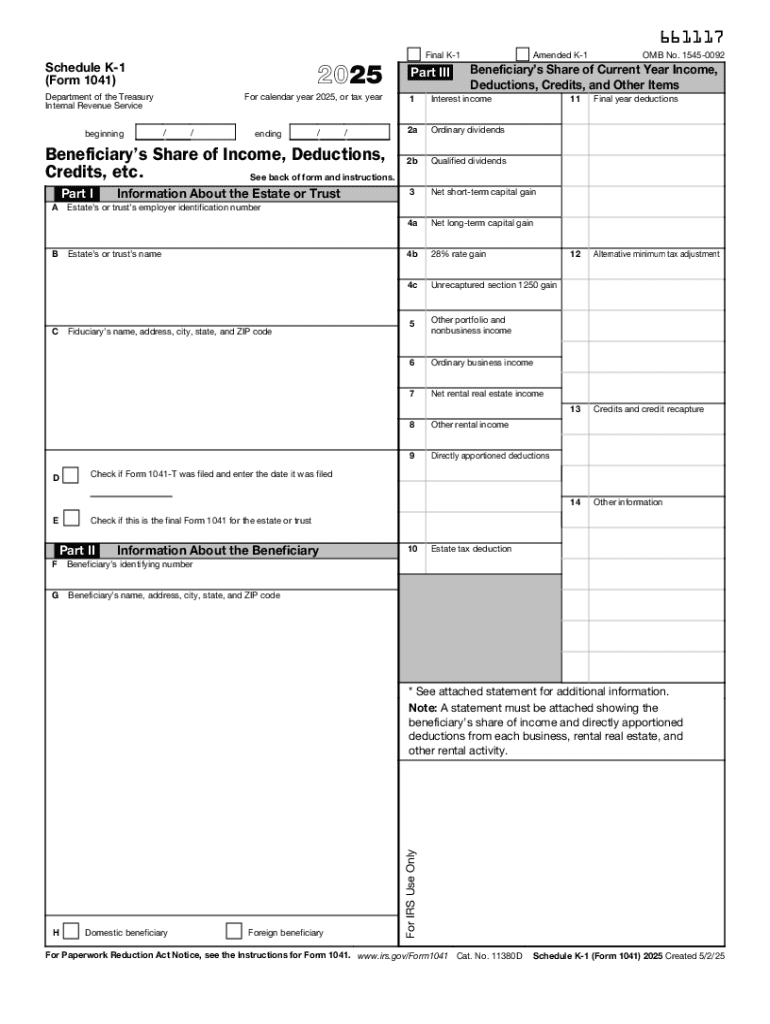
Schedule K-1 (Form 1041) is a tax document used in the United States to report income, deductions, credits, and other financial details from trusts and estates to beneficiaries. This form is an integral part of the tax reporting process for estates and trusts, ensuring that income and deductions are correctly allocated to individuals who have a financial stake in these entities. The Internal Revenue Service (IRS) mandates the use of this form to provide transparency and accountability, allowing beneficiaries to report their share of the income on their personal tax returns.
Key Components of Schedule K-1 (Form 1041)
- Income Allocation: Details the income derived from various sources like interest, dividends, and capital gains.
- Deductions and Credits: Includes information on deductions that can reduce taxable income and credits that directly reduce tax liability.
- Other Items: Covers other financial elements such as alternative minimum tax adjustments and foreign tax credits.
How to Use the Schedule K-1 (Form 1041) GuideTrust and Estate Income Tax
Understanding how to utilize Schedule K-1 effectively involves recognizing how the form interacts with individual tax responsibilities. Beneficiaries use the information provided on Schedule K-1 to complete their own tax returns, typically Form 1040.
Steps for Using Schedule K-1 in Tax Returns
- Review Income Sections: Verify that the income allocations from the trust or estate are accurately reported.
- Check Deductions and Credits: Ensure that deductions and credits applicable to your share are correctly included.
- Report on Form 1040: Transpose figures from Schedule K-1 to the appropriate sections of Form 1040.
Real-World Example
A beneficiary receives a K-1 showing $5,000 in dividend income and $500 in deductible interest expenses. The beneficiary reports these figures on their individual tax return to properly account for their share of the estate’s taxable events.
Steps to Complete the Schedule K-1 (Form 1041) GuideTrust and Estate Income Tax
Filing Schedule K-1 requires precise completion to ensure accurate reporting and compliance with IRS regulations. Executors or trustees of estates and trusts must accurately complete this form for each beneficiary.
Step-by-Step Process
- Gather Essential Information: Collect details regarding the estate's income, deductions, credits, and distributions.
- Complete Income Section: Carefully allocate income items to beneficiaries according to the trust agreement.
- Fill Out Deductions and Credits: Input relevant deductions and credits that apply to each beneficiary.
- Review and Finalize: Verify calculations, ensuring all data corresponds to the estate's or trust's financial records.
Detailed Example
For a trust with three beneficiaries, the trustee must ensure each K-1 reflects the correct percentage of income and deductions distributed according to their share in the trust.
Important Terms Related to Schedule K-1 (Form 1041) GuideTrust and Estate Income Tax
Understanding specific terms associated with Schedule K-1 can aid in its accurate completion. These terms are not only vital for filling out the form but also for beneficiaries interpreting the information.
Key Terms
- Beneficiary: An individual or entity entitled to receive distributions from a trust or estate.
- Principal (Corpus): The original assets and contributions held in the trust or estate, separate from generated income.
- Distributable Net Income (DNI): Calculation that defines the amount of income that beneficiaries may need to report on their individual tax returns.
- Allocation: The method of assigning income, deductions, and credits to beneficiaries.
Practical Scenario
A trust provides that income be apportioned according to each beneficiary’s stake; thus, understanding the term "allocation" ensures proper financial reporting.
Filing Deadlines and Important Dates for Schedule K-1 (Form 1041)
Adhering to IRS deadlines is critical to avoid penalties and ensure timely tax filing. The Schedule K-1 form is a part of Form 1041, which has specific submission dates.
Key Deadlines
- Form 1041 Deadline: Typically due April 15th of the year following the tax year, or the next business day if it falls on a weekend or holiday.
- Extension Filing: Extensions can push the deadline to as late as October 15th.
Considerations
Trustees should provide beneficiaries with their K-1 forms as soon as possible, allowing sufficient time to complete individual tax returns.
Legal Use of Schedule K-1 (Form 1041) GuideTrust and Estate Income Tax
Schedule K-1 must be used in accordance with specific legal guidelines that ensure transparent and legally compliant distribution of trust or estate income.
Compliance Requirements
- Accurate Reporting: The precise reflection of income and deductions as per the trust agreement.
- IRS Compliance: Adheres to tax codes and requirements for estates and trusts.
- Confidentiality and Security: Protects sensitive financial information in the distribution process.
Legal Implications
Failing to utilize Schedule K-1 correctly can lead to legal challenges, penalties, and potential audits, underscoring the necessity of accurate completion.
Who Typically Uses Schedule K-1 (Form 1041) GuideTrust and Estate Income Tax
Understanding the typical users of Schedule K-1 can provide context and clarify who needs to be conversant with this form.
Typical Users
- Estate and Trust Beneficiaries: Individuals and entities receiving distributions from an estate or trust.
- Executors and Trustees: Individuals responsible for managing the trust or estate and ensuring compliance with tax regulations.
- Tax Professionals and Advisors: Provide expertise in completing and interpreting Schedule K-1.
Scenario Illustration
Retirees receiving income from a family trust will use the Schedule K-1 to report income on their tax returns.
IRS Guidelines for Schedule K-1 (Form 1041) GuideTrust and Estate Income Tax
The IRS provides specific guidelines on how Schedule K-1 should be utilized within the larger context of Form 1041 filings.
IRS Instructions
- Form Completion: Must reflect financial distributions as defined by the governing instrument of the trust or estate.
- Beneficiary Reporting: Facilitates accurate reporting by beneficiaries on their individual tax returns.
- Updates and Revisions: IRS periodically updates guidelines, affecting how trustees and beneficiaries interpret and apply the form.
Regulatory Context
Remain aware of any changes in tax laws that may influence the use and requirements of Schedule K-1, ensuring ongoing compliance.




