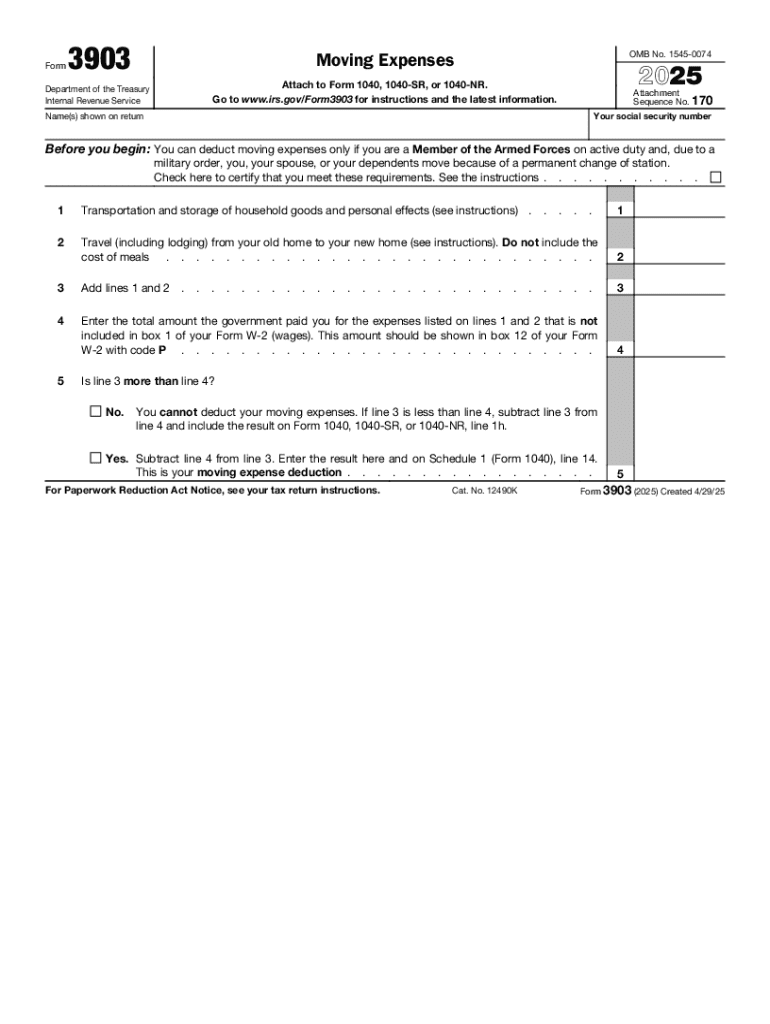







Definition & Purpose of Form 3903
Form 3903, known as the "Moving Expenses" form, is used by active duty members of the Armed Forces to report moving expenses incurred due to a permanent change of station (PCS). This form allows these individuals to deduct eligible moving expenses on their federal tax return, specifically using Form 1040. The main categories of expenses that qualify include the transportation and storage of household goods and personal effects, as well as travel costs associated with the move.
Eligible Expenses
To utilize Form 3903 effectively, it is important to understand which expenses are deductible:
- Transportation costs for moving household goods and personal belongings.
- Storage expenses for these items, strictly related to the move.
- Travel costs incurred while en route to the new station, which may cover personal vehicle expenses or airplane tickets for the taxpayer and their family.
Ineligible Expenses
Certain expenses cannot be deducted using Form 3903:
- Costs related to breaking a lease.
- Temporary lodging while awaiting housing at the new station.
- House hunting trips before the move.
Steps to Complete Form 3903
Gathering Information
- Collect Receipts: Gather all receipts and documents related to moving expenses.
- Verify Eligibility: Ensure all costs align with IRS guidelines on deductible expenses for moving.
Completing the Form
-
Part I: Moving Expense Deductions
- Line 1: Total transportation and storage expenses.
- Line 2: Travel costs during the move.
- Line 3: Total these values for your moving expense deduction.
-
Part II: Reimbursement
- If you received any reimbursement, state the amount to adjust your deduction.
Filing with Form 1040
Once the form is complete, transfer the total deduction amount from Form 3903 to the appropriate section on Form 1040. Attach Form 3903 with your tax return filing.
Eligibility Criteria for Using Form 3903
To file Form 3903, specific eligibility requirements must be met:
- Military Status: Only active duty Armed Forces members are eligible due to PCS orders.
- Move Distance: The move must be related to a change in duty station.
- Timing: Expenses must be closely related in time to the start of your new duty assignment.


IRS Guidelines
The IRS provides specific guidelines and instructions for filing Form 3903:
- Deductible Limits: Ensure claimed expenses adhere to the guidelines for transportation and storage.
- Documentation: Maintain thorough documentation for all claimed expenses for audit purposes.
Exceptions and Nuances
Situations where additional clarification might be needed include:
- Reimbursements: How reimbursements from the government or the military impact your deduction claim.
- Partial Moves: Deductibility for moves partially reimbursed by the military.
Form Submission Methods
You can submit Form 3903 in multiple ways:
- E-filing: Attach within your electronic IRS filing system if using tax software.
- Mail: Physically attach it to your Form 1040 if filing via mail.
Integration with Tax Software
Form 3903 is compatible with popular tax filing software such as TurboTax and QuickBooks. These platforms often provide additional guidance and checks to ensure the accuracy of your deduction entries.
Potential Penalties for Non-Compliance
Failure to comply with IRS rules regarding Form 3903 can lead to:
- Denied Deductions: Incorrect claims may result in denied deductions.
- Audits and Penalties: Inaccurate reporting can lead to audits, additional taxes owed, and possible penalties.
Practical Scenarios
- An active duty member moves from one duty station to another, incurs eligible expenses, and correctly files Form 3903 to reduce taxable income.
- A member incorrectly claims non-deductible expenses, leading to an audit and financial penalties.
Digital vs. Paper Filing
While both digital and paper versions are available, electronic filing through approved software offers advantages in:
- Speed: Faster processing times and confirmation of receipt.
- Accuracy: Built-in checks and automatic calculations reduce errors.
Conclusion
Form 3903 provides significant tax relief for military personnel undergoing a permanent change of station by allowing them to deduct certain moving expenses. Ensuring eligibility, accurately completing the form, and adhering to IRS guidelines are critical steps for the successful filing of moving expense deductions. Compliance with the outlined process not only facilitates a smoother tax filing experience but also optimizes the financial benefits associated with military-related moves.