




01. Edit your form online
Type text, add images, blackout confidential details, add comments, highlights and more.

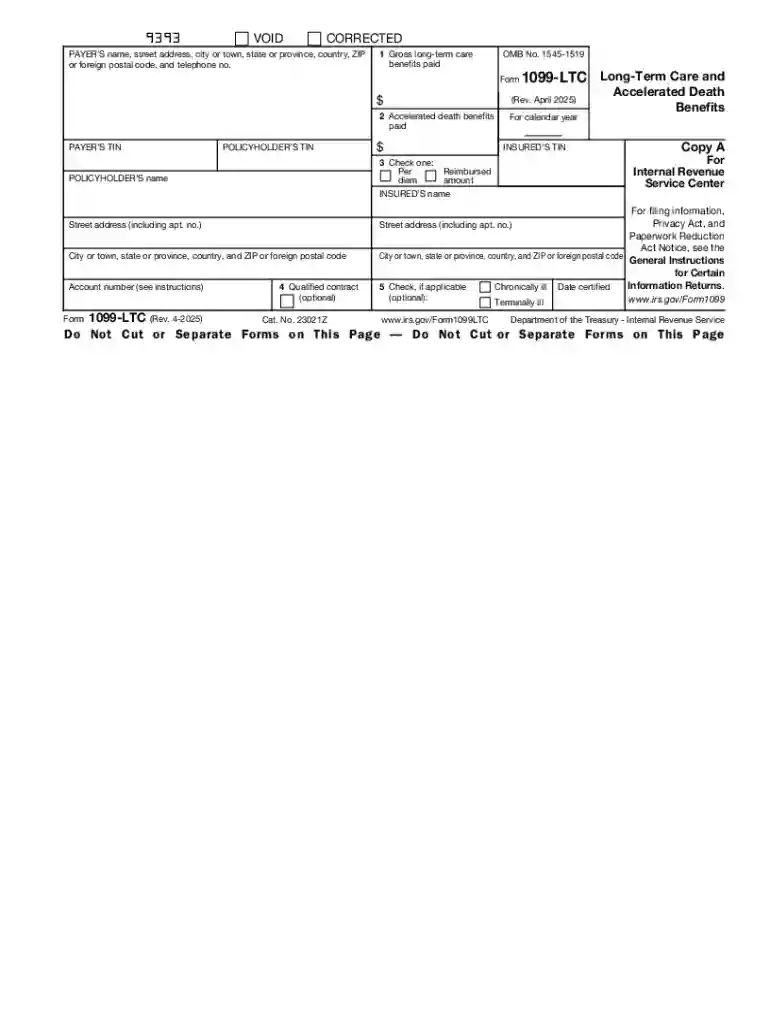
Type text, add images, blackout confidential details, add comments, highlights and more.

Draw your signature, type it, upload its image, or use your mobile device as a signature pad.

Send it via email, link, or fax. You can also download it, export it or print it out.
Form 1099-LTC is an IRS form used to report payments made under long-term care insurance contracts, as well as accelerated death benefits paid under life insurance contracts or viatical settlement agreements. The form serves to provide information on the distribution of these benefits to the IRS and the taxpayer, detailing the amount paid and the nature of the payments.
Form 1099-LTC includes several critical components:
Form 1099-LTC can typically be obtained from the insurance company or payer issuing the benefits. Most insurers automatically provide this form to both the policyholder and the IRS at the beginning of the tax year. It can also be accessed online through the IRS website for reference purposes.
IRS guidelines require that all issuers of long-term care and accelerated death benefits report these payments to both beneficiaries and the IRS using Form 1099-LTC. Taxpayers need to use this form to report any taxable benefits on their annual tax return. The IRS offers comprehensive instructions, and tax software can often assist in correctly reporting these forms.
To qualify for receiving a Form 1099-LTC, the beneficiary must have received payments due to a long-term care insurance contract or an accelerated death benefit. These payments are typically issued under specific circumstances, such as chronic illness or terminal conditions, which make the policyholder eligible.


Failure to report payments detailed on Form 1099-LTC accurately can lead to IRS penalties. Incorrect reporting can trigger fines or audits, emphasizing the importance of meticulous record-keeping and adherence to IRS guidelines.
The payer must file Form 1099-LTC with the IRS and provide a copy to the beneficiary by January 31st of the year following the payment. Timely filing is crucial to avoid penalties and ensure proper inclusion in tax returns.
Suppose a person, Jane Doe, is the beneficiary of a long-term care insurance contract. During the year, Jane receives $50,000 in per diem benefits. Her insurer will issue Form 1099-LTC to both her and the IRS, detailing this payment. Jane may then need to determine her tax obligations, considering IRS exclusions for specific benefits.
Form 1099-LTC can be filed either digitally or via a paper version. Digital filing is often facilitated through various tax software platforms, offering convenience and efficiency. However, those who prefer or require paper submissions can still rely on traditional mail services.
At DocHub, your data security is our priority. We follow HIPAA, SOC2, GDPR, and other standards, so you can work on your documents with confidence.


Oct 13, 2011 An accelerated death benefit is any amount paid under a life. File Form 1099-LTC, Long-Term Care and Accelerated Death insurance contract for
Jun 5, 2025 File this form if you pay any long-term care benefits, including accelerated death benefits. Payers include insurance companies, governmental units, and
Feb 24, 2021 Indicate by check mark whether the Registrant is a large accelerated filer, an accelerated Short-term obligations and current maturities of


