




01. Edit your form online
Type text, add images, blackout confidential details, add comments, highlights and more.

Type text, add images, blackout confidential details, add comments, highlights and more.

Draw your signature, type it, upload its image, or use your mobile device as a signature pad.

Send it via email, link, or fax. You can also download it, export it or print it out.
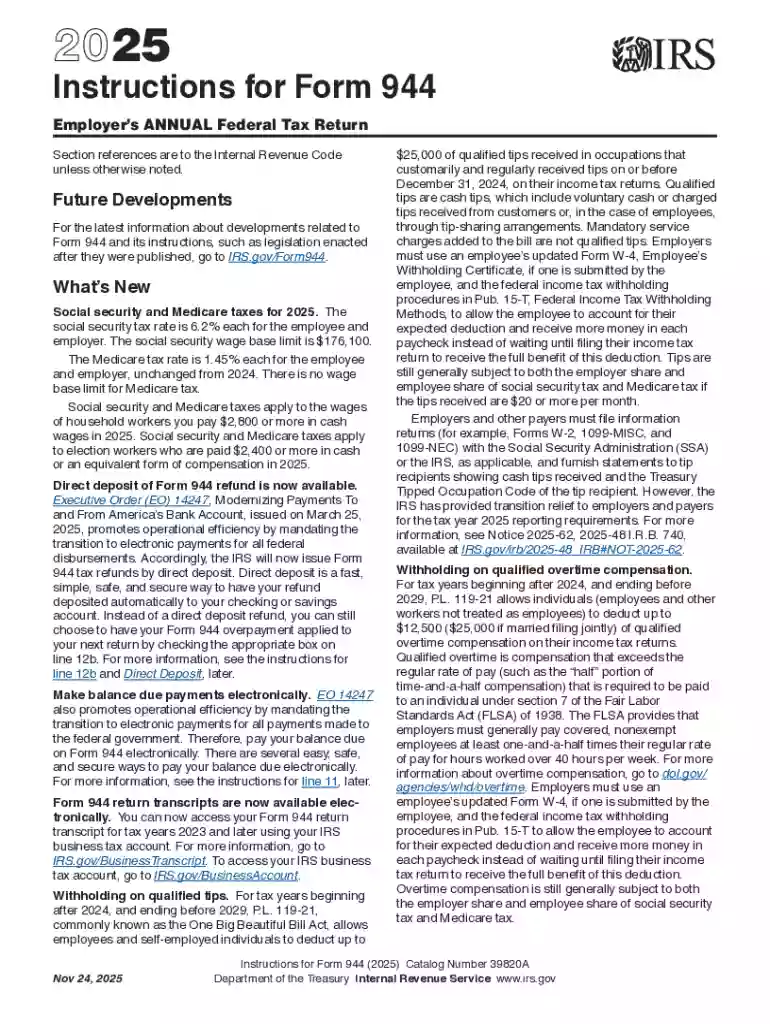
Form 944, known as the Employer's Annual Federal Tax Return, is designed for small employers to report federal income tax withheld and employer and employee shares of Social Security and Medicare taxes. Unlike Form 941, which is filed quarterly, Form 944 is filed annually. This annual filing is ideal for businesses that have a tax liability of one thousand dollars or less in a calendar year. By reducing the frequency of filings, the IRS aims to ease the administrative burden on small employers.
Eligibility to file Form 944 is determined by the IRS based on certain criteria including the amount of annual tax liability. Typically, employers with an annual employment tax liability of less than one thousand dollars qualify to use this form. It is essential for employers to receive a notification from the IRS that specifically directs them to file Form 944 instead of Form 941. If the business's tax responsibility increases, necessitating a switch back to quarterly filings, the business must contact the IRS to request this change.


The U.S. Internal Revenue Service requires Form 944 to be filed by January 31 of the following year. For example, the return for tax year 2025 is due by January 31, 2026. Employers should also schedule annual tax payments accordingly to avoid late fees or penalties. If mailing the form, ensure it is postmarked on or before this date.
Employers can submit Form 944 electronically or via mail. Electronic filing is often recommended as it is quicker and provides immediate confirmation of receipt by the IRS. Approved IRS e-file providers or tax software can be used to file electronically. If choosing to mail the document, ensure the correct IRS address is used as it varies based on the geographic location of the employer.
Failing to file Form 944 by the established deadline, or inaccurately reporting tax liabilities, may result in the imposition of penalties by the IRS. Late filing penalties are typically calculated as 5% of the unpaid tax for each month or part of a month that the return is late. The maximum penalty is 25% of the unpaid tax. Additionally, there are penalties for failing to deposit the owed taxes on time.
The IRS offers detailed instructions for filing Form 944, which include guidelines on reporting, paying, and rectifying taxes. Employers are encouraged to review IRS Publication 15 (Circular E), which offers further guidance on employment taxes. Understanding the nuances of these guidelines is crucial to ensure compliance and avoid any missteps in filing.
Apart from Form 944, businesses might encounter other variants such as Form 941 for quarterly employment tax reporting or Form 943 for agricultural employers. The correct form must align with the business's characteristics and the IRS's stipulations regarding tax liability and business type. The IRS makes necessary accommodations for businesses to switch forms if their tax liabilities change or if they no longer meet the criteria for Form 944.
Businesses that predominantly benefit from Form 944 include small employers who consistently meet the requirement of having an annual tax liability of one thousand dollars or less. These are often startups or small family-run businesses that have limited payroll processing needs. By filing annually, these businesses can reduce their administrative workload and focus more on their operations.
We've got more versions of the About Form 944, Employer's Annual Federal Tax Return form. Select the right About Form 944, Employer's Annual Federal Tax Return version from the list and start editing it straight away!
| Versions | Form popularity | Fillable & printable |
|---|---|---|
| 2025 | 4.5 Satisfied (21 Votes) | |
| 2024 | 4.8 Satisfied (51 Votes) | |
| 2023 | 4.2 Satisfied (26 Votes) | |
| 2022 | 4.9 Satisfied (27 Votes) | |
| 2021 | 4.9 Satisfied (42 Votes) | |
| 2020 | 4.4 Satisfied (130 Votes) | |
| 2019 | 4.4 Satisfied (100 Votes) | |
| 2018 | 4.4 Satisfied (91 Votes) | |
| 2017 | 3.8 Satisfied (27 Votes) | |
| 2016 | 4 Satisfied (47 Votes) | |
| 2015 | 4.4 Satisfied (218 Votes) | |
| 2011 | 4.3 Satisfied (128 Votes) |
At DocHub, your data security is our priority. We follow HIPAA, SOC2, GDPR, and other standards, so you can work on your documents with confidence.






Employers are responsible to ensure with Form 944. Lines 6b, 6c, 6d, 6e, and 6f will be deleted that tax returns are filed and deposits and payments are from
May 2, 2017 Use the 944 checkbox in box b of Form W-3 or Form W-3SS if you filed Form 944, Employers. ANNUAL Federal Tax Return. Also use the 944.
Sep 16, 2025 Form 944 is designed so the smallest employers (those whose annual liability for social security, Medicare, and withheld federal income


