




01. Edit your form online
Type text, add images, blackout confidential details, add comments, highlights and more.

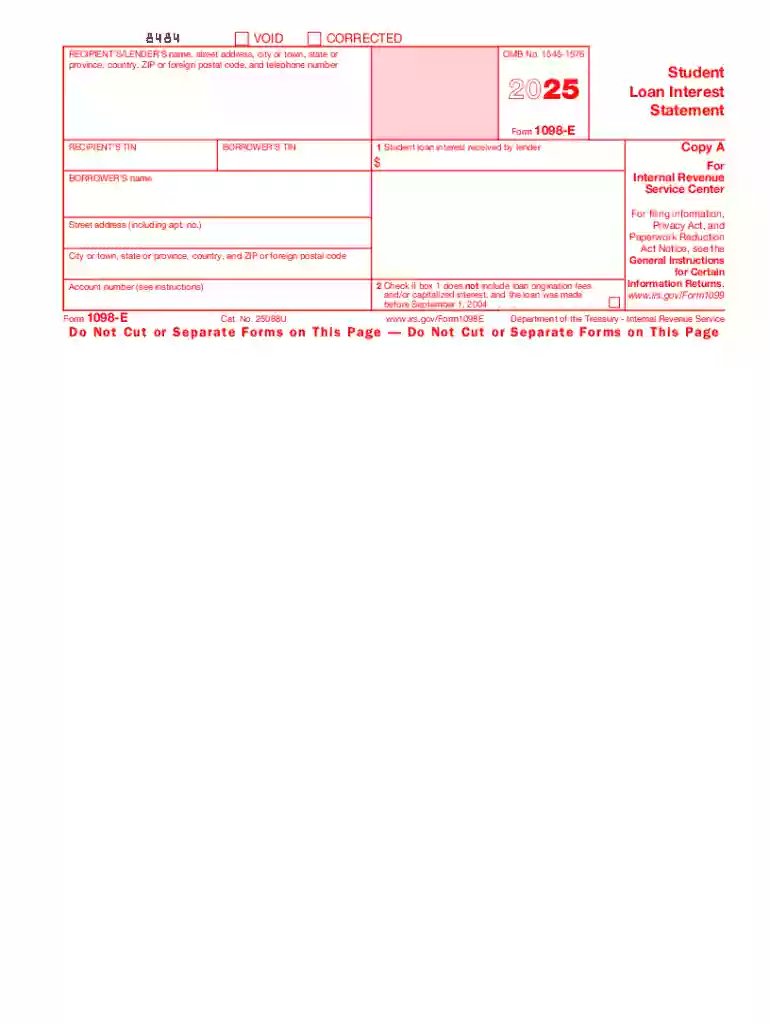
Type text, add images, blackout confidential details, add comments, highlights and more.

Draw your signature, type it, upload its image, or use your mobile device as a signature pad.

Send it via email, link, or fax. You can also download it, export it or print it out.
Form 1098-E, "Student Loan Interest Statement," is a tax document used by lenders to report the amount of student loan interest paid by borrowers throughout the year. This form is a crucial resource for borrowers seeking to claim a tax deduction for the interest paid on qualified student loans. The deduction helps reduce taxable income, potentially lowering the overall tax liability. Form 1098-E includes important details such as the lender's name and address, the borrower's name and address, and the total amount of interest paid. Understanding the specifics of Form 1098-E is essential for both borrowers and lenders to ensure accurate tax reporting and potential savings.
Borrowers use Form 1098-E primarily to calculate the student loan interest deduction on their federal tax returns. To claim this deduction, the borrower must itemize it on IRS Form 1040, Schedule 1. The deduction allows the borrower to deduct up to $2,500 of student loan interest paid, depending on income level and filing status. Properly utilizing this form can lead to significant tax savings, supporting borrowers in managing their educational debt.
Lenders typically issue Form 1098-E by January 31 of the year following the tax year in which interest was paid. Borrowers should receive the form electronically or by mail, depending on the lender's communication preference. If it is not received by this date, borrowers are encouraged to contact their lender directly to request a copy. Many lenders now provide digital access to Form 1098-E through online banking platforms or loan servicing portals.
Completion of Form 1098-E primarily involves receipt, verification, and inclusion of the reported information in your tax schedules. Since borrowers do not directly fill out this form, the process centers on accurate reporting.
Form 1098-E comprises several critical sections that borrowers need to understand:
Understanding these elements ensures borrowers can employ the form effectively to maximize their tax benefits.
The IRS provides specific instructions for both lenders and borrowers regarding Form 1098-E. Lenders must complete and furnish the form to borrowers and the IRS. Borrowers should follow IRS guidelines to accurately report their deductible interest on their tax returns.
Failing to adhere to Form 1098-E regulations can lead to penalties for lenders, such as fines for not issuing forms on time. Incorrect or incomplete reporting by borrowers may result in denied deductions or penalties for filing errors. Both parties must maintain accuracy to avoid potential issues with the IRS.
The digitization of tax forms has led to a choice between digital and paper versions of Form 1098-E. The digital version offers convenience and immediacy, while paper versions may suit those preferring traditional record-keeping.
Whether digital or paper, maintaining organized records of Form 1098-E remains a best practice for all borrowers.
We've got more versions of the Form 1098-e form. Select the right Form 1098-e version from the list and start editing it straight away!
| Versions | Form popularity | Fillable & printable |
|---|---|---|
| 2025 | 4.2 Satisfied (44 Votes) | |
| 2024 | 4.7 Satisfied (41 Votes) | |
| 2023 | 4.6 Satisfied (51 Votes) | |
| 2022 | 4.7 Satisfied (24 Votes) | |
| 2021 | 4.8 Satisfied (60 Votes) | |
| 2020 | 4.3 Satisfied (92 Votes) | |
| 2019 | 4.3 Satisfied (239 Votes) | |
| 2018 | 4.2 Satisfied (43 Votes) | |
| 2017 | 4.4 Satisfied (216 Votes) | |
| 2016 | 4.4 Satisfied (120 Votes) | |
| 2015 | 4 Satisfied (41 Votes) | |
| 2014 | 4 Satisfied (52 Votes) | |
| 2013 | 4 Satisfied (29 Votes) | |
| 2012 | 4.2 Satisfied (35 Votes) | |
| 2011 | 4.2 Satisfied (45 Votes) |
At DocHub, your data security is our priority. We follow HIPAA, SOC2, GDPR, and other standards, so you can work on your documents with confidence.





May 2, 2017 Severance payments are wages subject to social security and Medicare taxes. As noted in section 15 of Pub. 15 (Circular E), severance payments.
If an individuals interest payments met the $600 threshold, the 1098-E form will be provided by the student loan servicer (the entity processing the student
Jun 6, 2025 If you receive student loan interest of $600 or more from an individual during the year in the course of your trade or business: file this form,


