






Definition & Meaning
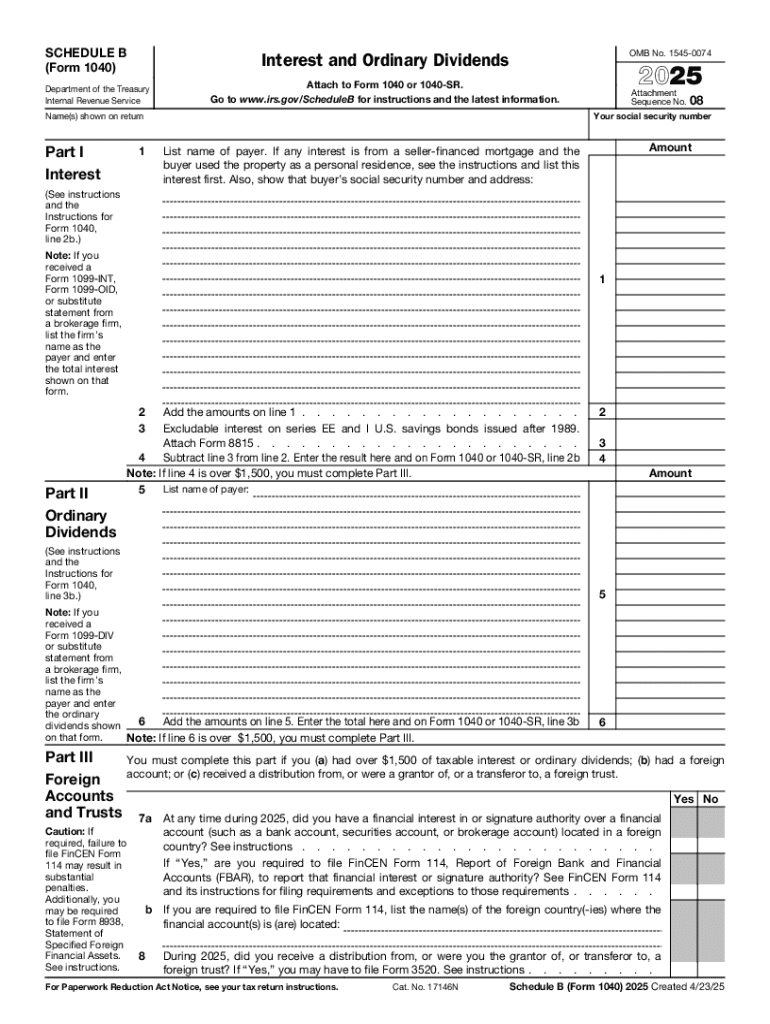
The 2025 Schedule B (Form 1040) is a supplementary tax document utilized for reporting interest and ordinary dividends received throughout the tax year. This schedule is an integral part of the Form 1040 or 1040-SR for taxpayers who exceed certain income thresholds from these sources. By using Schedule B, individuals provide detailed accounts of their interest income and dividends, helping to calculate the appropriate tax obligations on these earnings.
Interest Income
- Definition: Interest income refers to the earnings from investments such as savings accounts, bonds, or other fixed-income securities.
- Reporting Basis: Interest must be reported for the year it is constructively received, and taxpayers should include Form 1099-INT or similar documentation provided by the financial institutions.
Ordinary Dividends
- Explanation: Ordinary dividends are earnings distributed from a corporation’s profits. They do not include qualified dividends, which are taxed at a lower rate.
- Documentation: Typically, these are reported on Form 1099-DIV, providing necessary details such as the payer's name and the amount of dividend received.
How to Use the 2025 Schedule B (Form 1040) Interest and Ordinary Dividends
To correctly utilize Schedule B for the 2025 tax year, taxpayers must list all received interest and ordinary dividends exceeding certain thresholds. Ensuring that each source is accurately documented with any applicable forms, such as the 1099 series, is crucial to avoid misreporting.
- List Each Source: Organize each entity from which you've received interest or dividends.
- Detail the Amounts: Accurately record the amounts as specified on your supplementary tax forms.
- Account for Thresholds: Verify if additional forms, such as Form 8938, are necessary based on cumulative amounts and specific requirements for foreign assets or accounts.
Steps to Complete the 2025 Schedule B (Form 1040) Interest and Ordinary Dividends
- Gather Documentation: Collect all relevant forms like 1099-INT and 1099-DIV, ensuring they match your personal records.
- Enter Interest Income: Start with Part I, listing all entities and associated interest income.
- Account for ordinary dividends: Proceed to Part II, detailing ordinary dividends similarly.
- Review Foreign Accounts: If applicable, complete Part III to disclose interest in foreign accounts or trusts, ensuring compliance with IRS reporting requirements.
Detailed Considerations
- Multiple Sources: If the taxpayer has numerous sources, summarize additional entries on a separate sheet, but include the totals on Schedule B.
- Verification: Check calculations carefully to ensure accuracy before submission.
Who Typically Uses the 2025 Schedule B (Form 1040) Interest and Ordinary Dividends
Schedule B is most commonly used by individuals with notable interest and dividend income. This includes:
- Investors: Those holding multiple accounts or financial instruments yielding interest.
- Retirees: Individuals who rely on dividend income from pensions or investment portfolios.
- International Account Holders: Taxpayers with overseas bank accounts or investments needing compliance with U.S. tax regulations.


IRS Guidelines
The IRS provides detailed instructions accompanying the Schedule B form, specifying who must file it and highlighting any changes from prior years. These guidelines are instrumental for ensuring that taxpayers recognize their reporting obligations, especially concerning foreign financial interests and larger sums of interest or dividends.
- Updates: Monitor for any updates to thresholds or requirements annually.
- Resources: Utilize IRS publications and their official website for any clarifications needed.
Filing Deadlines / Important Dates
Key Deadlines
- Submission Deadline: Aligns with the standard tax filing cutoff, typically April 15 of the following year, unless an extension is granted.
- Extension Considerations: Taxpayers can request an extension, but all tax payments remain due by the original deadline to circumvent penalties.
Important Considerations
- Documentation Timing: Ensure all relevant forms (1099-INT, 1099-DIV) are received before initiating your tax filing.
- Early Preparation: Begin the process well in advance to address any discrepancies or missing information.
Required Documents
When preparing Schedule B, several key documents are necessary to ensure full compliance:
- Form 1099-INT: Details interest income from banks and other financial institutions.
- Form 1099-DIV: Summarizes dividend income from investments.
- Foreign Account Information: Additional documentation if foreign interests or trusts are involved.
Penalties for Non-Compliance
Non-compliance with reporting obligations for interest and dividend income can result in significant penalties. These may include:
- Underreporting Penalties: Failing to report all sources of income can lead to penalties based on the amount of unreported income.
- Fines for Foreign Account Non-Disclosure: Severe penalties apply for failing to disclose foreign accounts, potentially exceeding the value of the accounts themselves.
Mitigating Risks
- Regular Audits: Conduct periodic reviews of account statements and documentation to ensure compliance.
- Prompt Corrections: If errors are discovered post-filing, promptly amend through correct procedures to avoid extended penalties.