




01. Edit your form online
Type text, add images, blackout confidential details, add comments, highlights and more.

Type text, add images, blackout confidential details, add comments, highlights and more.

Draw your signature, type it, upload its image, or use your mobile device as a signature pad.

Send it via email, link, or fax. You can also download it, export it or print it out.
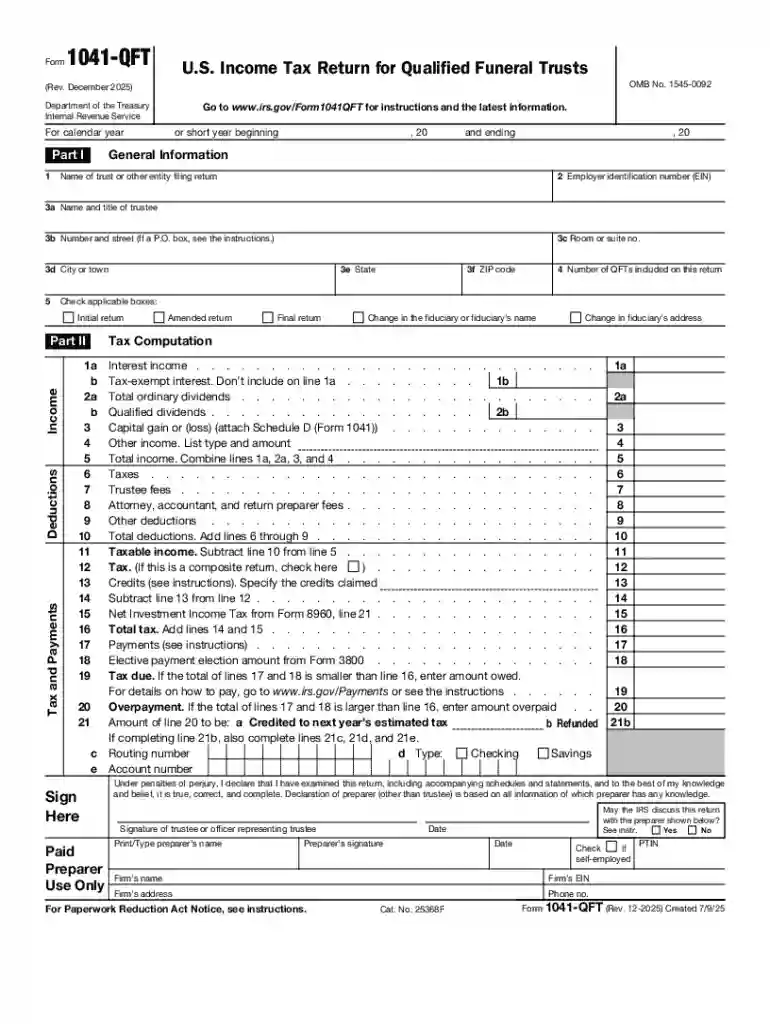
Form 1041-QFT (Rev December 2025) is the U.S. Income Tax Return for Qualified Funeral Trusts (QFTs), issued by the Internal Revenue Service (IRS). A QFT refers to a trust set up to manage funds specifically for funeral expenses, benefiting the trust's designated beneficiaries. The form serves as a tax return to report the income, deductions, tax computation, and payments connected to a QFT’s financial activities for a designated tax year. This means that trustees of qualified funeral trusts need to use this form to disclose financial information related to the management of the funeral trust, ensuring compliance with tax laws.
Filing Form 1041-QFT requires careful adherence to IRS guidelines to ensure accuracy and compliance. The process involves several steps:
Gather Necessary Information: Collect all relevant data, including the trust's EIN, financial records showing income and expenses, and beneficiary details.
Fill in General Information: Complete the preliminary sections with the QFT's name, address, Employer Identification Number (EIN), and the tax year.
Report Income: Document all income received by the trust, such as dividends, interest, and capital gains, on the respective lines as indicated in the form.
Deductions: List allowable deductions, including expenses directly related to the trust's administration. Ensure to differentiate between deductible and non-deductible expenses to avoid discrepancies.
Calculate Tax: Use the provided tax computation sections to determine the trust's taxable income and the associated tax liability.
Complete Payments and Credits: Note any payments made throughout the year, such as estimated tax payments, and apply credits where applicable to reduce tax liability.
Signing and Filing: Ensure the form is signed by the trustee managing the trust before submission. Retain a copy for internal records and compliance checks.
The primary users of Form 1041-QFT are trustees of Qualified Funeral Trusts. These individuals are responsible for managing funds allocated for funeral expenses, primarily set aside to ensure that beneficiaries do not bear the financial burden when funeral services are required. Typically, these trustees may include:
These users must possess detailed knowledge about trust administration and tax reporting to efficiently complete the form.


Form 1041-QFT is issued by the Internal Revenue Service (IRS), a U.S. government agency responsible for tax collection and enforcement. The IRS provides the most up-to-date forms, instructions, and guidelines regarding the completion and filing of the document. Taxpayers can access the form through the IRS website or request a physical copy through standard mail from IRS offices.
The deadline for filing Form 1041-QFT aligns with the U.S. tax return schedule:
Missing these deadlines may result in penalties and interest, emphasizing the importance of timely and accurate filing.
When preparing Form 1041-QFT, trustees need to gather several documents to ensure complete information:
Accurate documentation is critical to ensure compliance with IRS regulations and avoid potential audits.
Failure to comply with the IRS filing requirements for Form 1041-QFT can lead to several penalties:
These penalties highlight the necessity for trustees to maintain comprehensive and accurate records and adhere to filing deadlines.
To assist in the preparation and filing process, several tax software platforms support Form 1041-QFT:
Using compatible software can simplify data entry, reduce errors, and ensure compliance with tax regulations while easing the administrative burden of managing a QFT's tax affairs.
The IRS provides comprehensive guidelines within the instructions for Form 1041-QFT:
These guidelines are crucial for ensuring compliance and providing a roadmap for trustees who manage funeral trust finances.
We've got more versions of the Form 1041-QFT (Rev December 2025) U S Income Tax Return for Qualified Funeral Trusts form. Select the right Form 1041-QFT (Rev December 2025) U S Income Tax Return for Qualified Funeral Trusts version from the list and start editing it straight away!
| Versions | Form popularity | Fillable & printable |
|---|---|---|
| 2025 | 4.1 Satisfied (23 Votes) | |
| 2024 | 4.3 Satisfied (33 Votes) | |
| 2023 | 4.4 Satisfied (58 Votes) | |
| 2022 | 4.9 Satisfied (38 Votes) | |
| 2021 | 4.8 Satisfied (59 Votes) | |
| 2020 | 4.2 Satisfied (44 Votes) | |
| 2019 | 4.1 Satisfied (69 Votes) | |
| 2018 | 4.2 Satisfied (79 Votes) | |
| 2017 | 4.2 Satisfied (95 Votes) | |
| 2016 | 4.4 Satisfied (573 Votes) | |
| 2015 | 4.1 Satisfied (74 Votes) | |
| 2014 | 4 Satisfied (27 Votes) | |
| 2013 | 4 Satisfied (23 Votes) | |
| 2012 | 4.3 Satisfied (43 Votes) | |
| 2011 | 4 Satisfied (34 Votes) |
At DocHub, your data security is our priority. We follow HIPAA, SOC2, GDPR, and other standards, so you can work on your documents with confidence.



us with Thy presence upon this occasion, the opening of this grand lodge. In accordance with Thy law and the teachings of our ancient fra- ternity it is
Instructions for Form 1041-QFT, U.S. Income Tax Return for Qualified Funeral Trusts Revision Date Dec 2025, Posted Date 11/24/2025. Product Number Form


