






Definition & Meaning
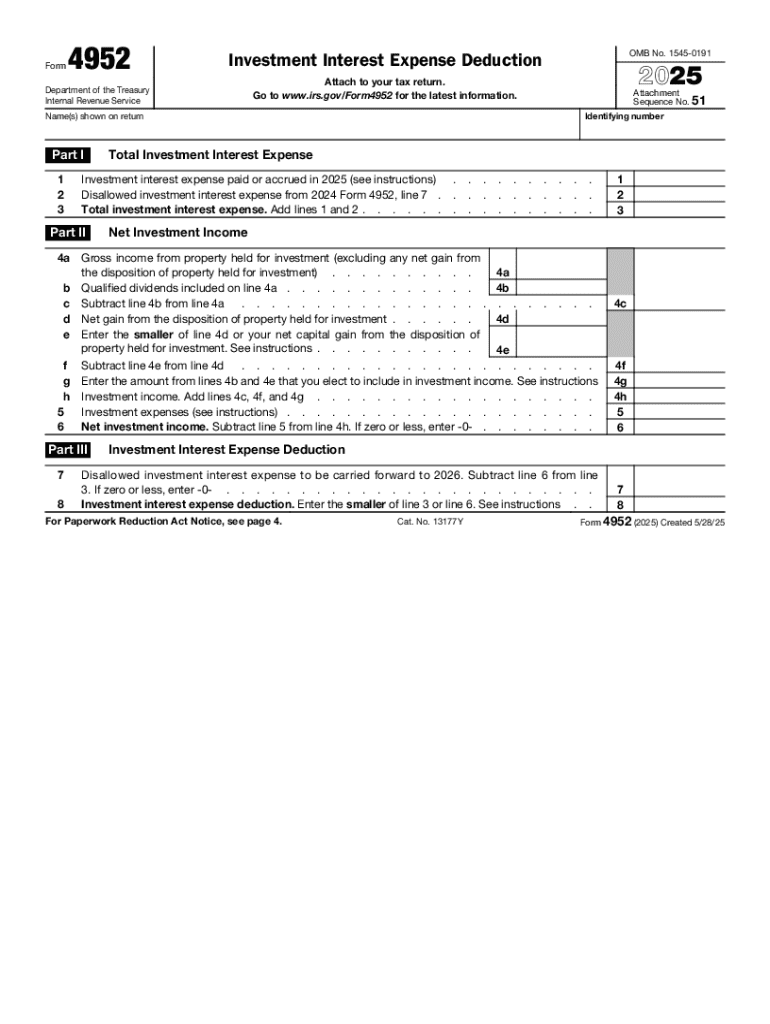
Form 4952, officially titled "Investment Interest Expense Deduction," is a tax document used by individuals, estates, and trusts to calculate and report their allowable investment interest expenses on their federal tax return. This form helps determine the amount of interest paid on loans used to purchase or carry investments that can be deducted from taxable income. The deduction can be crucial for investors seeking to lower their overall tax liability by offsetting income earned from investments. Properly filing Form 4952 ensures compliance with IRS regulations and helps optimize tax savings derived from investment activities.
Key Elements of Form 4952
Form 4952 is structured to systematically capture relevant details that influence the investment interest deduction. The key elements include:
- Investment Interest Expenses: A detailed calculation of all interest expenses tied to borrowing funds for investment purposes.
- Net Investment Income: This section accounts for gross income from taxable investment assets, reduced by any allowable expenses directly connected to producing such income.
- Carryover Rules: Provisions for carrying forward any disallowed investment interest expenses to future tax years.
Understanding these components is vital for accurately completing the form and maximizing allowable deductions under the IRS's guidelines.
How to Obtain the Form 4952
Form 4952 can be conveniently accessed from the IRS official website. It is available for download in PDF format, ensuring ease of use for electronic submissions or physical prints. Many contemporary tax preparation software platforms automatically generate Form 4952 for users, embedding it within their tax filing processes based on user-provided financial input, which simplifies the acquisition process.
Steps to Complete Form 4952
Filling out Form 4952 requires attention to detail and a comprehensive understanding of the filer’s investment activities:
- Calculate Total Investment Interest: Gather and sum up all interest payments made on loans used for investment purposes.
- Determine Net Investment Income: Assess total investment income, considering dividends, interest, and royalties, and subtract any related expenses.
- Apply Deduction Limits: Use net investment income figures to identify the maximum deductible amount.
- Complete Carryforward Section: Document any excess expenses that are eligible for future deductions if the current tax year’s limitation is reached.
These steps necessitate precise calculations along with appropriate documentation to ensure accuracy.
Examples of Using Form 4952
Consider an investor who incurs $10,000 in interest expenses from loans used to buy stocks. If the investor earns $8,000 in dividends and interest income, only $8,000 of the interest expenses can be deducted in the current year. The remaining $2,000 can be carried forward to future years. This exemplifies the practical application of Form 4952 in optimizing tax outcomes for varying investment income scenarios.
IRS Guidelines
The IRS provides specific instructions and guidelines to accompany Form 4952, which includes detailed information on eligible expenses, carryforward rules, and potential exceptions to filing requirements. Taxpayers must consult these guidelines to align their reporting with official regulations and to avoid penalties for non-compliance.
Filing Deadlines / Important Dates
Form 4952 should be filed as part of the standard annual tax return, typically due by April 15th for most individual taxpayers. Extensions may be available, but the form must still accompany any extended returns by the revised deadline. Adhering to these timelines is crucial to avoid late filing penalties and interest charges.
Eligibility Criteria
Eligibility for filing Form 4952 hinges on having incurred interest expenses linked to investments. Not all interest payments qualify, and the investment activity must align with generating taxable income. Furthermore, non-individual entities such as partnerships or non-grantor trusts cannot individually use this form; they must report relevant data on their respective tax returns.


Penalties for Non-Compliance
Failing to correctly file Form 4952 or misrepresenting information can result in penalties from the IRS. These penalties may include fines, disallowance of the claimed interest deductions, and additional scrutiny during audits. Proper documentation and adherence to IRS rules are critical preventive measures against penalties and interest charges.
Software Compatibility (TurboTax, QuickBooks, etc.)
Popular tax software solutions such as TurboTax, QuickBooks, and others offer support for Form 4952. These platforms facilitate data entry and calculation processes, ensuring accurate deductions, while reducing the complexity involved in manual preparation. Integration with financial data systems ensures seamless processing and minimizes room for error.
Business Types That Benefit Most
Business entities like LLCs, corporations, and partnerships operating in sectors with substantial investment activities can significantly benefit from Form 4952. It effectively allows these entities to manage their interest expense-related tax liabilities, fostering enhanced financial planning strategies and improved cash flow management.