






Definition & Meaning
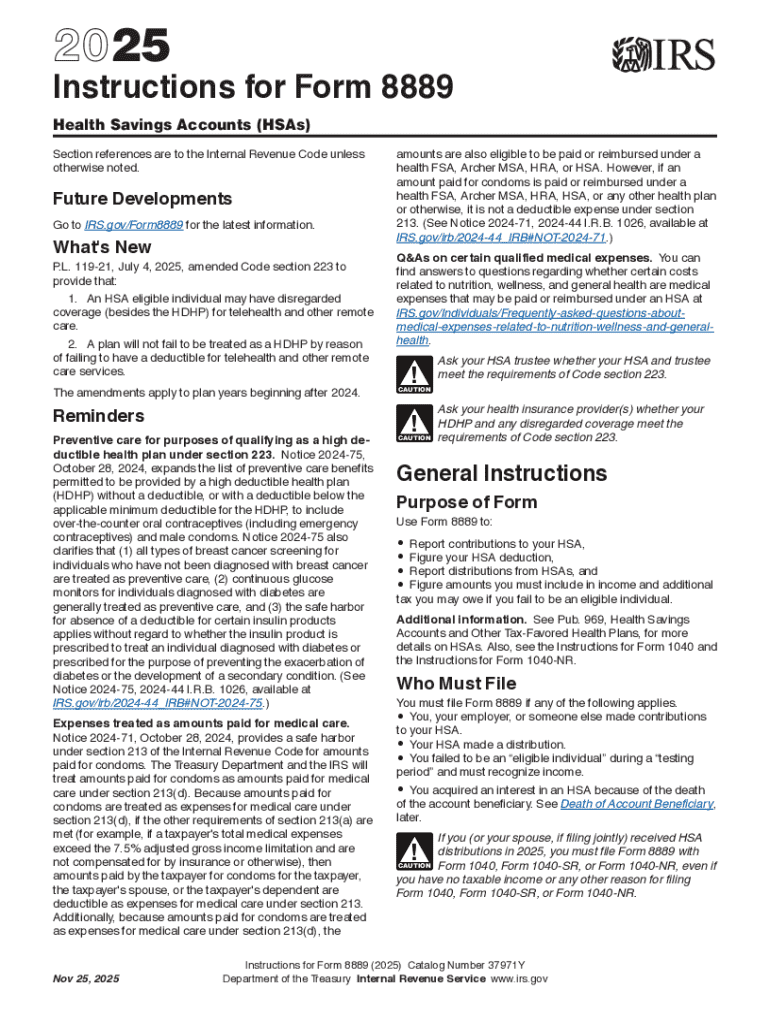
Form 8889 is used by taxpayers in the United States to report contributions to and distributions from Health Savings Accounts (HSAs) for the tax year 2025. HSAs are tax-advantaged accounts used to pay for qualified medical expenses. The form helps individuals calculate allowable contributions, report distributions, and determine any taxable income.
Key Aspects of Form 8889
- Contributions: Includes both individual and employer contributions towards the HSA.
- Distributions: Tracks usage of funds for qualified and non-qualified medical expenses.
- Deductions: Provides information on available tax deductions for contributions made to the HSA.
How to Use the 2025 Instructions for Form 8889
The instructions for Form 8889 guide taxpayers in accurately completing the form to ensure compliance with IRS regulations regarding HSAs. These instructions break down each section of the form, providing line-by-line guidance on how to fill it out.
Structure of the Instructions
- Section Overview: Clear explanations of each part of Form 8889.
- Line-by-Line Guidance: Detailed steps and tips for completing each section.
- FAQs: Common queries and solutions for typical user challenges.
Steps to Complete Form 8889
Successfully completing Form 8889 involves understanding and following a series of steps related to both contributions to and distributions from your HSA during the tax year.
Detailed Steps for Completion
- Gather Documentation: Collect all relevant documents, including records of HSA contributions and distributions.
- Calculate Contributions: Include personal and employer contributions. Factor in any excess contributions.
- Report Distributions: Detail all distributions, specifying amounts used for qualified medical expenses.
- Complete Deductions: Deduce the allowable amounts contributed to the HSA.
Eligibility Criteria
To effectively utilize Form 8889, certain eligibility requirements must be met, particularly concerning the HSA itself and the taxpayer's insurance coverage.


Criteria for HSA Eligibility
- High Deductible Health Plan (HDHP): Must be enrolled in an HDHP to qualify.
- No Other Health Coverage: Cannot have additional health coverage that is not an HDHP.
- Not Enrolled in Medicare: Eligibility ceases upon enrollment in Medicare.
- Cannot Be Claimed as a Dependent: Must not be claimed as a dependent on another's tax return.
Important Terms Related to Form 8889
Understanding key terms related to Form 8889 can assist taxpayers in accurately completing their submissions.
Glossary of Key Terms
- Qualified Medical Expenses: Expenses that are HSA-eligible under IRS regulations.
- Excess Contributions: Contributions exceeding the annual limit.
- HDHP: A health plan with a higher deductible than typical plans and specific IRS limits.
Filing Deadlines / Important Dates
Being aware of filing deadlines ensures compliance and avoids potential penalties related to Form 8889.
Critical Dates for Filing
- Tax Filing Deadline: Typically April 15, unless extended for weekends or holidays.
- Contribution Deadline: Contributions for the prior year can be made until the tax filing deadline.
IRS Guidelines
Form 8889 follows specific IRS guidelines, which dictate how to report HSA-related financial activity correctly.
Key IRS Considerations
- Contribution Limits: Annual limits set by the IRS for individual and family coverage.
- Penalty for Non-Qualification: Distributions not used for qualified expenses may incur a 20% penalty in addition to tax.
Penalties for Non-Compliance
Failure to properly complete and submit Form 8889 can result in strict penalties.
Consequences of Non-Compliance
- Monetary Penalties: Fines for not adhering to reporting requirements or exceeding contribution limits.
- Loss of Tax Benefits: Incorrect reporting may result in lost tax advantages.
Examples of Using Form 8889
Analyzing real-world usage scenarios can clarify the application of the form and highlight important considerations.
Practical Scenarios
- Self-Employed Individuals: Reporting both contributions and distributions for tax benefits.
- Families with Dual HDHP Coverage: Strategizing to maximize contributions across family HSAs.
Software Compatibility
Using the right tax software can simplify the process of completing Form 8889.
Software Tools
- TurboTax, QuickBooks: Most major tax software supports Form 8889, offering integrations and e-filing capabilities.
- Manual vs. Digital: Differences between traditional paper filing and modern digital methods for submission.
Business Entity Types
Certain business entities might have unique considerations when dealing with HSAs and Form 8889.
Eligible Business Structures
- Sole Proprietorships: Self-employed individuals managing their own HSAs.
- Corporations (S or C): Providing HSA contributions as part of employee benefits packages.
By understanding each of these components, taxpayers can effectively complete Form 8889 and optimize their tax position related to Health Savings Accounts for the year 2025.