01. Edit your form online
Type text, add images, blackout confidential details, add comments, highlights and more.

Type text, add images, blackout confidential details, add comments, highlights and more.

Draw your signature, type it, upload its image, or use your mobile device as a signature pad.

Send it via email, link, or fax. You can also download it, export it or print it out.
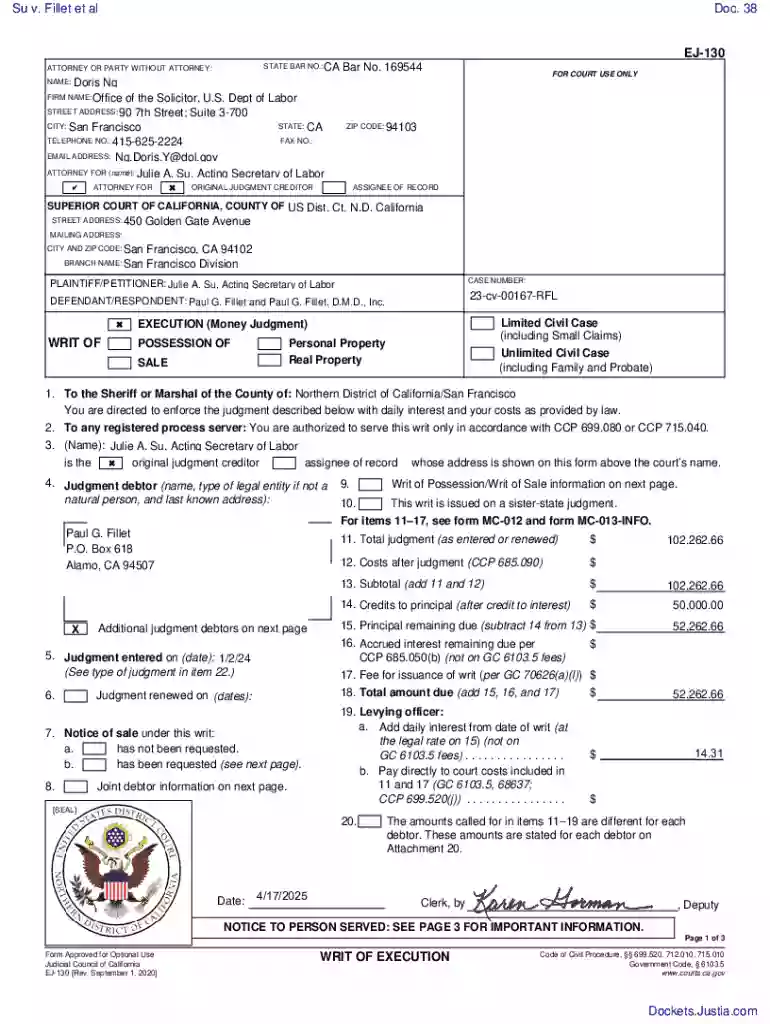
A writ of execution is a court order granting authority to enforce a judgment, usually by seizing and liquidating assets or property of a debtor to satisfy an outstanding debt. In the context of U.S. law, it is a legal mechanism used to implement the court’s decision after a verdict is rendered in favor of the plaintiff. For instance, if a debtor fails to fulfill a financial obligation as determined by a court judgment, the creditor can request this writ. The purpose of the writ is to empower the sheriff or another law enforcement official to locate the debtor’s assets, seize them, and proceed with necessary actions like auctions to recover owed funds. It’s important in upholding the integrity of the judicial process so that judgments are not just symbolic but enforceable.
Obtaining a writ of execution involves several procedural steps that vary slightly depending on the state’s jurisdiction. Typically, once a court issues a judgment in favor of a creditor, the creditor must submit a formal request or motion for the writ. This request is submitted to the court that issued the original judgment. It is crucial to provide certified copies of the judgment and any supporting documentation that outlines unpaid amounts or violations. Some jurisdictions might require additional affidavits affirming that the judgment remains unsatisfied. Once the court reviews and approves the application, the creditor may receive the writ, which can now be executed by a law enforcement officer.
Executing the writ requires careful adherence to legal protocols. Here’s a step-by-step guide:
In the United States, the legal framework for using a writ of execution is governed by state laws and the Federal Rules of Civil Procedure. The writ serves as an important tool for creditors to enforce the judgment legally. It is critical to navigate the laws surrounding the writ diligently to avoid claims of wrongful execution or abuse of process. Most importantly, all efforts must conform with property exemption statutes, which protect certain assets—like primary residences—up to specified values. Violating these laws can invite sanctions and invalidate the execution process.
There are several core components that the writ of execution must contain:
Different states have unique regulations and exemptions concerning the writ of execution. For example:
Creditor attorneys must therefore tailor execution strategies to align with these variations to ensure the writ’s effectiveness.
A typical scenario is when the Superior Court of California issues a writ of execution on a judgment involving misappropriated retirement funds. In practice, the sheriff’s department, upon receiving the writ, might seize non-exempt business equipment, company vehicles, or cash assets to cover the owed amount. Alternatively, in a different situation, an impasse could arise when a debtor’s assets are structured to fall entirely under exemption protection, necessitating a legal reassessment or appeal by the creditor to progress the writ’s enforcement.
Failing to comply with a writ of execution can result in severe legal consequences for a debtor. Defiance or obstruction of the writ can lead to contempt of court charges, additional fines, or even imprisonment. Moreover, assets could be subjected to forced sale without the owner’s consent, causing potential loss beyond the initial judgment. In certain cases, subsequent legal action could expand to involve previously untargeted assets or additional penalties, such as accumulating interest on unpaid sums. Thus, compliance is crucial to avoid cascading repercussions.
At DocHub, your data security is our priority. We follow HIPAA, SOC2, GDPR, and other standards, so you can work on your documents with confidence.