






Definition & Meaning
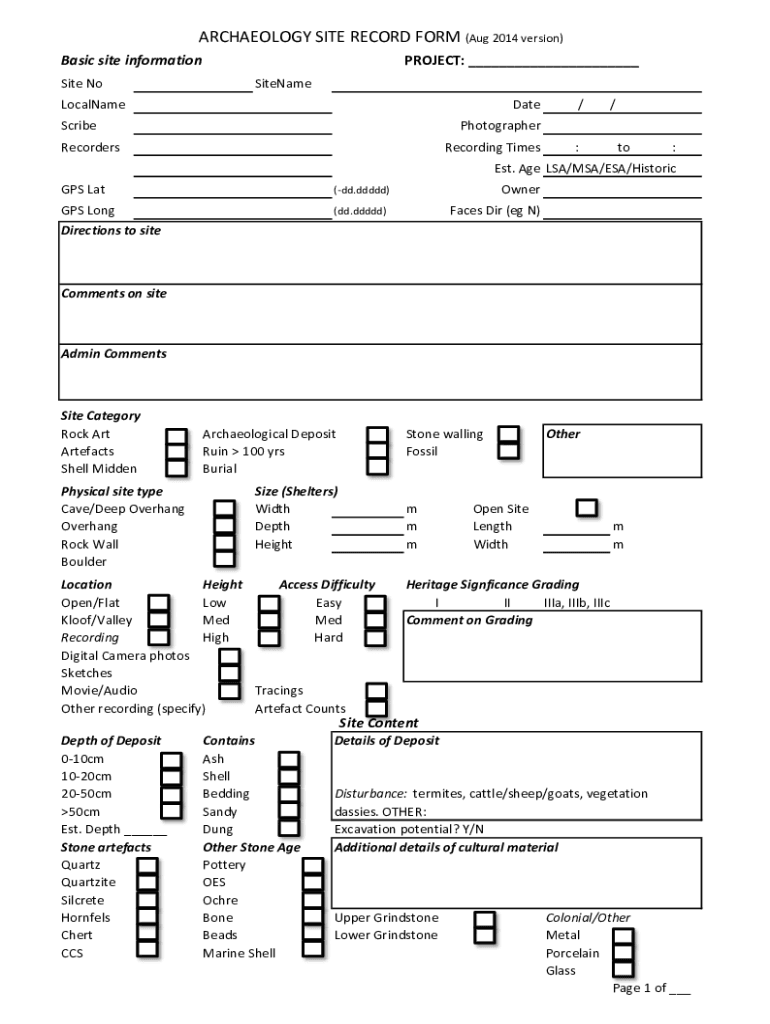
The Archaeology Site Record Form (Aug 2014 version) is a standardized document used to accurately capture detailed information about archaeological sites. It serves as a comprehensive record, ensuring consistency and precision in documenting site features, artefact distribution, and other critical data. This form functions as both a guide for archeologists in the field and a repository of site history for future reference.
Key Components
- Site Details: Includes essential information such as site name, location, and identifying codes.
- GPS Coordinates: Crucial for pinpointing the exact location of the site.
- Category Classification: Defines site types based on certain criteria like habitation, ceremonial, or industrial.
How to Use the Archaeology Site Record Form (Aug 2014 version)
Using the Archaeology Site Record Form requires careful attention to each section to ensure that all relevant data is captured accurately. The form is divided into various fields designed to streamline data entry, making it easier for archeologists to organize findings.
Usage Instructions
- Preparation: Gather all necessary information before starting the form, such as site measurements and cultural materials.
- Field Work Documentation: Enter observations directly at the site to improve accuracy.
- Review: Ensure all sections are filled with as much detail as possible, including photos and notes taken during site visits.
Steps to Complete the Archaeology Site Record Form (Aug 2014 version)
Completing this form involves a step-by-step approach to ensure comprehensive data collection. Follow these detailed procedures to ensure thorough documentation.
- Identification Section: Start by filling out all identification fields, including the site name and archaeologist's contact information.
- Location Description: Note the GPS coordinates and describe the environment surrounding the site.
- Detailed Survey: Include a meticulous description of the location's features and any artefacts found.
- Observations on Site Content and Damage: Record any existing damage and hypothesize potential causes.
- Photography and Sketches: Attach images and sketches to accompany the descriptions for visual reference.
Key Elements of the Archaeology Site Record Form (Aug 2014 version)
The form includes several critical elements essential for preserving the integrity of the archaeological record.
- Physical Characteristics: Captures detail about topography, vegetation, and any construction present.
- Artifact Counts: Specifies the type and count of artifacts found, including provenance and typology.
- Rock Art Descriptions: If applicable, detailed accounts of rock art presence and state are necessary.
Who Typically Uses the Archaeology Site Record Form (Aug 2014 version)
This form is predominantly used by professional archeologists and research teams. Governments and cultural heritage organizations may also employ it to document sites within their jurisdiction.


User Profiles
- Professional Archeologists: Use the form for systematic fieldwork documentation.
- Research Scholars: Assist in academic studies requiring site data.
- Cultural Resource Managers: Facilitate considerations for heritage site management.
Legal Use of the Archaeology Site Record Form (Aug 2014 version)
While the form itself is a tool for documentation, it can carry legal significance, particularly in the context of site preservation laws and heritage conservation statutes.
Considerations
- Permits: Typically required before data collection on private or protected land.
- Confidentiality: Sensitive information such as precise site locations should be protected to prevent unauthorized access.
- Compliance with Acts: Ensure adherence to relevant government acts that protect archaeological and historic interests.
State-Specific Rules for the Archaeology Site Record Form (Aug 2014 version)
Archaeological practices in the United States can vary significantly depending on state regulations.
Examples of Differences
- Permit Requirements: Varying levels of bureaucratic intervention may be needed to proceed with archaeological digs.
- Site Protection Laws: Some states have stricter enforcement to safeguard archaeological sites.
Examples of Using the Archaeology Site Record Form (Aug 2014 version)
Practical uses of this form have been observed in several prominent archaeological projects across the United States.
Case Studies
- Desert Southwest Excavations: Utilized to document Ancestral Puebloan sites, capturing intricate details about settlement patterns.
- Coastal Digs: The form was essential for recording data about shipwrecks and trade artifacts in Southeastern maritime digs.
Required Documents
Before utilizing the form, various documents and permissions may be required to ensure compliance with regional guidelines and research protocols.
- Permits: Permissions from relevant authorities for site access.
- Landowner Agreements: Written consent from private landowners where sites are located.
- Research Proposals: A brief outline detailing the objectives and methodologies employed in the fieldwork.