




01. Edit your form online
Type text, add images, blackout confidential details, add comments, highlights and more.

Type text, add images, blackout confidential details, add comments, highlights and more.

Draw your signature, type it, upload its image, or use your mobile device as a signature pad.

Send it via email, link, or fax. You can also download it, export it or print it out.
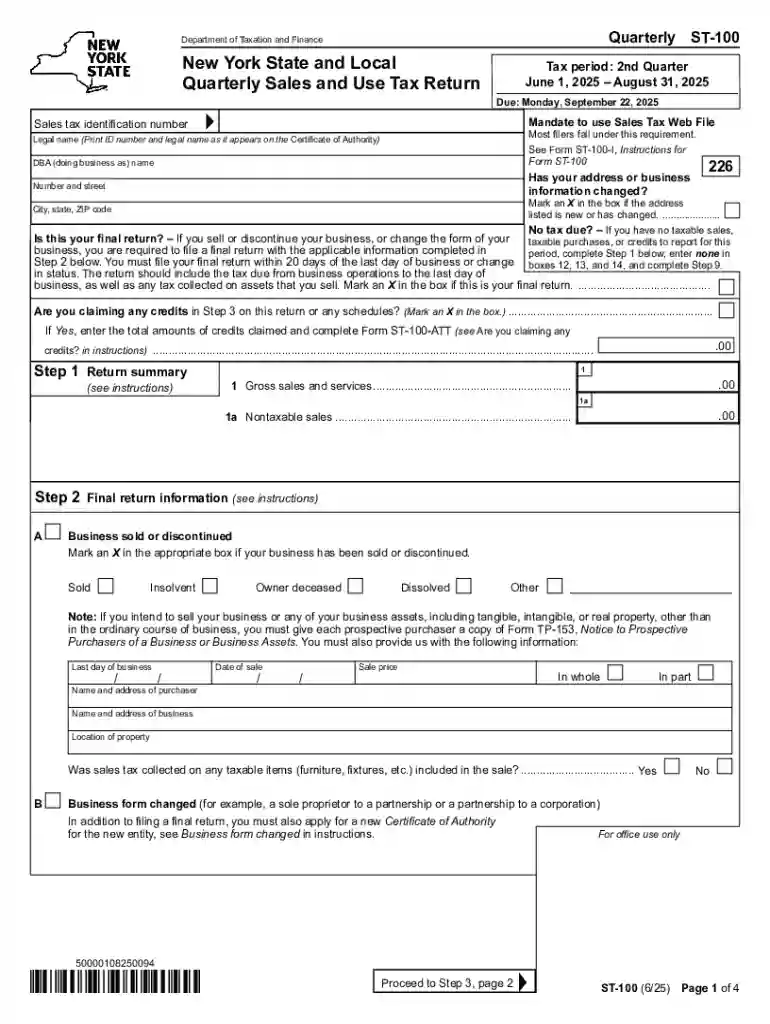
The Form ST-100, also known as the New York State and Local Quarterly Sales and Use Tax Return, is a document used by businesses to report their sales tax liabilities. This form outlines the obligations for sales taxes collected by businesses within the state of New York, focusing on both state and local jurisdiction requirements. It is crucial for maintaining compliance with New York's tax laws, detailing sales activities, and ensuring appropriate payment of taxes owed.
The Form ST-100 must be used by eligible businesses to report sales tax collections accurately. The document requires detailed information, such as gross sales, taxable sales, and any deductions or credits.
Businesses can obtain the Form ST-100 through several channels, ensuring convenient access for timely filing.
Completing the Form ST-100 involves a methodical approach to ensure accuracy and compliance with tax regulations.
Adhering to specific timelines is critical for avoiding penalties when dealing with the Form ST-100.
Failure to file the Form ST-100 accurately or on time can result in several penalties, highlighting the necessity of compliance.
Specific documentation is necessary to support the details provided in the Form ST-100, ensuring accuracy and compliance.
There are several methods available for submitting the Form ST-100, each catering to different user preferences.
While traditional paper forms are still in use, digital versions of the Form ST-100 offer several advantages.
Different business entities may have varying requirements and procedures when filing the Form ST-100.
Understanding specialized terms related to the Form ST-100 enhances the accuracy of submission and compliance.
Certain types of businesses reap significant compliance and operational benefits by properly utilizing Form ST-100.
We've got more versions of the Form ST-100 New York State and Local Quarterly Sales and Use Tax Return Revised 6 25 form. Select the right Form ST-100 New York State and Local Quarterly Sales and Use Tax Return Revised 6 25 version from the list and start editing it straight away!
| Versions | Form popularity | Fillable & printable |
|---|---|---|
| 2025 | 4.7 Satisfied (44 Votes) | |
| 2024 | 4.8 Satisfied (48 Votes) | |
| 2023 | 4.8 Satisfied (42 Votes) | |
| 2022 | 4.1 Satisfied (57 Votes) | |
| 2021 | 4.8 Satisfied (45 Votes) | |
| 2020 | 4.2 Satisfied (125 Votes) | |
| 2019 | 4.3 Satisfied (179 Votes) | |
| 2018 | 4.3 Satisfied (109 Votes) | |
| 2017 | 4.2 Satisfied (49 Votes) | |
| 2017 | 3.9 Satisfied (28 Votes) | |
| 2016 | 4.4 Satisfied (431 Votes) | |
| 2015 | 3.9 Satisfied (49 Votes) | |
| 2014 | 4 Satisfied (32 Votes) | |
| 2013 | 4 Satisfied (21 Votes) | |
| 2012 | 4 Satisfied (28 Votes) |
At DocHub, your data security is our priority. We follow HIPAA, SOC2, GDPR, and other standards, so you can work on your documents with confidence.



Apr 9, 2021 We are making this Proxy Statement, including the Notice of Annual Meeting and 2020. Annual Report on Form 10-K for the year ended December 31,
Oct 1, 2010 Chapter 57 of the Laws of 2009 converted the State and local QEZE sales and use tax exemption to a refund or credit of tax paid on qualifying
The return should include the tax due from business operations to the last day of business, as well as any tax collected on assets that you sell. Mark an X in


