






Definition & Importance
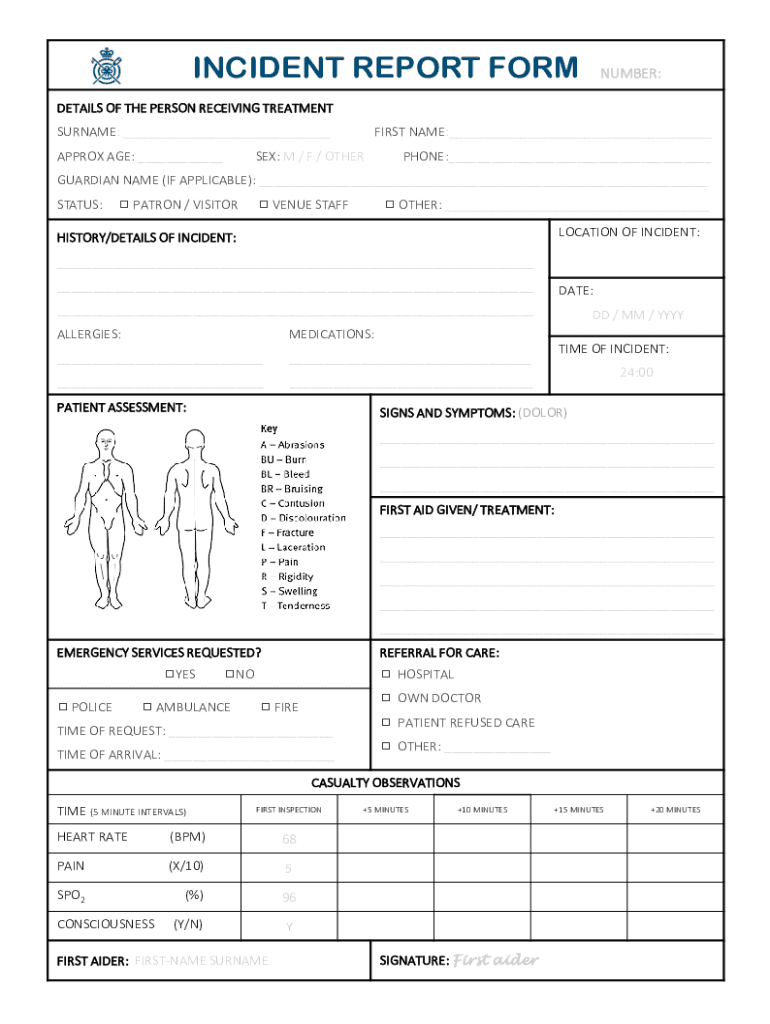
Incident Report Form First Aid Forms are crucial documents designed to systematically capture detailed information about incidents requiring first aid. They serve as official records that provide a comprehensive account of the event, including the nature of the incident, the individuals involved, and the first aid measures taken. These forms ensure that organizations can conduct effective follow-ups, identify preventive measures, and maintain compliance with legal and administrative requirements. Essential for risk management and workplace safety, these forms are used across various sectors, including healthcare, education, and manufacturing.
- Purpose: The primary function is to document incidents accurately to evaluate the cause and mitigate future risks.
- Significance: Forms can serve as legal documents in investigations and are essential for insurance claims.
How to Use the Incident Report Form First Aid Forms
Utilizing these forms involves several steps to ensure accuracy and completeness. Completing the form soon after an incident helps capture vital details while they are fresh in the mind.
- Immediate Documentation: After an incident, access the form to start recording details.
- Accurate Entries: Fill in all fields accurately, including names, dates, locations, and descriptions.
- Detailed Descriptions: Provide a thorough account of the incident, outlining what happened, how it occurred, and any involved parties.
- First Aid Administered: Document the specific first aid measures provided, including who administered them.
Tips for Effective Use
- Be Timely: Complete the form as soon as possible after the incident.
- Use Clear Language: Avoid jargon to ensure the information is understandable.
- Consult a Supervisor: When unsure, discuss with a supervisor for guidance on completing the form.
How to Obtain the Incident Report Form First Aid Forms
Obtaining these forms can be straightforward if you follow the correct channels within your organization or through official websites.
- Internal Resources: In many organizations, the forms are available in designated areas like first aid kits or HR departments.
- Online Access: Some institutions offer downloadable versions on their websites.
- Human Resources: Reach out to HR to obtain a physical or digital copy.
Alternative Sources
- Industry Associations: Many provide generic templates for broad use.
- Regulatory Bodies: Check with OSHA or equivalent bodies for standard forms.
Steps to Complete the Incident Report Form First Aid Forms
Filling out the form correctly is essential for compliance and efficiency. A systematic approach ensures all necessary information is included.
- Personal Details Section: Enter the name, contact information, and role of the person reporting.
- Incident Description: Use specific details to describe the scenario, including what led up to the event.
- Assessment and First Aid: Record observations and the first aid administered, specifying any equipment used.
- Witness Statements: Collect and attach statements from any witnesses to corroborate accounts of the incident.
Additional Tips
- Review Thoroughly: Double-check for any inaccuracies before submission.
- Attach Supporting Documentation: Include any additional evidence like photographs or medical reports.
Key Elements of the Incident Report Form First Aid Forms
The form is structured to cover various components to capture all relevant details comprehensively.
- Incident Details: Description of the time, date, and precise location of the incident.
- Parties Involved: Identification of individuals involved, including witnesses.
- Injury Description: Details regarding the nature of any injuries sustained.
- First Aid Treatment: Specifics about the treatment provided, including any medical intervention.
Common Sections
- Emergency Services: Documentation of any external emergency assistance requested.
- Follow-Up Action: Notes on subsequent steps taken to address and prevent future incidents.
State-Specific Rules for the Incident Report Form First Aid Forms
While the basic structure remains consistent, certain states have specific requirements and variations in how incidents must be reported and documented.
- State Mandates: Some states might have additional fields or require particular reporting timelines.
- Regulatory Compliance: Ensure adherence to state-specific occupational health and safety laws.
Practical Examples
- California: Employers might need to report certain incidents within a specific timeframe.
- Texas: Might require additional sections related to industrial or field-specific incidents.
Examples of Using the Incident Report Form First Aid Forms
The form is versatile and applicable in various scenarios, from minor injuries to significant workplace accidents.
- Healthcare Environment: A nurse documents an incident where a patient falls and requires assistance.
- Construction Site: An injury occurring from equipment misuse is recorded for safety reviews.
- Schools: A student receives first aid after a sports-related accident.
Case Studies
- Corporate Office: A case where the form helped in improving safety protocols after analyzing reported incidents.
- Public Events: Use during events to record incidents for insurance and organizational reviews.
Penalties for Non-Compliance
Failure to use or properly fill out Incident Report Form First Aid Forms can lead to substantial penalties, including legal and financial repercussions.
- Legal Accountability: Not maintaining proper records can result in non-compliance with OSHA or state laws.
- Financial Costs: Potential fines and higher insurance premiums due to inadequate incident documentation.
Long-Term Implications
- Reputational Damage: Organizations might suffer reputational harm impacting public trust and employee morale.
- Operational Setbacks: Inability to mitigate risks can lead to repeated incidents, affecting business operations.
In summary, the Incident Report Form First Aid Forms are vital tools for capturing critical incident details, enhancing workplace safety, and ensuring compliance with legal standards. Their comprehensive structure supports various scenarios, providing essential documentation for organizational, administrative, and legal processes.