






Definition & Meaning of "Beyond Mapping III - Topic 18: Understanding Grid-based - Data"
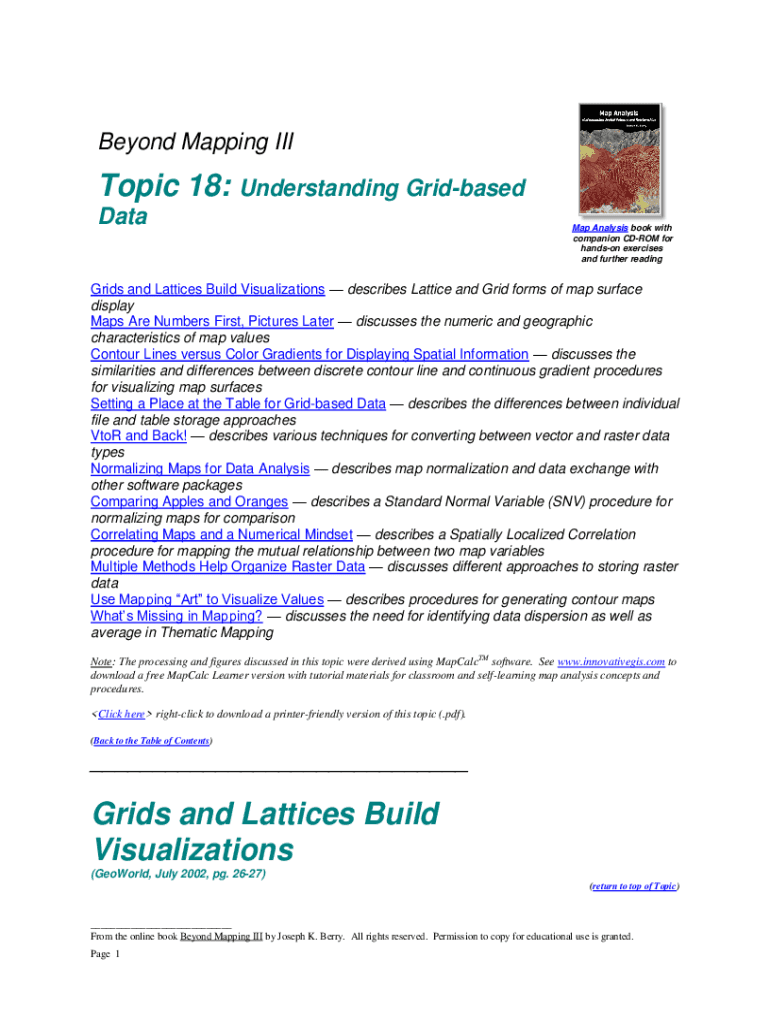
"Beyond Mapping III - Topic 18: Understanding Grid-based - Data" refers to a section of the document by Joseph K. Berry that delves into grid-based data systems in mapping. It outlines the transformation from vector data, which uses points, lines, and polygons, to grid-based or raster formats that represent data via continuous surfaces. This transition is crucial as it impacts how spatial data is analyzed and visualized, affording a more dynamic understanding of geographical and numerical characteristics. The document further explores various methodologies and their practical applications in map analysis.
Key Elements of Grid-based Data in Mapping
Grid-based data focuses on breaking down geographical areas into a matrix of equally-sized cells or grids. This method provides several key advantages:
-
Continuous Surface Representation: Unlike vector data, which represent features as discrete entities, grid-based systems allow for the depiction of data as a continuous surface, offering a more holistic view.
-
Ease of Analysis: It simplifies complex calculations like distance measurement, perimeter, and area calculations due to its uniform structure. This makes it particularly useful for large-scale environmental and resource-management applications.
-
Consistency in Data Handling: The regular structure of grid data ensures uniform operations across different datasets, facilitating comparative analysis.
-
Enhanced Visualization: Grid-based visualization, such as heat maps, can offer intuitive insights into data distribution and density that vector maps may not easily provide.
How to Use "Beyond Mapping III - Topic 18" for Effective Map Analysis
To use grid-based data effectively in map analysis, professionals can follow these steps:
-
Choose the Right Data Format: Decide whether grid-based data suits your analysis type. For continuous data, such as elevation or temperature, grids are ideal.
-
Use Appropriate Tools: GIS software that supports raster data, such as ArcGIS or QGIS, can be employed to manipulate and analyze grid-based data.
-
Normalize Data for Comparison: Apply normalization techniques to standardize data, making comparison over time or different regions viable.
-
Analyze Spatial Patterns: Utilize grid data to identify patterns and trends across a landscape, providing insights into geographical phenomena.
-
Convert Vector Data When Needed: For datasets originally in vector format, use conversion tools within GIS systems to transform them into grid-based formats, maintaining the integrity of spatial analysis.
Examples of Using Grid-Based Data in Real-World Applications
Grid-based data can be applied in various sectors:
-
Climate Analysis: Meteorological data, such as precipitation or temperature, are frequently represented in grids, allowing for climate modelling and forecasting.
-
Urban Planning: Planners utilize grid-based models to visualize population density, infrastructure distribution, and growth patterns, aiding in strategic development initiatives.
-
Agriculture: Farmers can use grid systems to monitor and manage soil properties, crop conditions, and potential yield across vast tracts of land, enhancing efficiency and productivity.
-
Disaster Management: Emergency services analyze risk maps, such as flood or wildfire spread models, that employ grid formatting, facilitating improved preparedness and response strategies.
Important Terms Related to Grid-based Data
Understanding specific terminology is critical for working with grid-based data:
-
Raster: A pixel-based representation of spatial data, each cell in a raster grid holds a specific value.
-
Resolution: Refers to the cell size in a grid; higher resolution grids can capture more detail.
-
Interpolation: The process of estimating unknown values within the grid using known data points.
-
Georeferencing: Aligning grid data to real-world coordinates to ensure spatial accuracy.
Software Compatibility for Leveraging Grid-based Data
Various software platforms facilitate the usage of grid-based data:
-
GIS Software: Programs like ArcGIS, QGIS, and Global Mapper are robust options for handling raster data, offering tools for visualization, analysis, and data management.
-
Data Analytics Tools: Platforms such as R and Python (with libraries like GDAL and Rasterio) can process and analyze grid-based data, providing a scriptable environment for advanced analytical operations.
-
Database Systems: Geographical databases, including PostgreSQL with PostGIS extension, support grid-based data, enabling complex spatial queries and data management.
Versions or Alternatives to Grid-based Mapping Techniques
While grid-based data is a dominant method, there are alternatives and enhancements:
-
Vector Data: Still widely used for representing discrete geographical features like boundaries and infrastructure.
-
Hybrid Models: Systems that integrate both vector and grid-based elements can offer comprehensive spatial representations.
-
3D Gridding: Allows for the visualization and analysis of data in three dimensions, valuable in fields like mining exploration and subsurface mapping.
Legal Use and Considerations
The integration of grid-based techniques should align with legal and regulatory frameworks:
-
Data Protection: Ensure that spatial data usage complies with privacy and data protection laws, especially when involving sensitive information.
-
Intellectual Property: Be aware of licensing issues related to proprietary software or datasets, securing appropriate permissions where necessary.
Grid-based data in mapping represents a transformative approach that extends beyond traditional methods, allowing for nuanced analysis and insights into spatial phenomena. Through careful consideration and application of these techniques, a deeper understanding of the geographical landscape is achievable.