






Definition & Meaning
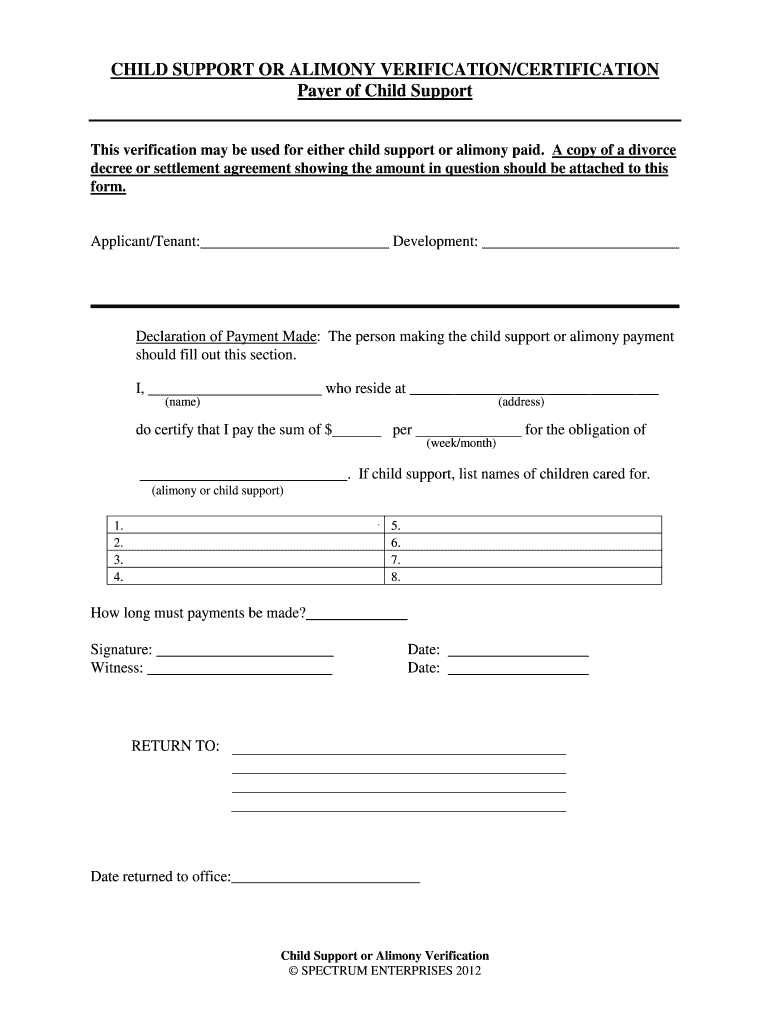
The "Child Support or Alimony Verification Certification" is a formal document used to verify the specifics related to child support or alimony payments. This form serves as a declaration by both the payer and recipient to confirm the payment details, number of children involved, and instances where actual payments may deviate from what was legally agreed upon. This document is an essential component for ensuring transparency and compliance with legal and financial obligations associated with family support agreements.
Key Features:
- Payment Verification: Involves the declaration of payments made or received, ensuring clarity on both parties' commitments.
- Notarization Requirement: The recipient's declaration must be notarized to legitimize the information provided, added an official layer of verification to the process.
- Legal Documentation: Acts as a crucial record that may be required in legal proceedings, tax filings, or other official obligations.
How to Obtain the CHILD SUPPORT OR ALIMONY VERIFICATION CERTIFICATION
Securing this certification involves a few straightforward steps aimed at ensuring both accuracy and legal compliance. The steps vary slightly based on the jurisdiction but generally adhere to a similar process.
Steps to Obtain:
- Contact the Issuing Authority: Begin by identifying the specific governmental or legal body responsible for distributing the form in your jurisdiction, typically a family court or a department of social services.
- Request the Form: You may need to fill out a request form online or physically present yourself at the relevant office to obtain a copy.
- Verify Requirements: Ensure you understand the specific documentation and information needed, like identification documents and any previous court orders.
- Download/Collect the Form: Obtain a physical or digital copy of the form to begin the certification process.
Real-world Scenario:
In some states, you can visit a local courthouse's family law section, where clerks assist in obtaining and understanding the form. In regions offering online services, the download is often available directly from the state's official website.
Steps to Complete the CHILD SUPPORT OR ALIMONY VERIFICATION CERTIFICATION
Completing the form requires attention to detail to ensure that all necessary information is accurately represented and legally compliant.
Process:
- Personal Information: Input details for both the payer and recipient, including full names, contact information, and social security numbers.
- Payment Details: Clearly document the amounts paid or received, along with specific dates and frequencies of payment.
- Children Involved: List all children involved in the agreement, including names and dates of birth.
- Discrepancies: Note any differences between current payments and the original legal agreement, providing reasons if applicable.
- Notarization: The recipient's section needs to be notarized, lending authenticity and legal weight to the declaration provided.
Additional Tips:
- Double-check Information: Carefully review every section of the form for accuracy before submission.
- Consult with Legal Counsel: If discrepancies are noted, seek legal advice to understand potential implications.
Why You Should Use the CHILD SUPPORT OR ALIMONY VERIFICATION CERTIFICATION
Utilizing this form primarily serves as a protective measure for both parties involved in child support or alimony agreements.
Benefits:
- Legal Compliance: Ensures all parties adhere to the agreements set forth, minimizing the risk of legal disputes or financial penalties.
- Record Maintenance: Provides a formal record useful for personal financial planning and potential audits.
- Transparency: Offers clear documentation that can prevent misunderstandings and foster better communication between both parties.
Practical Example:
A parent receiving inconsistent child support payments can use this form as formal documentation to appropriately address issues with a court or legal counsel.
Important Terms Related to CHILD SUPPORT OR ALIMONY VERIFICATION CERTIFICATION
When dealing with this certification, familiarity with key terms is pivotal to ensure understanding and proper compliance.
Glossary:
- Payer: The individual responsible for making support payments.
- Recipient: The individual receiving the support payments.
- Notarization: The process of having the document officially validated by a notary public.
- Legal Agreement: The court-approved document detailing support obligations.
Example Context:
Understanding notarization's role signifies the form's official status and protection against fraudulent claims, illustrating its necessity.
Key Elements of the CHILD SUPPORT OR ALIMONY VERIFICATION CERTIFICATION
The form includes several critical components that all users must be aware of to ensure comprehensive completion.
Components:
- Verification Statement: A statement signed by both parties certifying the truth of the information provided.
- Notarized Declaration: Necessary for the form's official recognition and validity in legal matters.
- Child Information Section: Details each child's involvement in the support arrangements.
Use Case:
During a divorce proceeding, the verification statement provides clarity on unfulfilled obligations, which can be addressed through legal channels.
Form Submission Methods (Online / Mail / In-Person)
The completed form can be submitted through various methods. Each method offers different benefits and considerations to take into account.
Submission Options:
- Online Submission: Often the fastest method, allowing for form upload via a secure government portal.
- Mail Submission: Provides physical proof of submission which might be required in certain jurisdictions.
- In-Person Submission: Enables immediate confirmation of receipt, ideal for sensitive documents or when guidance is needed.
Considerations:
- Choose online methods for speed and trackability.
- Use mail options when needing a paper trail for legal documentation.
- Opt for in-person delivery to confirm immediate receipt and address potential complications on the spot.
Penalties for Non-Compliance
Failure to correctly complete or submit the "Child Support or Alimony Verification Certification" can lead to serious consequences.
Possible Penalties:
- Legal Repercussions: Non-compliance may result in court actions or amendments to existing support agreements.
- Financial Penalties: Potential fines or sanctions could be imposed on the non-compliant party.
- Impact on Custodial Rights: Consistent non-compliance might affect one's custodial status or visitation rights.
Example Situation:
If a discrepancy is intentionally misstated, it could lead to accusations of fraud, with the offending party facing both criminal charges and civil penalties.
By understanding all aspects of the "Child Support or Alimony Verification Certification," individuals can ensure they meet their legal obligations while maintaining clear records of their financial responsibilities.