




01. Edit your elements compounds and mixtures worksheet online
Type text, add images, blackout confidential details, add comments, highlights and more.

Type text, add images, blackout confidential details, add comments, highlights and more.

Draw your signature, type it, upload its image, or use your mobile device as a signature pad.

Send elements compounds mixtures worksheet via email, link, or fax. You can also download it, export it or print it out.
Elements, compounds, and mixtures are fundamental concepts in chemistry that describe the composition and properties of matter.
Elements: An element is a pure substance that cannot be broken down into simpler substances by chemical means. Each element is made of identical atoms and is represented by a unique one- or two-letter symbol on the periodic table, such as H for hydrogen or O for oxygen. There are currently 118 known elements.
Compounds: A compound consists of two or more different elements that are chemically bonded together in a fixed ratio. Compounds have distinct properties that are often very different from the properties of the individual elements they contain. For example, water (H₂O) is a compound made of hydrogen and oxygen. It behaves very differently from its gaseous elemental forms.
Mixtures: Mixtures are physical combinations of two or more substances where each substance retains its individual characteristics. Mixtures can be homogeneous (uniform composition, like saltwater) or heterogeneous (distinct components, like salad). They can be separated through physical means, such as filtration or evaporation.
These definitions help students understand how substances interact within chemistry and establish a foundation for studying more complex chemical reactions and processes in the elements compounds and mixtures worksheet.
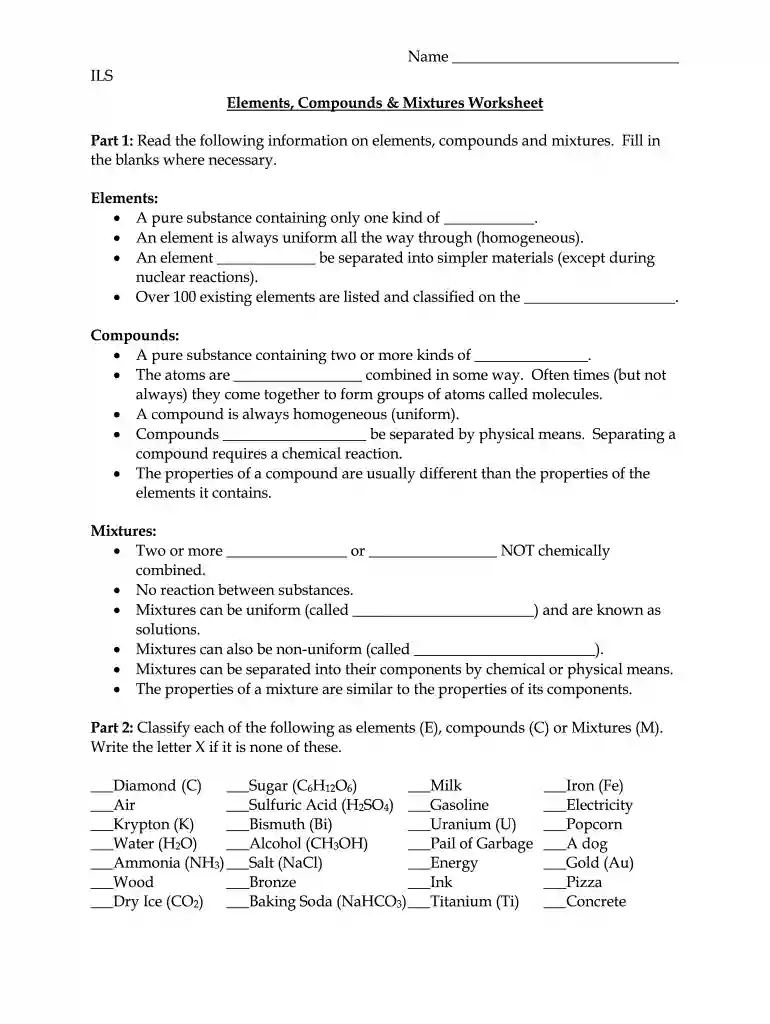
The elements compounds and mixtures worksheet is an educational tool designed for grade seven students to reinforce their understanding of these concepts.
Reading the Worksheet: Begin by reading the instructions carefully. The worksheet typically contains definitions, examples, and questions concerning elements, compounds, and mixtures.
Completing the Sections: The worksheet often includes various sections requiring students to classify provided substances, identify properties, and explain characteristics. Each student should fill in their answers thoughtfully, showing their grasp of the topics.
Reviewing Answers: After completing the worksheet, students should compare their answers with the answer key to check their understanding and accuracy concerning elements, compounds, and mixtures.
Further Study: If any answers were incorrect, review the relevant sections in textbooks or online resources to gain clarity on those concepts.
Using the worksheet as a structured guide can effectively reinforce students' comprehension and application of chemistry fundamentals.
To access the elements compounds and mixtures worksheet grade 7 in PDF format, consider the following methods:
Educational Institutions: Schools and teachers often provide worksheets as part of their curriculum. Check with your educator to obtain the specific worksheet used in your class.
Online Resources: Numerous educational websites and platforms offer downloadable worksheets. Look for the elements compounds and mixtures worksheet grade 7 pdf in reliable educational databases or science resource sites.
Library Access: Many libraries provide access to educational resources suitable for various grades. Visiting a local library can also yield printouts of the worksheet or similar materials.
These methods ensure easy access to the required educational materials for grade seven learners focusing on chemistry.
Completing the elements compounds and mixtures worksheet involves a systematic approach to ensure comprehensive understanding. Follow these steps:
Gather Materials: Have a pencil, eraser, and any reference materials like textbooks or notes handy for quick consultation.
Read Instructions: Carefully read all directions provided in the worksheet. Each section may have different requirements—classification, definition, or explanation.
Work Methodically: Begin with definitions, filling in what you understand first. Move to sections that require classification or matching—this aids recall.
Review Each Section: After finishing, double-check your responses in each section. Ensure you haven't skipped any questions.
Consult with Peers or Teachers: If areas of confusion remain, discussing with classmates or seeking clarification from a teacher can solidify understanding.
Complete Follow-Up Exercises: If the worksheet includes reflective questions or follow-up exercises, complete those to reinforce your learning.
This stepwise method helps in systematically addressing the worksheet while enhancing familiarity with chemistry concepts.
Understanding related terminology is crucial for grasping the concepts of elements, compounds, and mixtures effectively. Some essential terms include:
Familiarity with these terms enhances students' conversations and understanding of chemistry in relation to the elements compounds and mixtures worksheet.
Applying the elements compounds and mixtures worksheet to concrete examples can clarify its educational value.
Identification Exercise: Students might be asked to classify a list of substances as elements, compounds, or mixtures. For instance, given substances like sodium chloride (NaCl), oxygen (O₂), and salad, students would identify NaCl as a compound, O₂ as an element, and salad as a mixture.
Matching Activity: Worksheets could include diagrams and descriptions where students match elements or compounds to their physical representations. For example, matching the chemical formula H₂O to an image of a water droplet.
Short Answer Questions: The worksheet may include questions asking students to explain why a substance is classified as a mixture versus a compound. For instance, students should discuss the difference between saltwater (a mixture) and pure sodium chloride (a compound), focusing on how components retain properties in mixtures while compounds exhibit new properties.
These examples illustrate the practical application of the worksheet in promoting critical thinking and comprehension of chemistry basics.
Understanding elements, compounds, and mixtures through worksheets designed for educational purposes allows students to build a robust foundation in chemistry. By actively engaging with exercises and examples, learners can grasp the intricacies of matter and its classifications effectively.
At DocHub, your data security is our priority. We follow HIPAA, SOC2, GDPR, and other standards, so you can work on your documents with confidence.
Many substances are mixtures of compounds and/or elements. A mixture is a combination of two or more substances each of which retains its own identity. ARead more
IMPORTANT: This guidance document was developed for use on the web. Please review the following disclaimers before using the PDF version of the web-basedRead more


