






Definition and Meaning of Map-ematical Framework
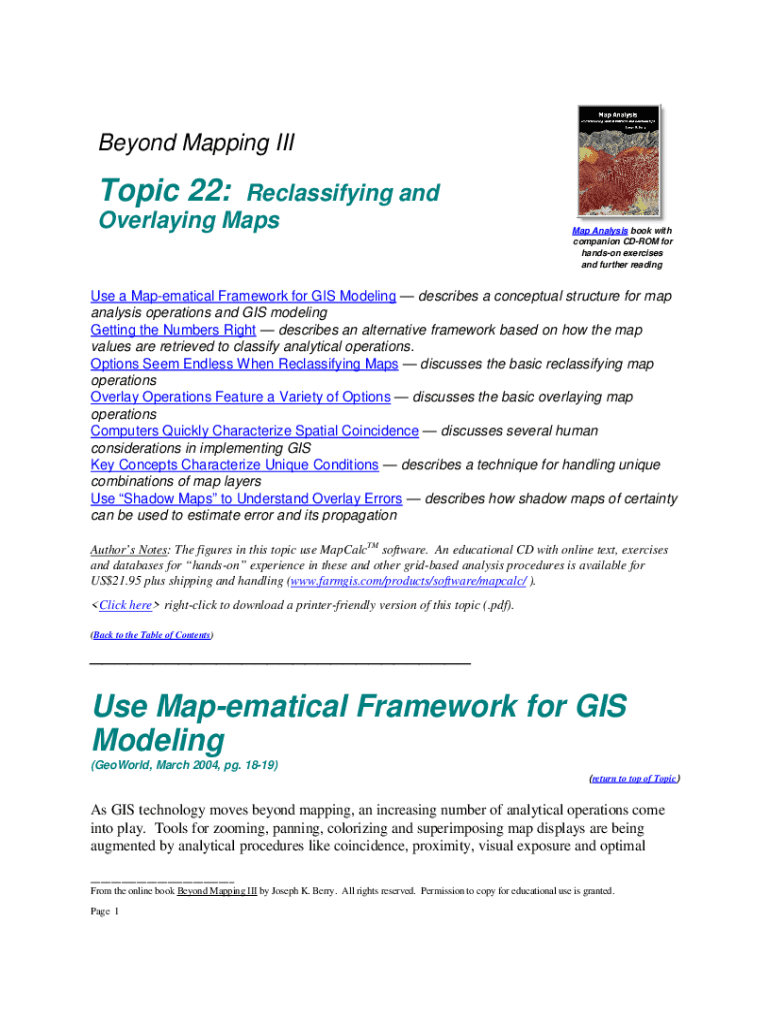
The "map-ematical framework" is a structured approach used within Geographic Information Systems (GIS) to enhance the modeling and analysis of spatial data. This method emphasizes the integration of numerical data into map analysis operations like reclassification and overlaying. The framework serves as a blueprint for organizing GIS models, focusing on the accuracy and precision of numerical data associated with geographical features. By applying this framework, GIS professionals can systematically interpret spatial relationships, ensuring data-driven decision-making.
How to Use the Map-ematical Framework for GIS Modeling
Using the map-ematical framework within GIS modeling involves several key steps:
-
Data Collection and Preparation: Gather relevant spatial and numerical data required for your GIS project. This includes maps, satellite imagery, and any additional datasets that provide necessary context.
-
Data Analysis Operations: Use reclassification operations to group data based on specific criteria; for example, categorizing land use types. Overlay operations can be applied to create composite maps by stacking layers.
-
Utilize Analytical Tools: Implement distance measurements to analyze areas of influence or accessibility, and use neighborhood characterizations to understand localized spatial patterns.
-
Ensure Precise Modeling: Focus on the spatial accuracy by considering error propagation, ensuring all classifications reflect the actual scenario on the ground.
This systematic use of the map-ematical framework in GIS ensures accurate modeling and analysis of spatial data.
Steps to Complete a GIS Project Using the Map-ematical Framework
Completing a GIS project using the map-ematical framework involves a structured step-by-step process:
-
Define Objectives: Clearly outline the goals of your GIS project, including what spatial relationships or patterns you wish to uncover.
-
Gather and Preprocess Data: Identify data sources and prepare datasets for analysis. This may include georeferencing maps and cleaning data for analysis readiness.
-
Implement Framework Tools: Apply reclassification, overlaying, and spatial measurements to carry out your analysis. Each tool contributes to building a comprehensive understanding of spatial data.
-
Interpret Results: Analyze output maps and datasets to draw conclusions about spatial trends and patterns, considering certainty and uncertainty in classifications.
-
Reporting and Visualization: Present findings in an accessible format, such as maps and reports, to communicate insights effectively to stakeholders.
Why Use the Map-ematical Framework in GIS
The map-ematical framework is invaluable for several reasons:
-
Accuracy and Precision: By structuring GIS modeling around numerical data, the framework enhances the reliability of map analysis.
-
Comprehensive Analysis: Integrating multiple analytical operations within the framework allows for a more detailed understanding of spatial phenomena.
-
Decision Support: Ensures that spatial data provides actionable insights, supporting evidence-based decision-making processes in a variety of fields, including urban planning and environmental management.
Key Elements of the Map-ematical Framework
Several core elements define the map-ematical framework:
-
Reclassification: This involves altering data classification on a map to group features based on shared attributes or characteristics.
-
Overlay Operations: Used to integrate different datasets, overlay operations create new layers of information by combining existing maps.
-
Distance and Neighborhood Analysis: These provide insights into spatial relationships by evaluating proximity and local conditions, crucial for tasks like site selection or biodiversity conservation.
-
Error Propagation Assessment: Critical for understanding how minor inaccuracies in data can affect the overall reliability of the mapping output.
Examples of Using the Map-ematical Framework
In practical applications, the map-ematical framework can be illustrated through real-world examples:
-
Urban Planning: Reclassification and overlay techniques help in zoning analysis to predict urban expansion and infrastructure needs.
-
Environmental Monitoring: Distance measurements and neighborhood characterizations play key roles in habitat conservation strategies, planning buffer zones, and assessing environmental impact.
-
Transportation Networks: GIS models that use the framework have been utilized in optimizing route planning and analyzing traffic flow patterns within urban regions.
Important Terms Related to GIS Modeling
Understanding GIS modeling with a map-ematical framework involves recognizing vital terms:
-
Spatial Coincidence: This refers to the occurrence of different features in the same physical space; critical in overlay analysis.
-
Error Propagation: The process by which errors in spatial data magnify as they move through different stages of GIS analysis.
-
Reclassification: The process of sorting data into different categories to simplify analysis.
Who Typically Uses the Map-ematical Framework
The framework is predominantly employed by professionals in:
-
Urban Planning and Development: Assists planners in making informed decisions regarding land use and infrastructure projects.
-
Environmental Science: Used by environmental scientists to monitor ecosystems, assess wildlife habitats, and plan conservation initiatives.
-
Transportation Engineering: GIS modeling aids in developing efficient transportation networks and managing urban traffic dynamics.
These professionals leverage the power of the map-ematical framework to make data-driven decisions that influence development and environmental strategies.