






Definition & Meaning
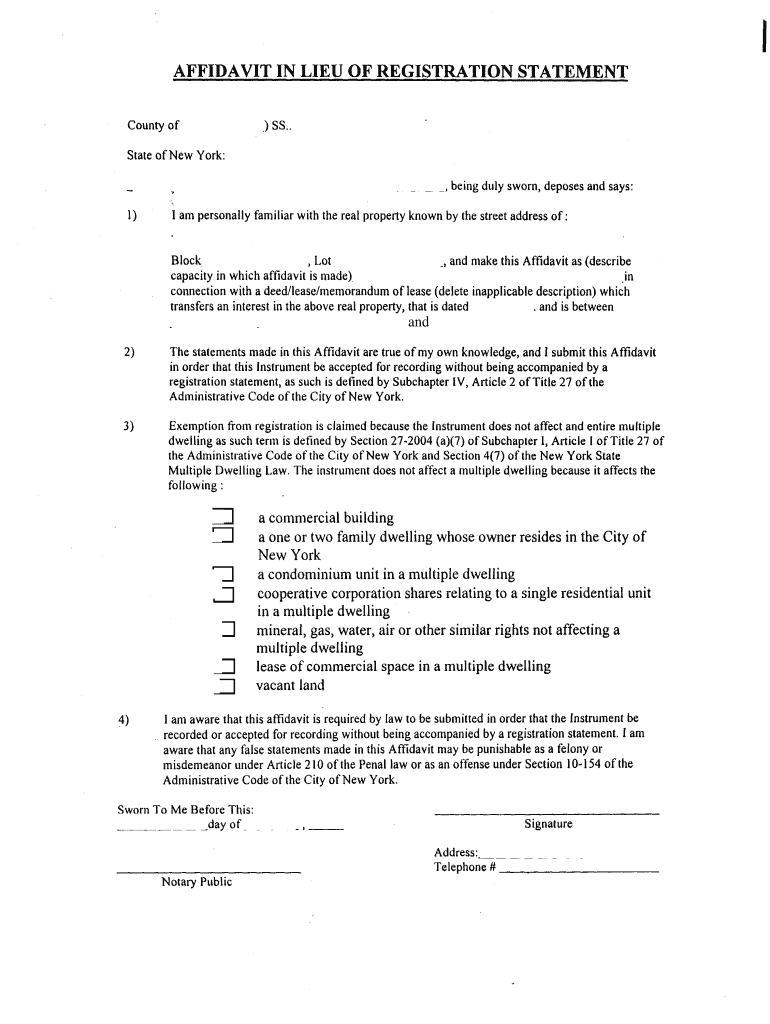
The "Affidavit in Lieu of Registration Statement" is a legal document often used in real property transactions in the United States, specifically New York. It serves as a formal declaration where the affiant asserts certain conditions of the property transaction that exempt it from requiring a standard registration statement. This affidavit is crucial in cases where the deed or lease does not need a registration statement due to specific legal exemptions, streamlining the process for eligible transactions.
How to Use the Affidavit in Lieu of Registration Statement
When using the Affidavit in Lieu of Registration Statement, one must first determine eligibility based on the nature of the real property transaction. The document typically requires the affiant to detail specific information about the property and the reasons it qualifies for exemption:
- Declare Familiarity: The affiant must state their comprehensive understanding of the property.
- Detail Exemptions: Clearly outline why the transaction is exempt from the usual registration requirements.
- Legal Implications: Acknowledge the potential legal consequences of providing false information within the affidavit, as it must be truthful and accurate.
How to Obtain the Affidavit in Lieu of Registration Statement
Acquiring an Affidavit in Lieu of Registration Statement involves several steps, often facilitated through legal or real estate professionals:
- Contact a Legal Professional: Lawyers familiar with real estate or notaries can help navigate the specific requirements.
- Local Government Access: Visit or contact the local government office responsible for real property registrations in New York.
- Online Resources: Some legal websites and real estate platforms may offer templates or guidance on drafting the affidavit.
Steps to Complete the Affidavit in Lieu of Registration Statement
Completing the affidavit involves careful attention to detail, ensuring compliance with legal requirements:
- Gather Information: Collect all necessary data about the property and transaction.
- Fill Out the Form: Enter all relevant details, ensuring accuracy in descriptions and legal references.
- Affiant’s Signature: The affidavit must be signed in the presence of a notary.
- Submit the Affidavit: Follow protocols for submission, either through electronic means or by physical delivery to the designated office.
Key Elements of the Affidavit in Lieu of Registration Statement
Several critical components are integral to the affidavit:
- Property Description: Includes detailed information on the property.
- Statement of Exemption: Clearly defined reasons for exemption from the registration statement.
- Affiant Information: Comprehensive details of the individual making the declaration.
- Notarial Witness: Signature and verification by a notary public to ensure the affidavit’s legitimacy.
State-Specific Rules for the Affidavit in Lieu of Registration Statement
The application and usage of the Affidavit in Lieu of Registration Statement can vary significantly by state. In New York, specific rules govern:
- Eligibility Criteria: Determine if the property transaction qualifies for the affidavit’s use.
- Submission Protocols: Follow state-defined procedures for filing the affidavit.
- Legal Boundaries: Each state might have unique legal frameworks that influence the affidavit’s formulation.
Legal Use of the Affidavit in Lieu of Registration Statement
Legally, this affidavit serves to assert details truthfully in real property transactions. It involves key considerations such as:
- Verification of Truthfulness: False declarations can lead to legal repercussions.
- Legal Binding: Once signed, the affidavit is considered a legally binding document.
- Jurisdictional Compliance: Ensures the transaction respects state-specific laws.
Who Typically Uses the Affidavit in Lieu of Registration Statement
This affidavit is predominantly used by:
- Real Estate Professionals: Agents handling complex property transactions adhering to legal exemptions.
- Property Owners: Individuals seeking to streamline the sale or transfer of their property under specific conditions.
- Legal Practitioners: Lawyers drafting or witnessing the affidavit as part of legal services for their clients.


Examples of Using the Affidavit in Lieu of Registration Statement
Real-world scenarios where the affidavit is beneficial include:
- Exempt Lease Agreements: Used when a lease arrangement falls under exemptions.
- Inheritance Procedures: In cases of inherited property, where certain exemption criteria are met.
- Property Transfers Among Family: Simplifies the registration process for legally exempt familial transactions.