






Definition & Meaning
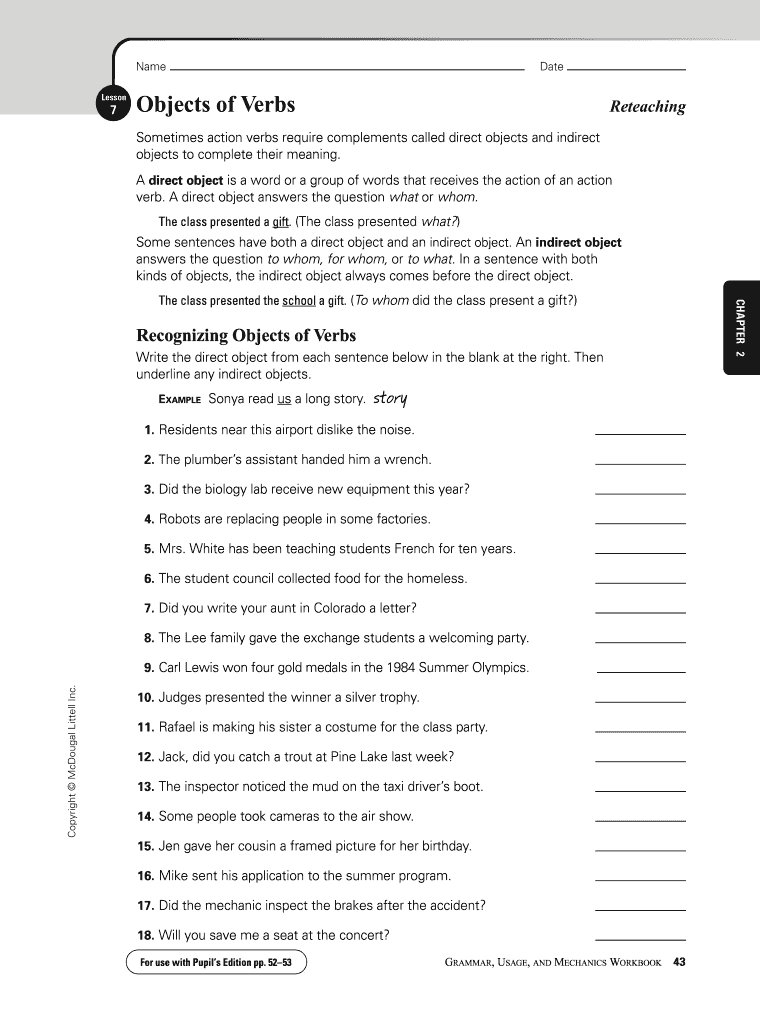
Lesson 7 delves into the grammatical concepts of direct and indirect objects within a sentence. A direct object receives the action of the verb directly, while an indirect object indicates to whom or for whom the action is performed. Understanding these components is crucial for constructing precise and clear sentences, particularly in academic and professional writing. For instance, in the sentence "She gave her friend a gift," "gift" is the direct object, and "friend" is the indirect object.
How to Use Lesson 7
Lesson 7 is designed to teach learners how to identify and correctly use direct and indirect objects in sentences. Practicing with sentences and exercises provided in this lesson will help reinforce the understanding of these grammar components. Utilizing sample sentences, it guides learners through the process of pinpointing objects and their functions, thereby enhancing communication skills.
Steps to Complete Lesson 7
- Read the definitions: Begin by reviewing the definitions of direct and indirect objects.
- Analyze examples: Study example sentences to see how these objects are used in context.
- Exercises: Complete the exercises that require identifying and using direct and indirect objects.
- Review: Go over the answers and consult explanations or seek clarification where needed.
- Apply: Try writing original sentences using these grammatical components to test comprehension.
Why Study Lesson 7
Understanding direct and indirect objects is integral for mastering the English language, as they play a significant role in conveying action effectively. Grasping this lesson improves both written and spoken communication. Proficiency in these areas helps prevent common errors and enhances clarity, making your writing more precise and effective.
Important Terms Related to Lesson 7
- Direct Object: A noun or pronoun that receives the action of the verb.
- Indirect Object: A noun or pronoun indicating to whom or for whom the action is done.
- Transitive Verb: A verb that requires a direct object to complete its meaning.
For example, in the sentence "He sent his brother a letter," "letter" is the direct object because it is what was sent, and "brother" is the indirect object, representing who received the action.
Examples of Using Lesson 7
Analyzing simple sentences helps reinforce the concepts of direct and indirect objects. Try creating sentences, such as "The teacher assigned the class a project." Here, "project" is the direct object, while "class" is the indirect object. Practicing with varied sentence structures will improve grammatical proficiency.
Key Elements of Lesson 7
- Clarity in Sentence Structure: Ensuring the placement of direct and indirect objects accurately reflects their roles.
- Pronoun Usage: Determining whether a pronoun is functioning as a direct or indirect object.
- Verb Compatibility: Understanding that only transitive verbs can have direct objects.
These elements are critical for crafting well-structured sentences that convey the intended meaning effectively.
Who Typically Uses Lesson 7
Lesson 7 is utilized by students, educators, and anyone looking to improve their grammar skills. It is particularly beneficial in educational settings, where precise language use is crucial. Writers, editors, and professionals who need to ensure clarity and accuracy in their work also benefit from mastering this lesson.
State-Specific Rules for Lesson 7
While grammar principles remain consistent, teaching methodologies may vary by educational institution or state standards. Teachers may introduce additional exercises or contextually relevant examples to align with state-specific curricula or standardized tests that emphasize grammar.
Software Compatibility (TurboTax, QuickBooks, etc.)
An understanding of direct and indirect objects is not directly related to software compatibility. However, proficiency in grammar may be advantageous when preparing written communications or documentation using any software, including those for tax preparation or financial record-keeping.
Digital vs. Paper Version
Learning resources for Lesson 7 are available in both digital and paper formats, allowing users to choose the method that best fits their learning style. Digital formats may offer interactive exercises and immediate feedback, while paper versions can be more traditional and tactile, allowing for handwritten notes and exercises.
Application Process & Approval Time
This section is primarily pertinent to official forms and processes outside the scope of Lesson 7. For grammar lessons, there is generally no formal application process, but timely practice and review enhance understanding and retention.