






Definition and Meaning of the Pandemic Project
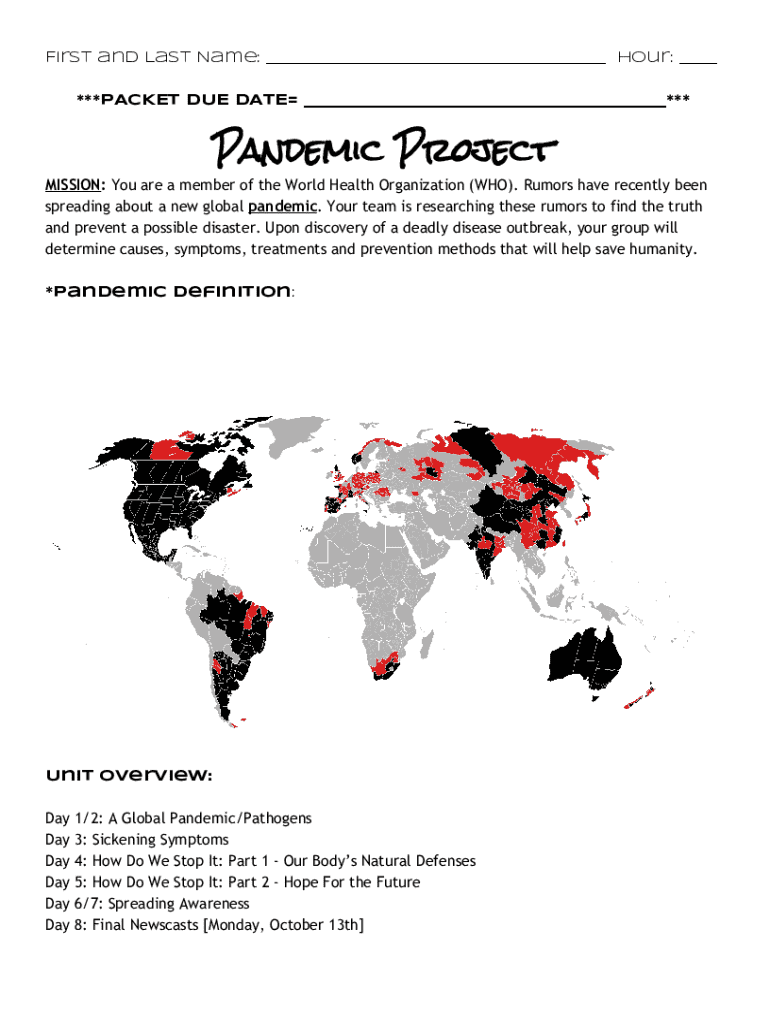
The "Pandemic Project" refers to an educational exercise designed for students acting as members of the World Health Organization. The project involves researching a fictional global pandemic, focusing on studying pathogens, identifying symptoms, and exploring treatment and prevention methods. This undertaking helps students understand the dynamics of disease control and prevention in a global context.
Steps to Complete the Pandemic Project
-
Research Pathogens and Disease Spread: Start by identifying the fictional disease's pathogen. Research how the disease spreads and its transmission methods, considering airborne, surface, or vector transmission scenarios.
-
Identify Symptoms and Effects: List the symptoms caused by the disease and the long-term effects it may have on health. Collaboration among team members is crucial to ensure a comprehensive understanding of the disease's impact.
-
Treatment and Prevention Methods: Investigate potential treatments and prevention strategies. This may include researching vaccines, antiviral drugs, or holistic approaches to mitigate the disease's effects.
-
Team Collaboration: Ensure teamwork by assigning roles, such as researchers, data analysts, and presenters. Regular meetings to share findings can enhance collaboration and ensure everyone is on the same page.
-
Prepare a Newscast Presentation: Synthesize the collected information into a coherent presentation. Create a newscast that effectively communicates the research findings and recommendations to a broader audience.
Importance of the Pandemic Project
The Pandemic Project is crucial in fostering a deeper understanding of global health issues. By simulating real-world scenarios, students gain valuable skills such as:
-
Critical Thinking: Analyzing data and drawing valid conclusions.
-
Collaboration: Working as part of a team to achieve common goals.
-
Communication: Presenting complex information effectively and persuasively.
Moreover, it prepares students for future roles in healthcare, research, and policy-making by providing practical experience in handling public health crises.
Who Typically Uses the Pandemic Project
The primary users of the Pandemic Project are students, particularly those involved in health sciences, public policy, or international relations programs. Educators use this project as a teaching tool to enhance curricula focused on global health and disease prevention. Additionally, public health professionals may incorporate aspects of the project for training purposes, helping new researchers understand epidemiological processes.


Key Elements of the Pandemic Project
-
Comprehensive Research: In-depth analysis of disease biology, transmission, and impact.
-
Collaborative Approach: Group work emphasizing communication and task delegation.
-
Innovative Thinking: Exploring creative solutions for disease prevention and treatment.
-
Simulation: Role-playing as WHO members to provide real-world context to the exercise.
Legal Use of the Pandemic Project
While purely educational, the Pandemic Project aligns with broader legal standards for public health research and simulation. Participants learn to navigate legal and ethical considerations intrinsic to public health initiatives, such as data privacy and informed consent when applicable. In the context of this educational tool, these aspects serve to heighten awareness and preparedness for real-world applications.
Important Terms Related to the Pandemic Project
-
Pathogens: Organisms causing disease.
-
Epidemiology: The study of disease distribution and determinants in populations.
-
Quarantine: Restriction of movement of individuals to prevent disease spread.
-
Vaccine: A biological preparation enhancing immunity to specific diseases.
Understanding these key terms is vital for participants, as they form the foundation of discussions and analyses within the project.
State-Specific Rules for the Pandemic Project
Although the project is fictional, participants must consider state-specific regulations that might influence real-world pandemic responses. Differences in public health infrastructures and legal frameworks can vary:
-
Resource Allocation: Varies by state based on available funding and infrastructure.
-
Health Policy: Different states may have unique legal approaches to health emergencies.
Analyzing such differences can provide participants with a more nuanced understanding of public health management disparities across regions.
Examples of Using the Pandemic Project
Consider a fictional scenario where a disease outbreak is centered in a densely populated urban area. Participants might explore:
-
Urban Vaccination Campaigns: Strategies to maximize vaccine outreach in urban settings.
-
Public Communication: Approaches to effectively disseminate information in multicultural communities.
-
Logistical Challenges: Managing resource distribution in cities versus rural areas.
These examples illustrate the variety of challenges and strategies that might be encountered and explored during the project, enhancing real-world applicability of the skills learned.