







Definition & Meaning
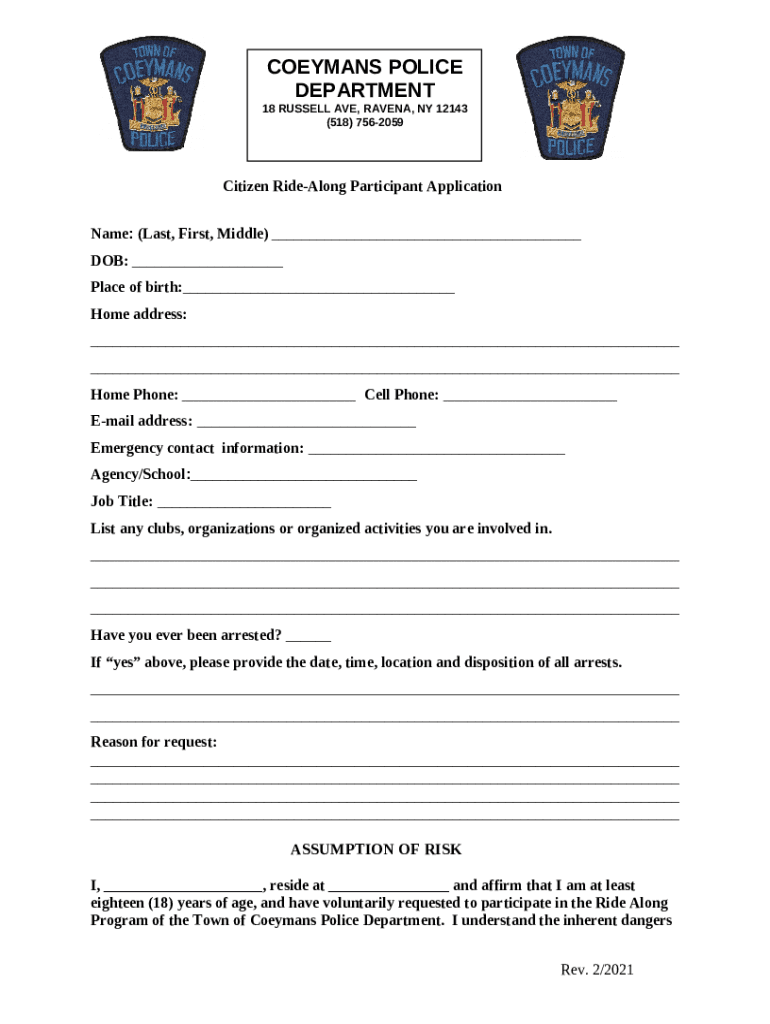
The Police Ride Along Request Form serves as an application for individuals interested in accompanying officers during their patrol shifts. This form is essential for citizens curious about police operations or seeking firsthand experience of law enforcement duties. Typically, police departments use this form to ensure that applicants meet the necessary criteria and understand the responsibilities and potential risks involved in a ride-along program.
How to Use the Police Ride Along Request Form
Applicants should first obtain and carefully review the Police Ride Along Request Form to understand the prerequisites and information required. Upon acquiring the form, users should complete all fields with accurate and current data. This includes personal identification, contact information, and an acknowledgment section regarding the risks involved in participating in a police ride-along.
Key Steps to Use the Form
- Review the Form: Begin by thoroughly reading the entire form to comprehend all terms and conditions.
- Complete Personal Information: Fill in your full name, address, contact details, and emergency contact.
- Background Information: Provide any required details about your criminal history or affiliations with organizations.
- Assumption of Risk: Carefully read and sign the acknowledgment of risks associated with participating in police activities.
- Submit the Form: Once completed, submit the form to the designated police department for processing.
How to Obtain the Police Ride Along Request Form
Individuals can usually acquire the Police Ride Along Request Form directly from the law enforcement agency they are interested in visiting. Many police departments provide downloadable forms on their official websites, while others may require a call or a visit to the station to obtain a physical copy.
Steps to Complete the Police Ride Along Request Form
Completing the Police Ride Along Request Form involves several specific actions to ensure all necessary information is accurately reported. It is vital to take time to fill out each section carefully to avoid errors that may lead to delays or rejection.
Detailed Steps for Form Completion
- Read Instructions: Understand the guidelines provided at the beginning of the form.
- Personal Information Section: Accurately fill in your name, date of birth, and contact details.
- Emergency Contact Information: List a reliable person who can be contacted in case of an emergency.
- Acknowledgment of Terms: Sign the section acknowledging the understanding of all terms, risks, and responsibilities.
- Review Submission Requirements: Ensure compliance with any departmental submission guidelines.
Key Elements of the Police Ride Along Request Form
The Police Ride Along Request Form is composed of several critical sections, each designed to capture essential information about the applicant.
Important Sections
- Personal Information: Includes details such as name, address, and contact numbers.
- Emergency Contacts: Requires data about a secondary contact person.
- Risk Acknowledgment: Where applicants affirm their understanding of the risks involved.
- Background Information: Queries regarding any criminal history or group affiliations.
Eligibility Criteria
Eligibility criteria for a police ride-along vary depending on the jurisdiction and department policies. Common requirements generally include age restrictions and a background check.


Typical Eligibility Requirements
- Age Requirement: Participants must usually be over 18. Exceptions may exist for younger individuals with parental consent.
- Criminal History Check: Departments often conduct a background check to vet participants for safety reasons.
- Affiliation Check: Individuals may be asked to disclose memberships in organizations, especially if related to law enforcement.
Legal Use of the Police Ride Along Request Form
The legal use of the Police Ride Along Request Form ensures that the process adheres to all local, state, and federal regulations. Participants must acknowledge legal disclaimers and understand the constraints and obligations of the ride-along program.
Legal Components
- Signature Requirement: Acknowledging the terms signals agreement and consent to the form's conditions.
- Liability Waiver: Participants usually sign a waiver that releases the police department from liability during the ride-along.
- Privacy Assurance: Personal information gathered is used solely for processing the application and ensuring participant safety.
Examples of Using the Police Ride Along Request Form
Several scenarios may motivate individuals to submit a Police Ride Along Request Form. These examples highlight different typical situations where the form is utilized.
Common Use Cases
- Criminal Justice Students: Those studying law enforcement often ride along to gain practical insight.
- Community Members: Individuals interested in understanding police work to foster community relations.
- Potential Recruits: Persons considering a career in law enforcement may use the opportunity to experience daily police activities firsthand.
By thoroughly understanding and following the procedures for the Police Ride Along Request Form, applicants can ensure a smooth application process and gain valuable experience within their local law enforcement framework.




