




Definition and Meaning of a Capital Contribution Agreement
A Capital Contribution Agreement is a legal document that defines the terms and conditions under which an entity, often a corporation or trust, receives financial contributions from another party to support its operations or obligations. These agreements typically involve parties such as issuers, providers, and trustees, as seen in the context of financial transactions involving securities or debt instruments. The agreement specifies the details surrounding the contribution, including the purpose, the amount, and the obligations of each party involved.
Example Scenario
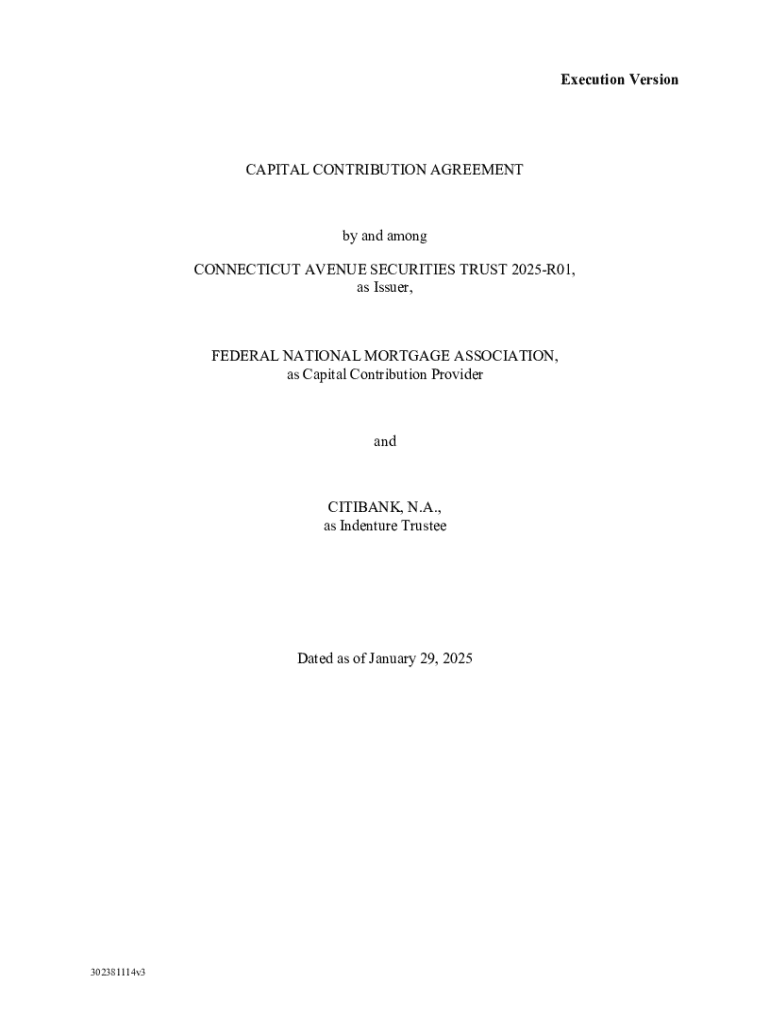
For example, in an agreement dated January 29, 2025, Connecticut Avenue Securities Trust 2025-R01 is the issuer, Fannie Mae serves as the capital contribution provider, and Citibank, N.A. acts as the indenture trustee. Here, the document outlines how Fannie Mae will contribute capital to meet the issuer's payment obligations under specific notes. Such documents play a critical role in ensuring the financial health of the issuer and protecting the interests of investors and stakeholders.
How to Use the Capital Contribution Agreement
When engaging with a Capital Contribution Agreement, it is essential to understand the document's purpose and navigate its provisions effectively. Organizations typically use these agreements as a framework for structuring financial inflows necessary to meet corporate or transactional goals.
Step-by-Step Usage
- Review the Terms: Carefully examine the terms, including contribution amounts, payment schedules, and obligations. This ensures all parties understand their commitments.
- Negotiate Provisions: Engage in discussions to tailor terms that align with business needs, focusing on clauses related to payment conditions, rights, and obligations.
- Execute the Agreement: Once all parties agree on the terms, execute the agreement through signatures, often requiring the use of electronic signature platforms like DocHub.
- Adhere to Requirements: Ensure compliance with specific conditions and timelines as outlined, maintaining transparency with all involved parties.
Practical Example
Consider a scenario where a corporation requires capital to fund a new project. Using a Capital Contribution Agreement lays down a clear path for obtaining this funding while specifying the roles and responsibilities for each contributing party, yielding a structured financial strategy.
Key Elements of the Capital Contribution Agreement
A comprehensive Capital Contribution Agreement includes several critical components that define its effectiveness and enforceability.
Core Elements
- Defining Parties: Identifies all involved parties, including issuers and providers, and their roles within the agreement.
- Payment Conditions: Outlines conditions under which contributions must be paid, including schedules and allowed methods.
- Tax Treatment: Specifies how contributions will be treated for tax purposes, ensuring compliance with relevant tax laws.
- Miscellaneous Provisions: Covers assignment rules, amendment procedures, and governing law to handle potential changes and modifications.
Real-World Example
In agreements similar to the Connecticut Avenue Securities Trust 2025-R01, key elements are meticulously arranged to safeguard creditors and ensure the issuer's obligations are met without default, protecting the trust's financial interests.
Required Documents for a Capital Contribution Agreement
To facilitate a Capital Contribution Agreement, specific documentation is necessary to verify, validate, and enforce the terms agreed upon.
Necessary Documentation
- Proof of Financial Capability: Provides evidence of the capital provider's ability to fulfill contributions.
- Legal Entity Documents: Includes articles of incorporation or trust agreements, proving the legitimacy of involved entities.
- Tax Identification: Ensures entities involved are recognized under tax law, with documentation like EIN numbers.
Example Documentation Process
For an agreement involving multiple parties, each must submit their financial statements, evidence of authority to enter into the agreement, and tax documents to streamline confirmation and legal verification processes.
Legal Use of the Capital Contribution Agreement
The legal framework surrounding a Capital Contribution Agreement is core to its implementation, ensuring the arrangement's enforceability and compliance with applicable laws.
Legal Considerations
- Governing Law: Indicates which jurisdiction's laws apply, crucial for resolving disputes.
- Liability Limitations: Defines the extent of liability for each party, protecting entities from undue financial risk.
- Amendments and Notices: Sets the process for making changes to the agreement, requiring formal notifications and consents.
Real-World Application
Consider an instance where a legal issue arises regarding contribution payments. The agreement’s governing law clause would guide the mediation or legal process through designated state or federal laws, ensuring disputes are managed legally and fairly.
State-Specific Rules for Capital Contribution Agreements
Different U.S. states might impose varying requirements and considerations specific to Capital Contribution Agreements, influencing their formulation and execution.
Variations by State
- Registration Requirements: Some states may require registering the agreement with a state authority to ensure transparency.
- Taxation Rules: Varying state tax treatments can impact the agreement's terms regarding capital gains or income tax.
Example of State Variances
In states such as California, entities may face specific disclosure requirements or need to adhere to additional compliance checks, affecting the agreement's legal standing.
Penalties for Non-Compliance with Capital Contribution Agreement
Non-compliance with a Capital Contribution Agreement can lead to significant repercussions, both legal and financial, for involved parties.
Potential Penalties
- Financial Penalties: May include fines or damages payable in case of breaches or defaults on terms.
- Legal Action: Parties might face lawsuits or other legal actions for non-compliance, with court-mandated resolutions.
Example Scenarios
If the issuer fails to meet note obligations due to a breach of contribution terms, they might incur financial penalties and lose trust from investors or other capital providers, proving costly both monetarily and reputationally.
Versions or Alternatives to the Capital Contribution Agreement
Organizations might consider alternative or modified versions of Capital Contribution Agreements depending on specific needs or variations in transactional goals.
Alternatives and Variations
- Equity Contribution Agreements: Focus on contributing ownership stake rather than capital funds.
- Loan Contribution Agreements: Define terms for contributions that are structured as loans with repayable terms.
Case Studies
A tech startup might prefer an Equity Contribution Agreement to attract venture capital investments, offering equity in lieu of direct monetary contributions, aligning with growth and valuation strategies in early stages.