






Definition and Meaning of the Acute Care Assessment Tool (ACAT)
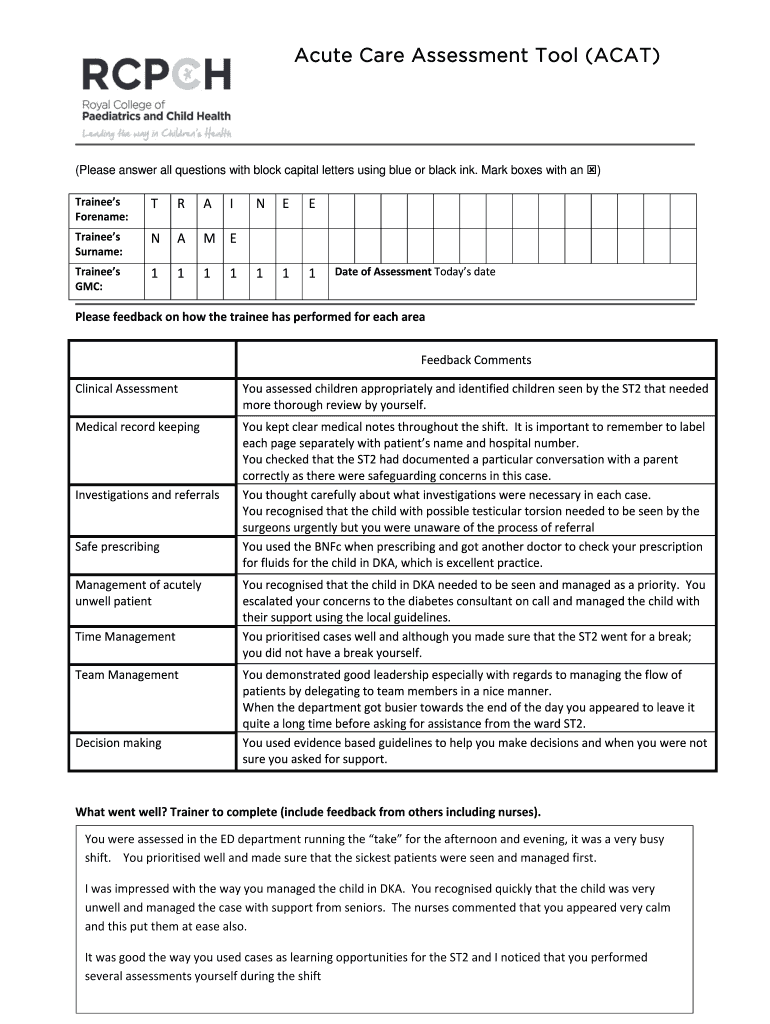
The Acute Care Assessment Tool (ACAT) is a specialized form used to evaluate the competencies of trainees in a clinical setting, particularly in pediatric emergency care. This tool assesses various critical competencies such as clinical assessment, medical record keeping, management of acutely unwell patients, time management, team management, and decision-making. Feedback is provided by an assessor who highlights the trainee's strengths and identifies areas for potential improvement, with an emphasis on prioritization and communication skills.
How to Use the Acute Care Assessment Tool (ACAT)
To effectively use the ACAT, the assessor observes the trainee in their clinical environment. The evaluation involves annotating sections of the form corresponding to different competencies. The tool is designed for direct application in real-world scenarios, making it easier to gauge a trainee's practical abilities. Assessors should provide detailed comments, focusing on specific incidents that demonstrate the trainee's skills or knowledge gaps.
Steps to Complete the Acute Care Assessment Tool (ACAT)
- Preparation: Review the ACAT form thoroughly before starting the assessment.
- Observation: During the clinical shift, watch the trainee's interactions and decision-making processes.
- Documentation: As you observe, make notes on each section related to the competencies being assessed.
- Feedback: Provide constructive feedback based on observations, highlighting both strengths and areas for improvement.
- Discussion: Sit with the trainee to go over the filled tool, ensure they understand the feedback and agree on action points for development.
Key Elements of the Acute Care Assessment Tool (ACAT)
- Clinical Assessment: Evaluates the trainee's ability to effectively assess patient conditions.
- Medical Record Keeping: Focuses on the accuracy and completeness of documentation.
- Investigations and Referrals: Assesses the judgment in ordering tests and referring patients.
- Safe Prescribing: Checks competency in prescribing medications safely and appropriately.
- Team and Time Management: Analyzes how well the trainee manages clinical tasks and team communication.
Important Terms Related to Acute Care Assessment Tool (ACAT)
- Competency: A skill or ability in a specific area, typically assessed through the tool.
- Assessor: An individual who evaluates the trainee's performance using the ACAT.
- Feedback: Constructive critiques and praise given to guide the trainee's development.
Who Typically Uses the Acute Care Assessment Tool (ACAT)
The ACAT is primarily used by medical educators, clinical supervisors, and experienced clinicians involved in the training of healthcare professionals. It serves as a developmental tool for trainees, providing them with valuable feedback from experienced practitioners in clinical settings.


Examples of Using the Acute Care Assessment Tool (ACAT)
Consider a scenario where a pediatric trainee is handling an emergency room shift. The assessor might observe how the trainee prioritizes patient care during a busy period, taking note of their decision-making process and interaction with team members. Based on these observations, the assessor uses the ACAT to document both achievements and areas where further training is required.
Versions or Alternatives to the Acute Care Assessment Tool (ACAT)
While the ACAT is commonly used in pediatric emergency care, there might be other similar tools designed for different specialties or healthcare settings. Alternatives might focus on specific areas such as surgery or internal medicine, adapting the ACAT's core principles to suit their unique requirements and expectations. These versions ensure the comprehensive evaluation of specific competencies relevant to those areas.
Legal Use of the Acute Care Assessment Tool (ACAT)
In the U.S., any feedback tool like the ACAT utilized within a healthcare training program should comply with institutional and educational regulations. Ensuring confidentiality, accuracy, and fairness in the assessments is paramount for legal and ethical compliance. Trainees should be aware of how their data from the ACAT evaluations is stored and used and should consent to its application within their educational framework.