






Definition and Meaning
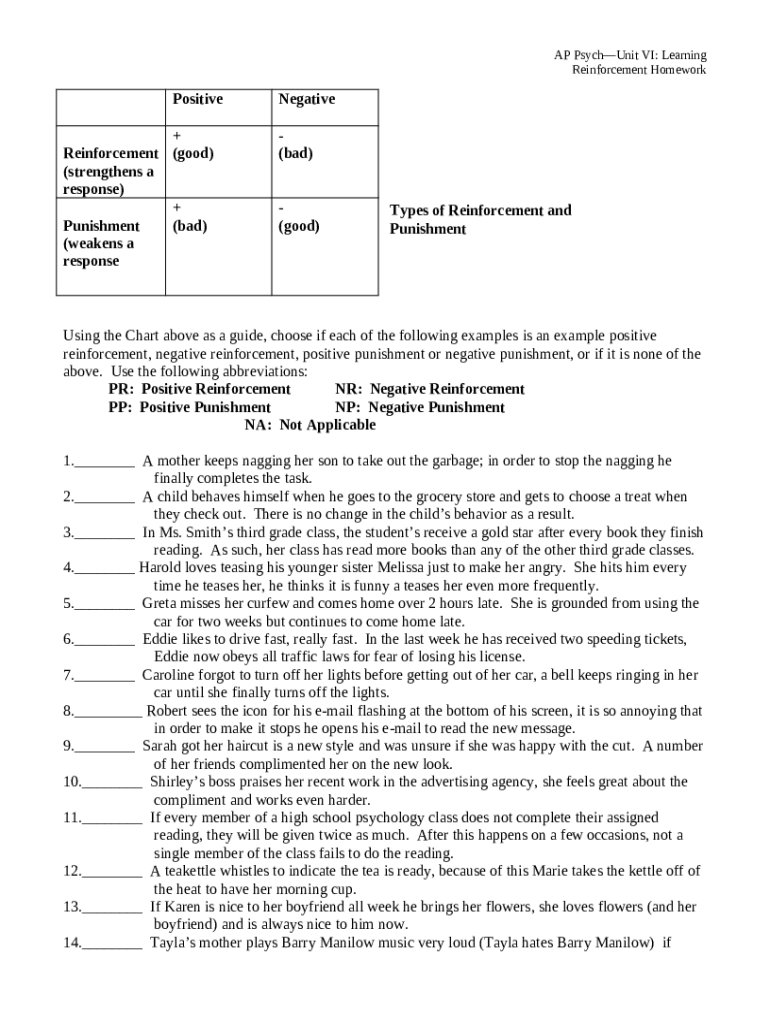
"Types of Reinforcement and Punishment Worksheet" refers to a tool used mainly in educational settings to help individuals understand and categorize various behavioral scenarios within the framework of reinforcement and punishment. This worksheet is designed to illustrate how behavior can be encouraged or discouraged using different methods. Among these are positive reinforcement, negative reinforcement, positive punishment, and negative punishment. By providing examples of each type of behavioral consequence, the worksheet aids students in recognizing and applying these psychological concepts to real-life scenarios. Understanding these concepts is crucial for teachers, trainers, psychologists, and students in fields related to behavioral sciences.
Key Elements of the Worksheet
The "Types of Reinforcement and Punishment Worksheet" typically includes several key components that facilitate learning and application. These elements ensure that the user can effectively categorize behavioral scenarios.
- Examples of Scenarios: The worksheet lists various situations where reinforcement or punishment might occur, providing context for categorization.
- Categorization Tasks: Users are tasked with determining whether a given scenario is an example of positive reinforcement, negative reinforcement, positive punishment, negative punishment, or none.
- Schedules of Reinforcement: Some versions of the worksheet include exercises on identifying schedules such as fixed-interval, variable-interval, fixed-ratio, and variable-ratio.
- Answer Key: This feature is often included to allow for self-assessment and understanding of incorrect responses.
How to Use the Worksheet
The worksheet can be effectively utilized by following a structured approach. This ensures that users gain the maximum educational benefit from the exercise.
- Read Each Scenario Carefully: Understand the context and outcome of each given situation.
- Identify the Type of Reinforcement or Punishment: Determine whether the scenario describes positive or negative reinforcement or punishment.
- Categorize Using Logic: Apply the learned definitions of each type in decision-making.
- Check Against the Answer Key: Use this for self-evaluation and to understand any misconceptions.
- Review Schedules of Reinforcement: If applicable, identify the pattern of reinforcement in scenarios to deepen your understanding.
Examples of Using the Worksheet
Applying the worksheet to various behavioral situations helps solidify understanding of the concepts of reinforcement and punishment.
- Educational Contexts: Teachers might utilize the worksheet to illustrate classroom management techniques and effective behavior modification strategies.
- Therapeutic Settings: Therapists could use scenarios from the worksheet to explain behavioral interventions to parents or caregivers.
- Training Programs: Companies or organizations implementing behavior policies might incorporate the worksheet into training sessions to explain reinforcement and punishment mechanisms.
Important Terms Related to the Worksheet
Understanding certain terminology is crucial for engaging with the worksheet effectively. These terms reflect core concepts in behavioral psychology.
- Positive Reinforcement: Presenting a rewarding stimulus after a behavior to increase its likelihood.
- Negative Reinforcement: Removing an aversive stimulus after a behavior to encourage its recurrence.
- Positive Punishment: Adding an aversive consequence to decrease a behavior.
- Negative Punishment: Removing a desired stimulus to diminish the frequency of a behavior.
Who Typically Uses the Worksheet
A range of individuals and groups might benefit from employing this worksheet as part of their educational or professional toolkit.
- Educators: Teachers and lecturers seeking to teach behavioral management techniques and principles.
- Students: Individuals studying psychology, education, or related fields.
- Psychologists: Professionals looking to explain or demonstrate behavioral concepts to clients or students.
- Corporate Trainers: Personnel developing behavior-related training programs for employees.


Steps to Complete the Worksheet
Completing the worksheet effectively involves a disciplined approach combining comprehension and application.
- Familiarize with Behavioral Concepts: Review definitions and examples of reinforcement and punishment types.
- Scenario Analysis: Tackle each scenario, applying learned concepts to determine its classification.
- Utilize Section on Reinforcement Schedules: For worksheets that include reinforcement schedules, identify appropriate types by understanding patterns.
- Cross-Check with Answer Key: Use this to assess understanding and correct mistakes.
Legal Use and Academic Integrity
Using the worksheet responsibly involves adhering to academic integrity and legal standards, particularly within educational institutions.
- Attribution: If distributing or using content from the worksheet, adhere to any copyright or usage rights associated.
- Academic Honesty: Ensure that it's used as a learning aid and not for plagiarizing responses.
Following these guidelines ensures the worksheet is a valuable educational tool in understanding reinforcement and punishment techniques effectively.