
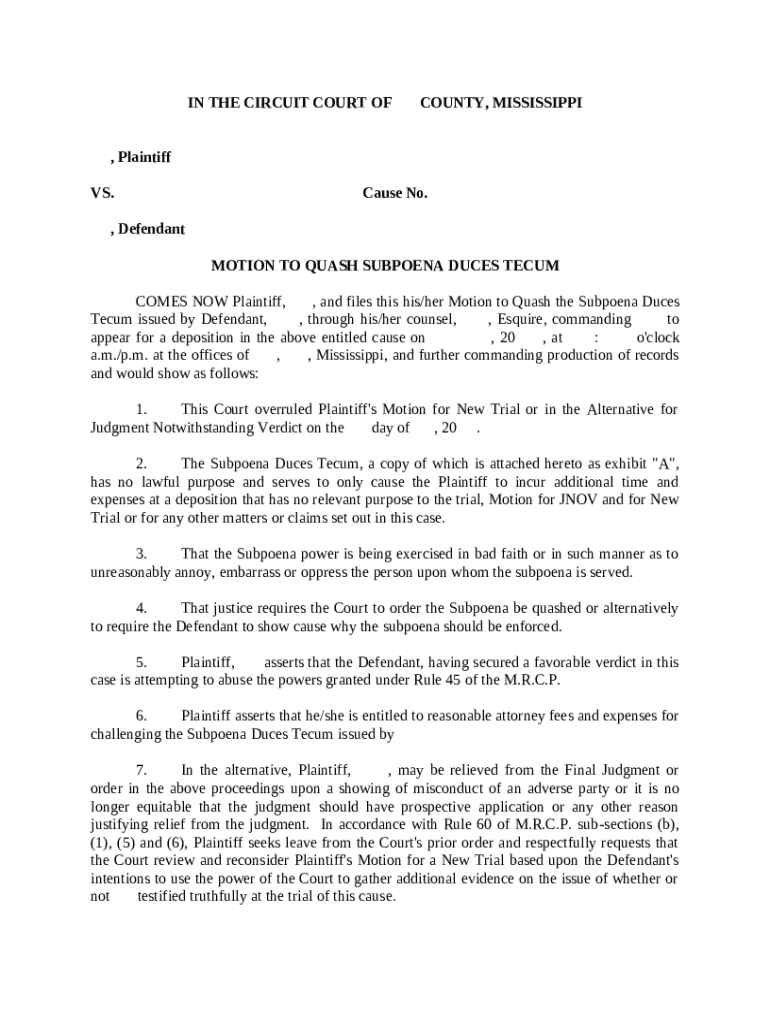







Definition and Meaning of Motion to Quash Subpoena Duces Tecum
A Motion to Quash Subpoena Duces Tecum is a legal document filed in court to challenge and attempt to invalidate a subpoena duces tecum, which is a court order requiring a person to produce documents or evidence for a legal proceeding. The motion is often used to assert that the subpoena is unreasonable, overly burdensome, irrelevant, or issued in bad faith. In essence, this legal tool helps protect individuals or entities from producing evidence that may not be necessary for the case at hand.
How to Use the Motion to Quash Subpoena Duces Tecum
To effectively use a Motion to Quash Subpoena Duces Tecum, it is essential to demonstrate that the subpoena fails to comply with legal standards. Key strategies include:
- Asserting that the requested documents or evidence are irrelevant to the legal proceedings.
- Arguing that the subpoena imposes an undue burden or is overly broad.
- Demonstrating that the subpoena was issued in bad faith or as a form of harassment.
Steps to Complete the Motion to Quash Subpoena Duces Tecum
- Review the Subpoena: Start by carefully examining the subpoena to understand its demands and deadlines.
- Identify Grounds for Quashing: Determine why the subpoena should be quashed, such as relevance, burden, or bad faith.
- Draft the Motion: Prepare a detailed motion outlining the grounds for quashing, supported by legal arguments and relevant case law.
- File the Motion in Court: Submit the motion to the appropriate court before the compliance deadline.
- Serve Opposing Parties: Ensure that a copy of the motion is served on all relevant parties, including the party that issued the subpoena.
- Attend the Hearing: Be prepared to argue the motion in court, providing evidence and legal reasoning.
Who Typically Uses the Motion to Quash Subpoena Duces Tecum
This motion is commonly used by parties involved in legal disputes, including:
- Plaintiffs or Defendants: To protect sensitive information or documents that are not directly relevant to the case.
- Third Parties: Such as witnesses or non-parties who have been subpoenaed to produce documents but believe the demand is unjustified.


Legal Use of the Motion to Quash Subpoena Duces Tecum
The legal use of this motion is supported by several principles:
- Due Process: Ensures that subpoenas do not infringe on rights without adequate legal justification.
- Proportionality: Prevents excessive demands that outweigh the importance of the information sought.
- Confidentiality: Protects sensitive or privileged information from unwarranted disclosure.
Key Elements of the Motion to Quash Subpoena Duces Tecum
Essential components of the motion include:
- Introduction: A brief statement of the motion and its purpose.
- Background: Details about the subpoena and why it was issued.
- Legal Grounds: Specific reasons for quashing, with supporting legal citations.
- Conclusion: A request for the court to quash the subpoena and award any necessary relief, such as attorney fees.
State-Specific Rules for the Motion to Quash Subpoena Duces Tecum
Different states may have distinct rules and standards regarding motions to quash. It is crucial to:
- Consult State Laws: Review local court rules and precedents related to subpoenas.
- Consider Court Variations: Be aware that different courts within a state may have additional procedural requirements.
Examples of Using the Motion to Quash Subpoena Duces Tecum
Consider these scenarios to understand practical applications:
- Corporate Litigation: A company may file a motion to prevent disclosure of trade secrets or proprietary data.
- Personal Cases: An individual might contest a subpoena that requests private communications irrelevant to the dispute.
- Third-Party Involvement: A non-party organization receiving a subpoena could use the motion to argue undue hardship or irrelevance.




