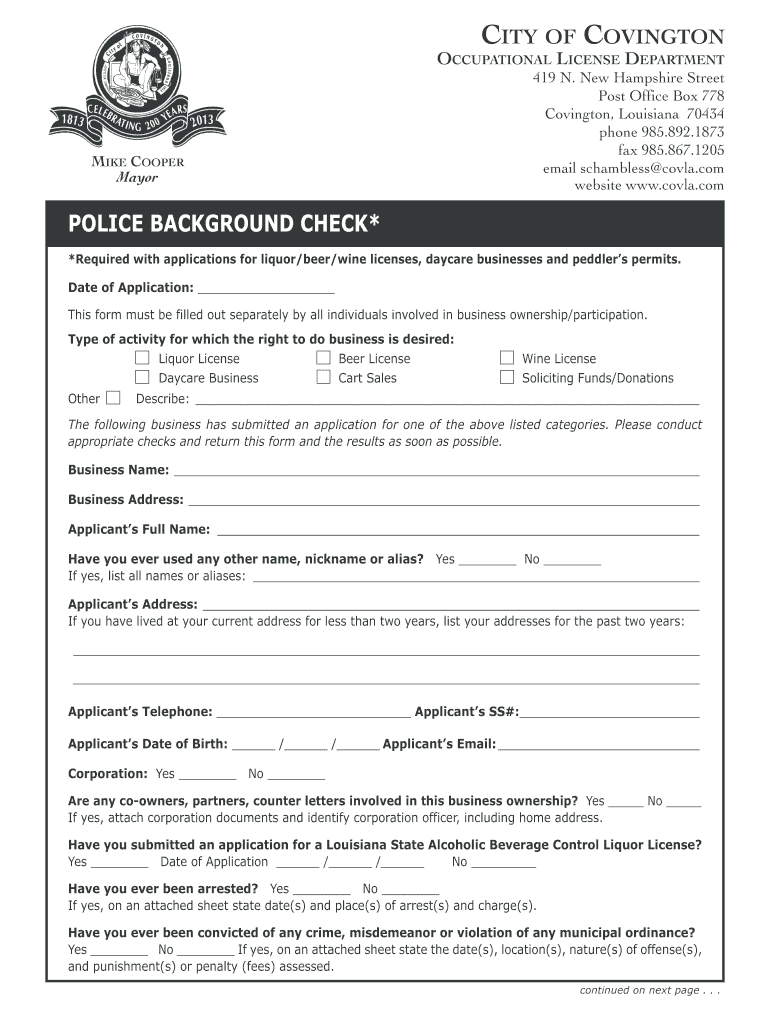







Definition and Meaning of the Police Background Check
A police background check is an official document used to evaluate an individual's criminal history and other pertinent information. This form is crucial for various applications, such as job screenings, business license applications, and permits. Typically, the check will include an individual's arrest records, past convictions, and any pending charges. This comprehensive overview helps organizations assess the suitability and safety of individuals for specific roles or activities, ensuring compliance with legal and ethical standards.
How to Use the Police Background Check
Using a police background check involves several key steps to ensure accurate and legal application. First, it is essential to determine the necessity of conducting the check and the information required. Employers or licensing authorities typically initiate the process by requesting the applicant's consent. Once approval is secured, the responsible party submits the required documentation and pays any associated fees. After obtaining the report, users should thoroughly review it, focusing on the relevancy of found records to the application or employment process. This evaluation helps make informed decisions while complying with privacy laws and regulations.
Steps to Complete the Police Background Check
Completing a police background check typically involves the following steps:
- Consent Gathering: Secure the applicant's written consent to conduct the check.
- Submission of Request: Fill out the necessary forms with the applicant’s details, including name, date of birth, and social security number.
- Fee Payment: Pay any required fees for processing the request, which may vary by state or agency.
- Information Review: Once the report is received, review the information carefully, noting any discrepancies or questions that may arise.
- Decision Making: Use the information provided to make informed decisions regarding the individual's suitability for the intended purpose.
Who Typically Uses the Police Background Check
Police background checks are predominantly used by employers, law enforcement agencies, and regulatory bodies. Employers across various industries leverage these checks during hiring to ensure candidates meet legal and ethical standards for employment. Regulatory bodies, such as those overseeing education, healthcare, and childcare, use these checks to screen applicants for licenses and permits. Additionally, individuals applying for certain types of licenses or permits, such as liquor licenses, may be required to undergo these checks to ensure compliance with state and municipal regulations.


Legal Use of the Police Background Check
The legal use of police background checks involves adhering to specific guidelines and regulations to protect individuals' rights. The Fair Credit Reporting Act (FCRA) regulates how background checks are used in employment decisions, mandating that employers obtain consent and provide notice if adverse actions are taken based on the findings. Additionally, certain criminal records may be protected or excluded from the report, depending on state laws, which can restrict how and when these records may be used.
Required Documents for the Police Background Check
To perform a police background check, several documents are typically required:
- Government-Issued ID: Such as a driver's license or passport for verifying identity.
- Consent Form: A signed document authorizing the background check.
- Social Security Number: Frequently required for identity verification and to locate records.
- Payment Method: Documentation or proof of fee payment, which can be a receipt or transaction confirmation.
Having these documents ready helps streamline the check process, reducing potential delays and ensuring compliance.
Important Terms Related to the Police Background Check
Understanding the key terms associated with the police background check can aid in the accurate interpretation of the results:
- Arrest Record: Documentation of any instances where the individual was detained by law enforcement.
- Conviction: A formal declaration that an individual is guilty of a criminal offense, following a verdict.
- Adjudication: Legal determination of a case, which may not result in a conviction.
- Expungement: Legal process to remove a criminal record, potentially invisible in some background checks.
Familiarity with these terms allows users to effectively analyze the report, interpret findings, and assess any implications.
State-Specific Rules for the Police Background Check
Background check procedures and regulations can vary significantly between states. Some states may restrict the disclosure of certain records based on age or offense type, while others may offer different levels of access to records. For instance, several states limit employers from accessing juvenile records or require that records older than seven years are not reported for certain positions. Understanding these variations is essential for ensuring compliance and effectively utilizing the police background check in a legally sound manner.
Examples of Using the Police Background Check
Practical examples can illustrate how a police background check functions in various scenarios. For an employer hiring for a daycare center, the check may unveil a past offense that disqualifies the candidate from working with children. A business owner applying for a liquor license might need a check to prove a clean record prior to approval, thereby ensuring community safety and compliance. Each use case highlights the importance of thorough background assessments for informed decision-making.