






Definition & Meaning of NRI Home Loans
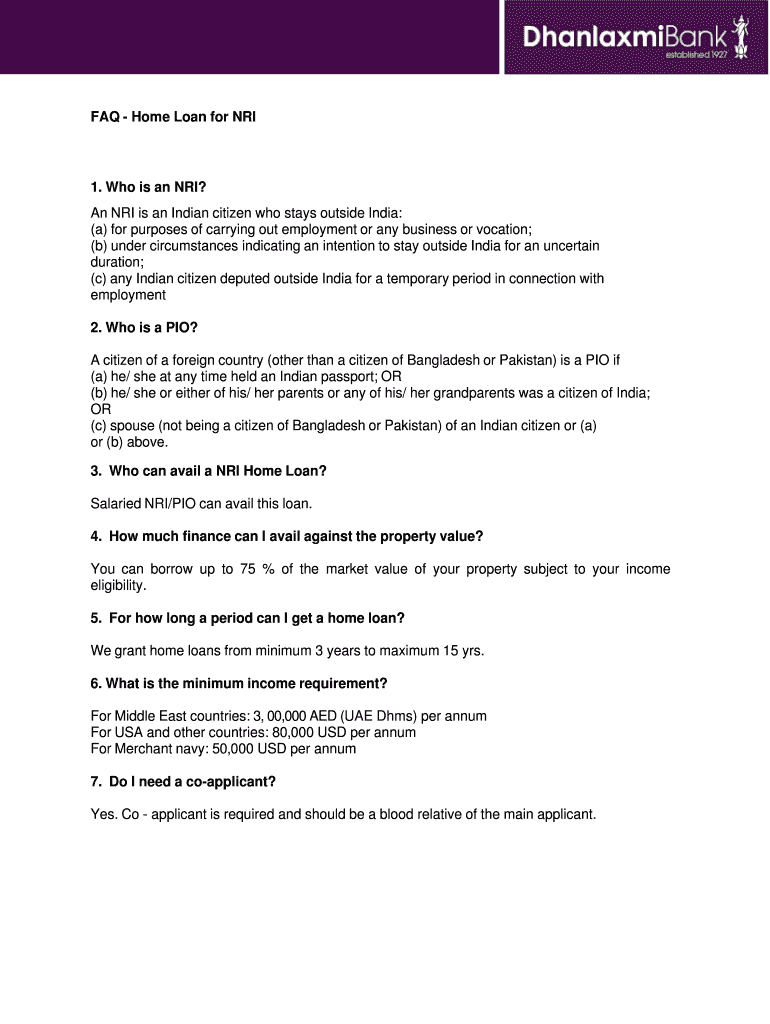
Non-Resident Indian (NRI) home loans are specialized financial products designed to facilitate property purchases in India by individuals residing outside the country. These loans cater to those categorized as NRIs, which includes not only Indian citizens living abroad but also Persons of Indian Origin (PIO) who hold foreign citizenship. The primary objective of such loans is to enable NRIs to invest in Indian real estate, either for residential or investment purposes.
Key Features:
- Currency: Typically granted in Indian Rupees.
- Repayment: Must generally be made in the same currency.
- Down Payment: NRIs are usually required to make a down payment from personal resources, like NRE/NRO accounts.
Eligibility Criteria for NRI Home Loans
To qualify for an NRI home loan, applicants need to meet specific eligibility criteria that differ from those for resident Indians. These criteria ensure that NRIs have a reliable source of income and stable financial standing.


Main eligibility factors include:
- Age: Applicants usually need to be between 21 and 60 years.
- Income: Demonstrable, regular income from overseas.
- Employment: Generally must be employed abroad for at least one to three years.
- Credit History: A good credit score is crucial for favorable interest rates.
Required Documents:
- Identity Proof: Passport and visa.
- Income Proof: Salary slips, employment contract, and past tax returns.
- Bank Statements: From both domestic and overseas accounts.
Steps to Apply for NRI Home Loans
Applying for an NRI home loan involves a structured process similar to resident home loans but includes additional steps due to international considerations.
Application Process:
- Research/Pre-Qualification: Determine eligibility and research lending options.
- Submit Application Form: Complete the lender's application form and attach required documents.
- Verification: The bank verifies financial and personal credentials.
- Approval & Sanction Letter: Post-approval, a sanction letter is issued detailing loan terms.
- Property Verification & Legal Check: The bank inspects and verifies the legality of the property.
- Signing Agreement & Disbursement: Finalize agreement and disbursal of funds for the property purchase.
Key Documents Required for NRI Home Loans
While the documentation required for NRI home loans includes standard elements from resident loans, certain additional documents aid in validating one’s non-resident status and income.
- KYC Documents: Including a valid passport, overseas residency proof, and photographs.
- Employment Proof: Current employment contract, continuity certificate, or offer letter.
- Property Documents: Sale or construction agreement, allotment letter from builder, and previous property deeds.
- Bank Statements: Recent statements from NRE/NRO or foreign bank accounts for the last year.
Legal and Regulatory Considerations
Obtaining an NRI home loan involves compliance with numerous legal provisions both in India and the applicant’s country of residence.
Important Considerations:
- FEMA Compliance: Loans are regulated under the Foreign Exchange Management Act (FEMA), which outlines all procedural guidelines for NRI financial transactions.
- Power of Attorney: NRIs may need to appoint a Power of Attorney in India for property registration and legal matters, which the lender might facilitate.
Application Process & Approval Times
The application and approval duration for an NRI home loan can vary depending on several factors, including the lender’s processing capabilities and the applicant’s ability to quickly provide necessary documents.
Typical Timeline:
- Pre-Processing: 1-2 weeks for documentation.
- Internal Review and Verification: 2-4 weeks for credit and property evaluation.
- Final Decision & Disbursement: Approximately 1-2 weeks post-verification.
Digital vs. Paper Version of Loan Applications
In today's digital age, many banks offer both digital and paper versions of loan application forms, with the digital format becoming increasingly popular for its convenience.
Benefits of Digital Applications:
- Accessibility: Submit applications from anywhere around the globe.
- Efficiency: Reduced processing times due to digital workflows.
- Convenience: Easy document upload and e-signatures.
State-Specific Rules and Variances
Certain state-specific regulations in India may influence the NRI home loan application process, especially regarding property registration laws and tax rebates.
State Differences Could Include:
- Stamp Duty Rates: Varying rates for property registration.
- Tax Benefits: Some states might offer incentives or additional deductions.
Awareness of these nuances helps in planning a more efficient and compliant loan application strategy.