




01. Edit your form online
Type text, add images, blackout confidential details, add comments, highlights and more.

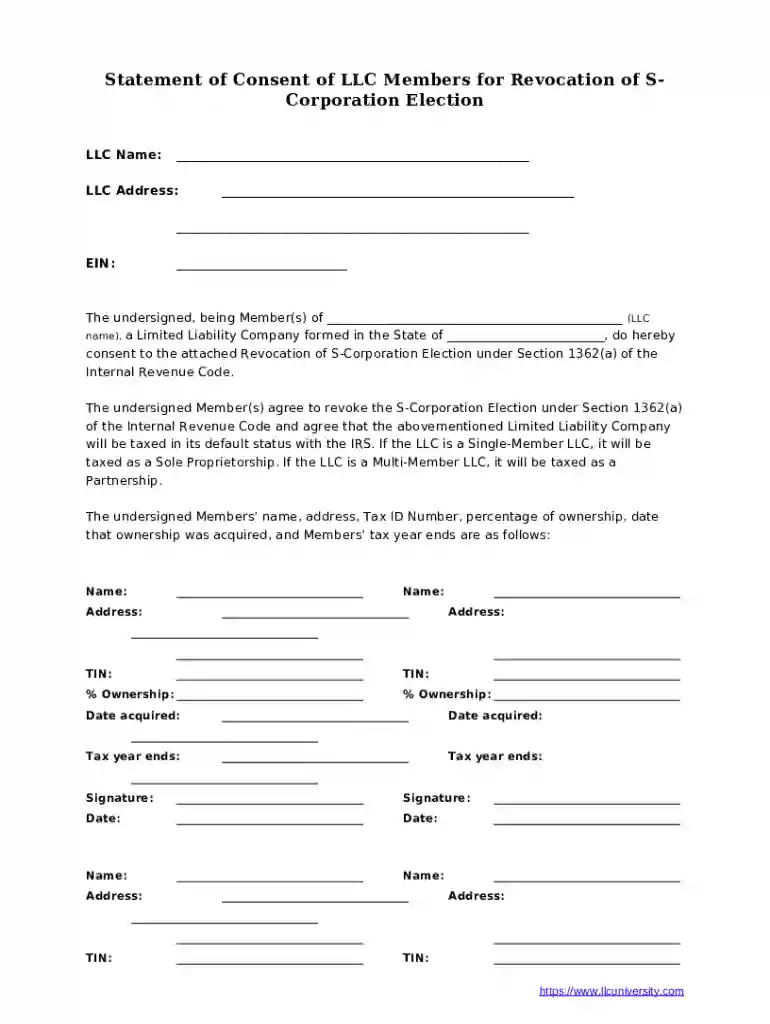
Type text, add images, blackout confidential details, add comments, highlights and more.

Draw your signature, type it, upload its image, or use your mobile device as a signature pad.

Send it via email, link, or fax. You can also download it, export it or print it out.
The "Statement of Consent of LLC Members for Revocation of S-Corporation Election" is a pivotal document used by Limited Liability Companies (LLCs) to officially withdraw their previously elected S-Corp tax status. This revocation signifies the LLC's decision to return to its default tax classification. For single-member LLCs, this generally means reverting to a sole proprietorship status, while multi-member LLCs typically return to being taxed as partnerships. Understanding its essence is crucial for LLC members to align with tax planning and compliance strategies.
The Statement of Consent encompasses several critical components to ensure a clear and legal agreement among members:
Member Details: This includes the names, addresses, Tax ID Numbers, and ownership percentages of each LLC member. These details establish the identity and the right of each member to consent to the revocation.
Acquisition Dates: Clear records of when each member acquired their LLC interest are necessary for confirming their eligibility to participate in such decisions.
Signatures: All LLC members must sign the document, illustrating unanimous consent. Without comprehensive signatures, the revocation may face legal challenges.
Successfully completing the Statement of Consent involves thorough attention to detail:
Gather Member Information: Compile comprehensive data for each LLC member, including contact information and ownership interests.
Document the Decision: Clearly state the decision to revoke the S-Corporation election, with a rationale if needed, for internal records.
Acquire Signatures: Ensure each member signs the document. Consider using DocHub’s e-signature feature to streamline this process, especially for remote teams.
Submit the Form: Depending on IRS requirements, you may need to file this with relevant authorities. Confirm submission methods and deadlines well in advance.
Revoking the S-Corporation election can yield several strategic benefits:
Tax Efficiency: Depending on current tax laws and business income, the LLC might face a more favorable tax situation under default IRS classifications.
Flexibility: Returning to the default classification can provide greater flexibility in income distribution and management of profits.
Adherence to IRS guidelines is pivotal:
Section 1362(a): This section of the Internal Revenue Code provides rules and stipulations for electing and revoking S-Corp status. Understanding this legal framework is essential for compliance.
Revocation Timing: Be aware of critical timeframes, such as when the revocation can be filed and when it becomes effective, typically starting the following tax year.
Meeting statutory deadlines ensures smooth processing:
Notification Period: The IRS generally requires notification of revocation by March 15 for changes applicable to the same calendar year.
Post-revocation Procedures: Following revocation, the LLC should adjust its tax filings to reflect its new classification.
Different states may have unique rules regarding S-Corporation status:
Jurisdictional Variations: Confirm state-level requirements for switching tax statuses, as some states have distinct tax obligations for LLCs and S-Corps.
State Income Tax Implications: Assess how the revocation might impact state tax liabilities. Some states may provide specific forms or processes that need to be adhered to during revocation.
Failing to properly revoke the S-Corporation election can result in significant repercussions:
Tax Penalties: Non-compliance with IRS guidelines can lead to penalties and interest charges on owed taxes.
Legal Challenges: Incomplete or improperly executed consents may be legally challenged, causing further administrative burdens.
At DocHub, your data security is our priority. We follow HIPAA, SOC2, GDPR, and other standards, so you can work on your documents with confidence.
To revoke a Subchapter S election/small business election that was made on Form 2553, submit a statement of revocation to the service center where you file
▫ To revoke the election, the corporation files a statement with the IRS service center where the S election was filed indicating the effective date of the


